
Anchoring Bias in Trading: Why You Can't Let Go of That Entry Price
The trade is down on you. Your entry was $48.20. The price is now at $47.10. And you're telling yourself: "It'll get back to $48.20. Then I'll decide."
That's not a strategy. That's anchoring bias — one of the most costly cognitive errors in trading, and one that almost nobody catches in real time.
What Is Anchoring Bias?
The foundational research comes from Amos Tversky and Daniel Kahneman (1974). In their experiments, people who were shown an arbitrary high number made higher estimates for completely unrelated quantities. The anchor didn't need to be meaningful to influence judgment. It just had to be the first number in the room.
In trading, your entry price is the first number you know — and it's not arbitrary at all. It's the number tied to your decision, your money, your ego. That makes it an extremely powerful anchor. From the moment you enter a position, your brain treats that price as the reference point for everything that follows: what counts as profit, what counts as loss, when it's "okay" to exit.
The market, of course, has no idea where you bought. It doesn't respect your entry as a reference point. That mismatch between your mental model and reality is where the losses compound.
Three Places Anchoring Shows Up
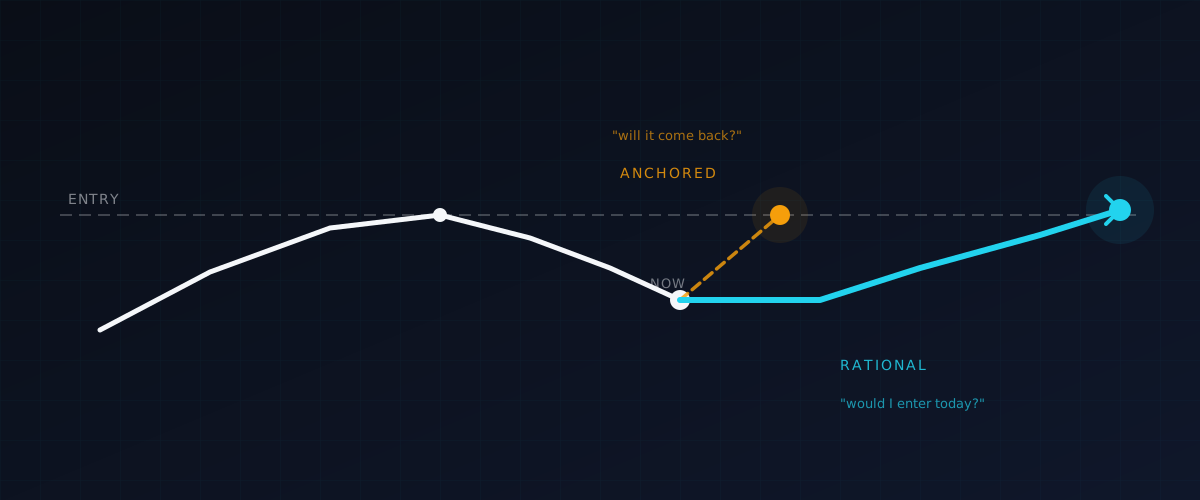
Holding losers too long. The most common form. You're down on a position. Instead of asking "would I enter this trade right now, at the current price, given what I see?" — you're asking "how long until it gets back to where I bought?" Those are completely different questions. The second one makes the market responsible for validating your original decision, instead of letting you evaluate current conditions on their merits.
Cutting winners too early. This works in reverse. You entered at $50.00. Your target is $55.00. The price hits $52.40 and your brain starts whispering: "you're up $2.40 a share — that's solid, lock it in." You exit not because of a technical reason, but because the gain relative to your entry feels sufficient. A fresh-eyed trader seeing the same setup might hold with confidence.
Averaging down into failing setups. When traders add to a losing position, they're often not making a clean new decision based on current conditions. They're managing their average entry price — another anchor. The position quality hasn't changed. The P&L math on paper looks slightly better. That psychological improvement is the anchor at work, not the market.
Why the Brain Does This
Anchoring is deeply wired. Richard Thaler and Cass Sunstein's work in behavioral economics (Nudge, 2008) shows that humans consistently evaluate outcomes against reference points rather than in absolute terms. We don't ask "is this outcome good?" — we ask "is this outcome better or worse than the reference?" And the reference almost always gets set by the first salient number we encountered.
For traders, that number is always the entry price. You can't un-know it. But you can change what you do with it.
How to Actually Fight Anchoring Bias
Evaluate every trade from the current price.
At any point in a live trade, ask: "If I had no position right now and saw this exact setup, would I enter?" If the honest answer is no — that's a signal. Your entry price is a sunk cost. The market never sees it on its chart.
Write your exit rules before you enter.
The mechanical antidote to anchoring is to define stops and targets at entry — before emotional investment locks in the anchor. A complete trading plan forces this discipline at the right moment. Once you're inside a position, the anchor is already set.
Log every time you adjust an exit mid-trade.
Whenever you move a stop or extend a target, write down the real reason. "I wanted to give it more room to come back to my entry" is not a technical reason — it's an anchoring-bias note. Logging these moments precisely is how patterns become visible. MindTradr captures mid-trade emotional state alongside trade data specifically so you can see this pattern across sessions, not just in painful hindsight.
Use the fresh-eyes test.
Brett Steenbarger, who coaches professional traders, recommends regularly evaluating your live positions as if someone else placed them. View the chart without the entry marker visible. What would you tell another trader to do with this setup, right now? That's usually the right answer for you too.
How to Track This Pattern Over Time
The problem with cognitive biases is that you can understand them intellectually and still fall for them in the moment. Reading about anchoring bias doesn't make you immune. What does help is building a feedback loop that catches the pattern across multiple trades.
That's what tracking your emotional state alongside trade data accomplishes — you can start to see which types of situations reliably trigger the anchoring response in your own behavior. Maybe it's always after a strong entry that quickly reverses. Maybe it's trades in a specific session time. The data shows you your actual pattern, not the pattern you think you have.
The One Question That Cuts Through It
When you're wrestling with a position that's gone against you, there's a single question that short-circuits the anchor:
"Would I enter this trade right now, at the current price, with the current setup?"
If yes — hold. If no — close.
Entry price doesn't appear in that question. It can't. And that's the point.
MindTradr logs the question you asked yourself at every decision point — so over time, you can see whether your holds were based on fresh analysis or on waiting for the market to return to your anchor. The difference shows clearly in your journal. The difference also shows clearly in your P&L.
Anchoring bias doesn't disappear once you name it. But it does become manageable — trade by trade, journal entry by journal entry, until evaluating current conditions rather than entry prices becomes your default.