
Boredom Trading: Why You Take Trades When There's Nothing to Trade
The market's dead this afternoon. Price has gone nowhere for two hours, the news feed hasn't produced anything new since lunch, and you've refreshed the same few tickers so many times the numbers have stopped meaning anything. Then, without quite deciding to, you click into a setup that doesn't meet your own criteria — on something you don't normally trade, for reasons you can't fully explain when you look back at it that evening.
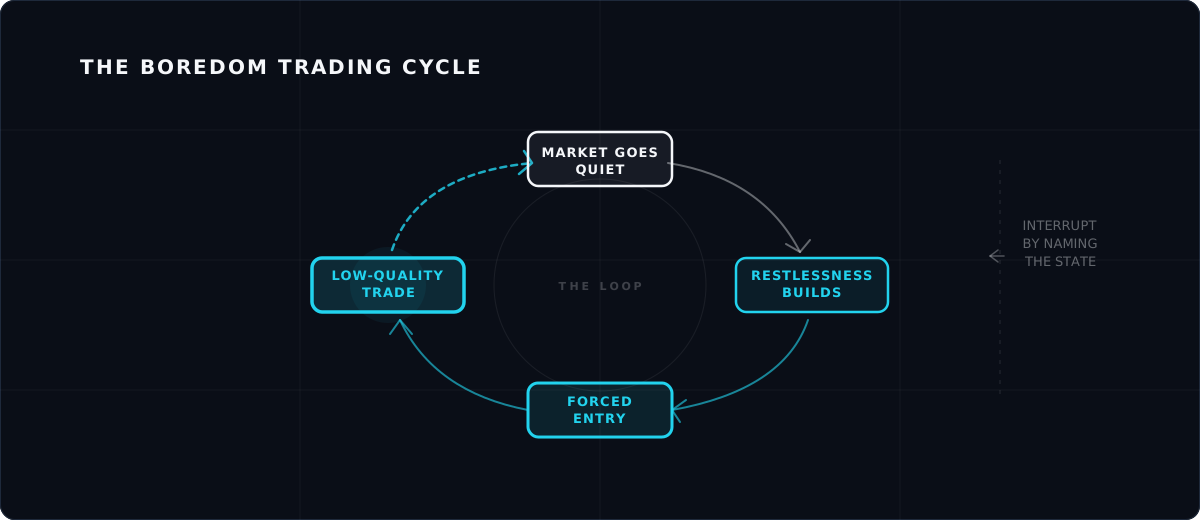
That's boredom trading. It doesn't announce itself the way fear or greed does. There's no adrenaline, no urgency, no obvious villain in the story. Just a quiet, restless need for something — anything — to happen.
Why Boredom Trading Doesn't Feel Like a Mistake
Most trading mistakes come from too much feeling: panic on a drawdown, euphoria after a win, the itch to get revenge on the market that just took your money. Boredom trading is different. It comes from too little feeling — a session with no stimulation, and a brain that starts manufacturing its own.
That's what makes it so easy to miss in a post-trade review. A revenge trade is obvious once you see the sequence: loss, frustration, oversized re-entry. A boredom trade looks almost identical to a real one on the surface — a chart, a setup, an entry. The only thing missing is a genuine reason for taking it, and that absence is hard to spot when you're not looking for it.
Is Boredom Trading Just Another Form of Overtrading?
It's related, but the trigger is different, and the difference matters for how you fix it. Overtrading can be driven by overconfidence after a win, urgency after a loss, or simple compulsion. Boredom trading has one specific cause: understimulation. It shows up on slow days, thin sessions, choppy ranges — precisely the conditions where the right move is to do nothing.
That's the trap. The moments that call most clearly for patience are exactly the moments your attention is least willing to cooperate.
What's Actually Happening in Your Brain During a Slow Session?
Boredom isn't just an absence of activity — psychologists treat it as a functional signal in its own right. Shane Bench and Heather Lench, in a 2013 paper in the journal Behavioral Sciences, describe boredom as a state that pushes attention toward more engaging or stimulating alternatives when current activity fails to hold it. In other words, boredom isn't neutral. It actively pulls you toward something else.
For traders who score higher on what psychologist Marvin Zuckerman termed sensation seeking — the trait tied to a preference for novel and intense experience — that pull is stronger, and the market is an unusually convenient place to satisfy it. A click is right there. It's fast. It feels like progress.
Brett Steenbarger, a trading psychologist whose Trader Feed blog has documented decades of work with professional traders, has written about how understimulated traders often substitute market activity for the stimulation they're missing elsewhere in the session — trading not because a setup demands it, but because the alternative is sitting with an uncomfortable quiet.
What a Boredom Trade Actually Costs You
The direct cost of one boredom trade is usually small — that's exactly why it's easy to dismiss. The damage is cumulative. A trade taken because nothing else is happening, by definition, wasn't screened against your actual criteria. Run enough of those over a quarter and you've quietly built a second, much weaker "strategy" running underneath your real one, funded from the same account.
The harder cost is what it does to your pattern recognition. Every boredom trade you take without naming it as one teaches your brain that "nothing to trade" and "something to trade" look the same. That's a much more expensive lesson than the loss on any single position, because it degrades the one skill — recognizing when there genuinely isn't a trade — that quiet sessions are supposed to be training.
How to Catch a Boredom Trade Before You Click
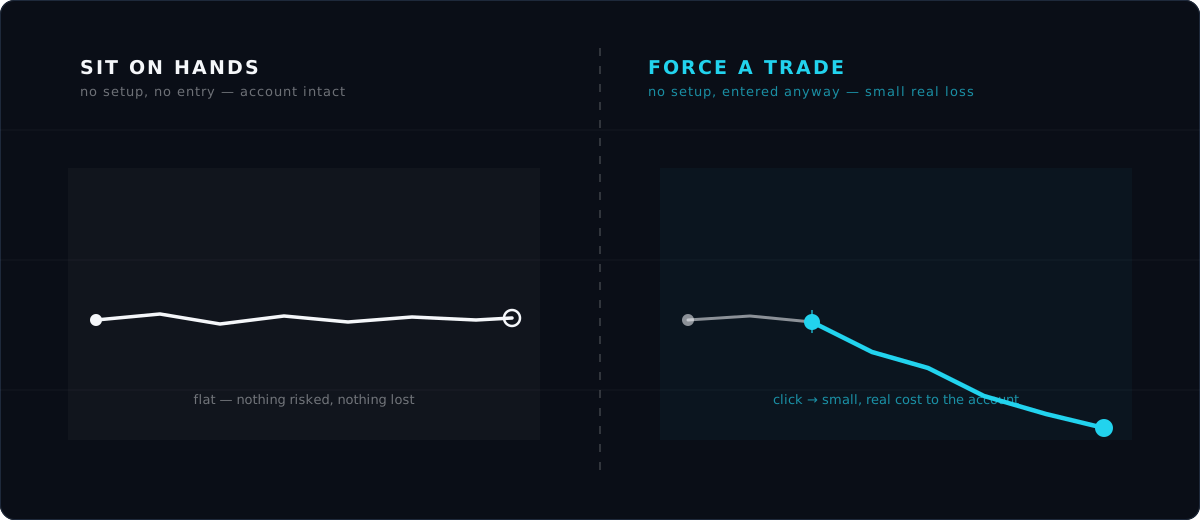
The fix isn't more discipline in the moment — by the time you're hovering over the entry, the restless part of your brain has already won the argument. The fix is structure that operates earlier:
- Name the state before you act on it. A one-word pre-trade check — calm, anxious, bored, rushed — takes five seconds and turns an invisible impulse into a labeled data point. This is the same habit covered in how to track trading emotions, and "bored" deserves its own tag rather than getting folded into "distracted."
- Decide what a slow session is for, in advance. Review, backtesting, watchlist maintenance — anything that keeps your attention engaged without requiring the market to cooperate.
- Build a genuine no-trade condition into your plan. Not "trade less" — a specific, written line that says what a slow session looks like and what you do instead of entering.
A daily trading routine that defines what counts as a real setup before the session opens gives you something concrete to compare a boredom impulse against. If the trade you're about to take doesn't match what you wrote down calm, before the tedium set in, that mismatch is the signal.
Building a Session With No Room for Boredom to Win
Boredom trading persists because it's under-discussed compared to fear and greed — it doesn't make for a dramatic story, so it rarely gets named as the reason behind a losing stretch. But it's common precisely because quiet markets are common, and every trader eventually sits through a session where nothing is happening and the screen is still on.
This is why MindTradr asks for a pre-trade emotional state alongside every entry, not just the setup and outcome. MindTradr is a trading psychology journal that tags the reason behind every trade — including boredom — so a low-conviction entry shows up as data instead of quietly disappearing into your P&L. Once "bored" has its own column next to your win rate, the pattern stops hiding.
The next time a session goes quiet, the discipline that matters isn't resisting one trade. It's noticing that the quiet itself is the thing you're reacting to — and giving yourself something better to do with it than a click you can't fully justify later.
If you want to start tagging what's actually behind your trades, MindTradr is free to start.