
Decision Fatigue in Trading: Why Afternoon Trades Cost You More
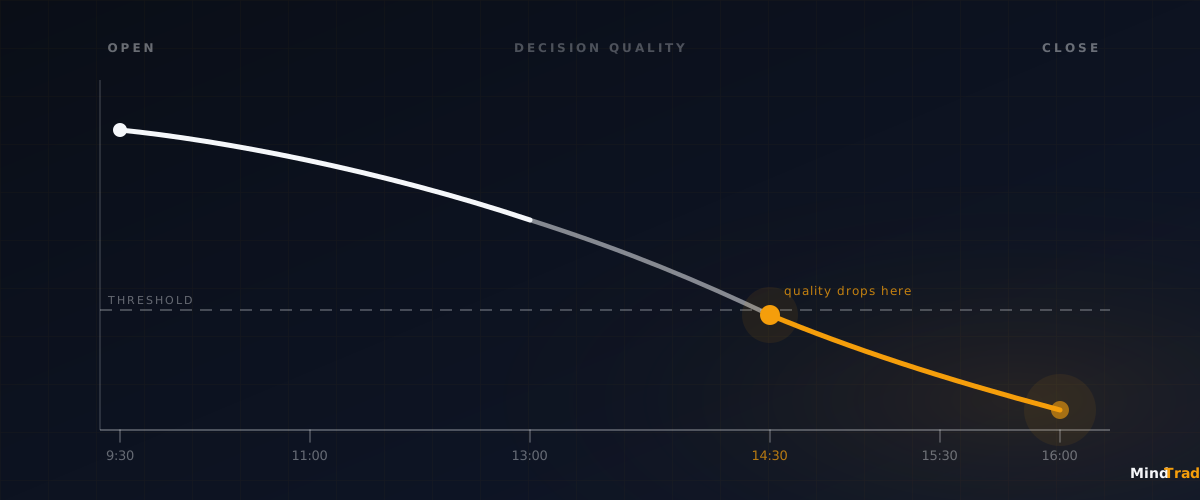
The morning session runs cleanly. Setups look obvious, sizing stays in range, entries hit or they don't and you move on. Then something shifts around mid-session — not the market conditions, not your setup criteria, but your relationship to the rules you wrote before the open.
Stops start getting wider. Trades that don't fully qualify start looking like they do. You take a trade just because watching feels worse than acting. By late session, you're making decisions that your morning self would have passed on without a second look.
This is not a discipline problem. It's a cognitive resource problem — and it has a name: decision fatigue.
What Decision Fatigue Actually Is
In 1998, Roy Baumeister, Bratslavsky, Muraven, and Tice published research in the Journal of Personality and Social Psychology establishing what they called ego depletion: the idea that self-control and deliberate decision-making draw from a limited, depletable resource. The finding was that making decisions, resisting impulses, and exercising judgment all deplete the same cognitive pool. The more you use it, the less remains.
The concept became widely known via a 2011 study by Shai Danziger, Jonathan Levav, and Liora Avnaim-Pesso, published in the Proceedings of the National Academy of Sciences, tracking parole judges across full sessions. Approval rates were highest at the start of each session and fell sharply before breaks, then partially reset. The researchers attributed the pattern to decision fatigue. (The study has since attracted methodological debate — case ordering and other variables complicate the interpretation — but it illustrated something the ego depletion literature had already identified: quality degrades with accumulated volume, and renewal helps restore it.)
The underlying mechanism is real regardless of the exact shape of the curve: cognitive resources that underpin good judgment are not unlimited, and repeated use depletes them in ways that are not always obvious from the inside.
Why Traders Are Especially Vulnerable
A standard trading session is not a few decisions. It's a continuous stream of micro-judgments: Is this setup forming or am I projecting? Does this match my criteria exactly or just approximately? Should I move the stop? Is this chop or accumulation? Each question carries cognitive cost, and in a live session they arrive relentlessly.
Add the emotional charge of financial outcomes — the cortisol, the temptation to recover a loss, the confidence from a good morning pushing you to press — and you have a context that depletes cognitive resources faster than almost any other professional environment.
Traders managing overnight positions, following multiple instruments, or processing macro news before the open have already spent some of that budget before price even moves. The session's decision bank is smaller than it looks from the outside, and it starts drawing down the moment the first chart opens.
What It Looks Like in Your Actual Trading
The behavioral fingerprint of decision fatigue is recognizable once you know what to look for:
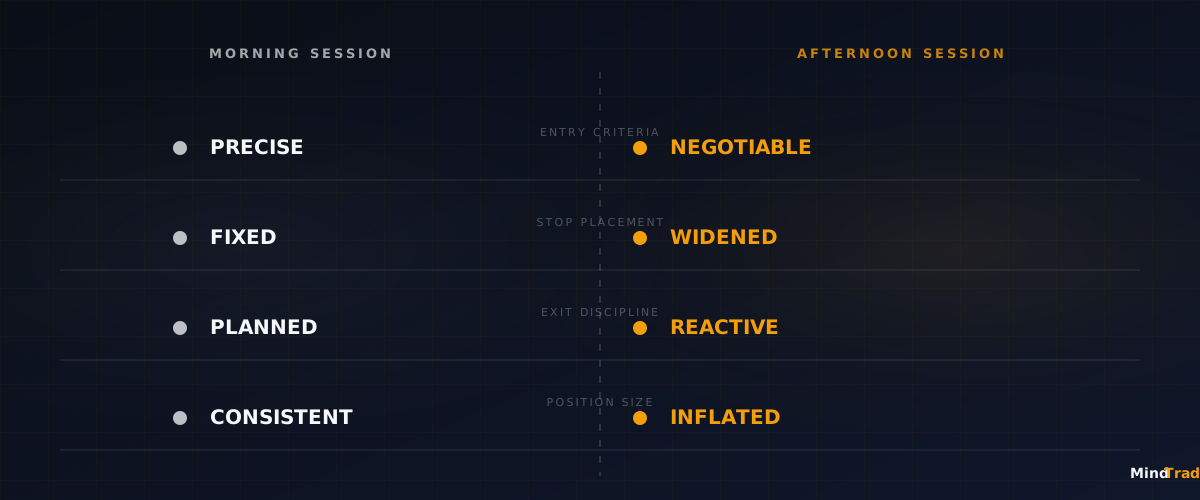
- Entry criteria drift — rules that were specific in the morning ("I need a close above the level, not just a wick") start feeling negotiable by early afternoon
- Stop-widening — not because the trade genuinely requires more room, but because accepting a loss requires the cognitive effort to re-plan, and that effort is running low
- Action for action's sake — the urge to be in the market regardless of setup quality, because inaction has started feeling worse than a bad trade. This is one of the clearest markers of overtrading driven by depletion rather than genuine opportunity
- Declining exit discipline — staying past targets or holding through stops because the decision to exit requires active engagement that isn't there anymore
The pattern matters because these are not random mistakes. They're predictable — they cluster in the back half of high-decision-count sessions, and they share a common cause.
Does the Research Actually Apply to Trading?
The honest answer: the research doesn't come with a "your P&L will be X% worse after noon" guarantee, and any article citing a specific number for decision fatigue in trading is fabricating it. What the evidence supports is the mechanism — the same person, later in a high-decision-count session, makes qualitatively different choices than earlier: more default, more impulsive, more avoidance-driven.
For traders, the actionable version is not a statistic. It's a pattern. When you review a month of session data and find that a disproportionate share of your rule-breaking trades and oversized losses cluster in the late session, cognitive depletion is a likely contributor.
Dr. Brett Steenbarger, who has spent years studying the psychology of professional traders, frames peak performance in trading as a state that can be cultivated and depleted across a session — not a stable baseline you simply have or don't. The implication is practical: performance management across the session is a skill separate from pre-session preparation, and most traders only practice the latter.
Three Habits That Protect Your Edge
Set a session trade maximum before the open. Not as a way to miss opportunities — as a recognition that decision quality, not trade count, determines long-term results. Many traders find their clearest sessions are also their quietest. A hard cap converts an unlimited-resource assumption (which is always wrong by late session) into an accurate one. Set it when fresh; let the morning version of you constrain the afternoon version.
Build in a mandatory mid-session break. Ten to fifteen minutes away from the screen at midday removes you from the decision environment. This is not superstition. The Danziger study's most consistent finding was renewal after a real break — the judges who had eaten and rested returned to their starting-session approval rates. Whatever the exact mechanism, the prescription holds: close the charts, step away from screens entirely, eat something. Passive exposure to price action still carries cognitive cost even without active decision-making.
Log your session state, not just your trades. The overlap between stress and trading performance and decision fatigue is real — both impair the same cognitive functions, and both are invisible from the inside. The solution for both is the same: make the pattern visible through systematic tracking. Log your energy level, focus, and the number of trades already made at each session checkpoint.
This is what MindTradr is designed to surface. MindTradr is a psychology-first trading journal that captures both trade data and psychological context in the same place, so the decision fatigue pattern in your own sessions becomes visible rather than invisible — which session lengths and decision volumes correlate with your worst late-day trades, and which session structures produce your cleanest results.
The Afternoon Session Is Not Your Enemy
Your afternoon session isn't broken. It's operating on fewer cognitive resources than the morning, which means it requires different management — not avoidance.
Fewer trades, tighter pass criteria, a position limit that enforces what the morning's discipline handles naturally. The goal is to match your session structure to your cognitive reality rather than treating every hour of the day as equivalent.
The edge lives in quality. Your morning knows this. Help your afternoon remember it.
If you want to start tracking which session patterns correlate with your cleanest decisions, MindTradr is free to get started.