
The Disposition Effect: Why You Sell Winners Too Fast and Hold Losers Too Long
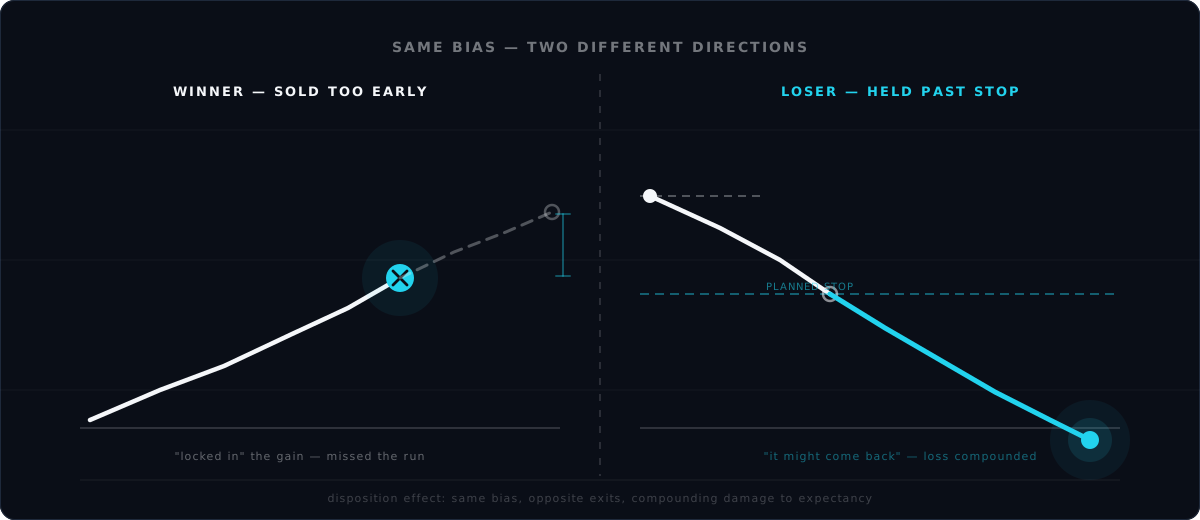
The trade is up. You click sell. It keeps going without you.
The other trade is down. You don't click sell. It keeps going in the wrong direction.
These two moments — the premature exit and the stubborn hold — feel like separate problems. They're not. They're the same psychological mechanism running in opposite directions, and behavioral economists have spent decades documenting exactly why it happens.
What the Disposition Effect Actually Is
In 1985, economists Hersh Shefrin and Meir Statman published a paper in the Journal of Finance titled "The Disposition to Sell Winners Too Early and Ride Losers Too Long." The name itself is the definition.
Their observation: traders and investors systematically exit profitable positions too quickly and hold losing positions too long — not for strategic reasons, but because of how the human brain processes gains and losses emotionally. They named it the disposition effect.
Terrance Odean's 1998 study, "Are Investors Reluctant to Realize Their Losses?" in the Journal of Finance, analyzed over 10,000 brokerage accounts and found that investors sold winning positions at substantially higher rates than losing ones — even after accounting for tax-loss harvesting and rebalancing rationales. The asymmetry held consistently across the full sample, in both rising and falling markets.
The Psychological Mechanism: Prospect Theory in Your P&L
The behavioral foundation is Kahneman and Tversky's Prospect Theory (1979), which describes how people evaluate outcomes asymmetrically rather than in absolute terms.
Two properties drive the disposition effect directly:
Loss aversion. Tversky and Kahneman's research documented that most people experience losses as roughly twice as painful as equivalent gains feel good. Losing €100 doesn't feel like the mirror image of winning €100 — it feels substantially worse. This creates a powerful psychological drive to avoid making a loss permanent by closing it.
Diminishing sensitivity. As gains accumulate, each additional increment feels like less than the one before. The move from flat to up €100 registers strongly. The move from up €500 to up €600 registers weakly. But any reversal from up €600 back toward up €500 is experienced as a loss — which, through loss aversion, feels disproportionately painful.
The combination produces a specific exit pattern:
When you're sitting on a winner, you're in the "gains" zone. Each extra point delivers less emotional reward, but any reversal feels like loss. The dominant impulse becomes: secure the gain while it's here, before something takes it away. You exit early.
When you're sitting on a loser, you haven't crystallized the outcome. Selling makes the bad result final and undeniable. Holding keeps the recovery technically possible — however unlikely — and defers the psychological pain. The dominant impulse becomes: stay a little longer, it might come back. You hold too long.
Why It Destroys Your Edge Even When You're Right
Here's the mechanism that makes the disposition effect expensive, not just frustrating.
Trading edge is mathematical: your average winner needs to be large enough to offset your average loser, across the frequency of each. The ratio between average winner size and average loser size is the core of expectancy.
The disposition effect attacks both sides of this equation at once:
- Cutting winners short reduces average winner size
- Holding losers beyond your plan increases average loser size
This is why many traders can have a positive win rate on their setup selection and still lose money over time. The setup is fine. The exit behavior is the leak. Risk-reward ratio math is unforgiving here — a consistent behavioral shift in exit timing can negate an otherwise positive edge completely, without any change in how good your entries are.
How to Fight the Disposition Effect
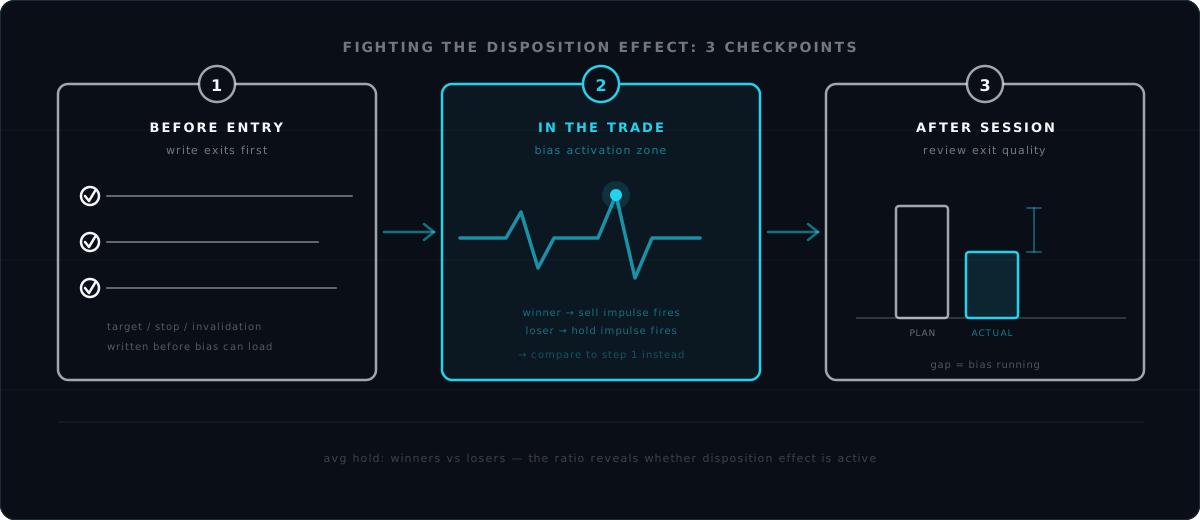
Awareness of the bias is not sufficient on its own. Three structural approaches address the mechanism directly:
Write your exits before your entry. Before placing a trade, document your planned exit conditions: what price constitutes a completed winner, and what price constitutes a confirmed loser. This decision, made before you have skin in the game, is far less contaminated by the emotional weight of a live P&L. The disposition effect primarily attacks exit decisions made while you're inside the trade — decisions where the emotional math has already shifted. Pre-written exits route the decision around the bias at its most active moment.
Treat the stop as already executed. If your stop is at X, mentally treat that loss as pre-spent — a confirmed cost of taking the trade. When the stop is something you've already agreed to rather than a threshold still open for negotiation, the in-trade emotional dynamic changes. You're managing a position with committed parameters, not bargaining with a loss that hasn't crystallized yet.
Review exit quality, not just entry quality. Most traders analyze entries obsessively: was the setup valid, was the entry price good? Fewer analyze exit quality: where did I exit versus where the plan said to? What was my average hold time on winners versus losers over the last month? Brett Steenbarger, who has written extensively about trader performance at traderfeed.blogspot.com, emphasizes that behavioral patterns damaging to traders are often visible in the data before they're consciously recognized. Reviewing your trades with an explicit focus on exits — not just entries — makes the disposition effect legible in your own numbers.
The Test: Two Numbers
After your next 20 trades, calculate: average hold time on closed winners, and average hold time on closed losers. If losers are being held significantly longer than winners with no systematic reason for the difference — no strategy, no position type, no market condition — the disposition effect is running in your trading.
MindTradr is designed to make this pattern visible in your own data. MindTradr logs each trade alongside your emotional state at exit, your exit notes, and the gap between planned and actual close — so over time you can see not just that the bias is there, but which sessions and emotional conditions it fires in. That specificity is what makes behavioral change tractable rather than theoretical.
The disposition effect is not a flaw in your strategy. It's a consistent feature of how the human decision-making system handles financial uncertainty. Structural defenses — pre-written exits, committed stops, exit quality review — don't require you to override the emotional pull in the moment. They route the decision around it before it has a chance to fire.
If you want to start building that data, MindTradr is free to start.