
Drawdown Psychology: How to Trade Through Your Worst Losing Streak
Every trader has a version of this stretch. Five sessions in, the setups still look clean, the entries still look right, and the trades still close red. Not dramatically — just consistently. A stop hit here, a reversal the moment you exit there, a few textbook entries that still didn't work.
By day eight, the P&L is in a hole that would have been easy to dismiss on day two. Now it feels like a statement about your competence.
That's a drawdown. Not a bad day. A drawdown is the sustained period between the peak of your equity and the point where you've recovered it — and the psychological damage done during that interval is usually worse than the financial damage.
What Happens to Your Brain During a Drawdown
Loss processing is neurologically expensive. Kahneman and Tversky's foundational work on loss aversion (Prospect Theory: An Analysis of Decision Under Risk, 1979) established that losses are weighted roughly twice as heavily as equivalent gains in the brain's evaluation system. But that asymmetry describes individual losses. A sustained drawdown compounds the effect across sessions.
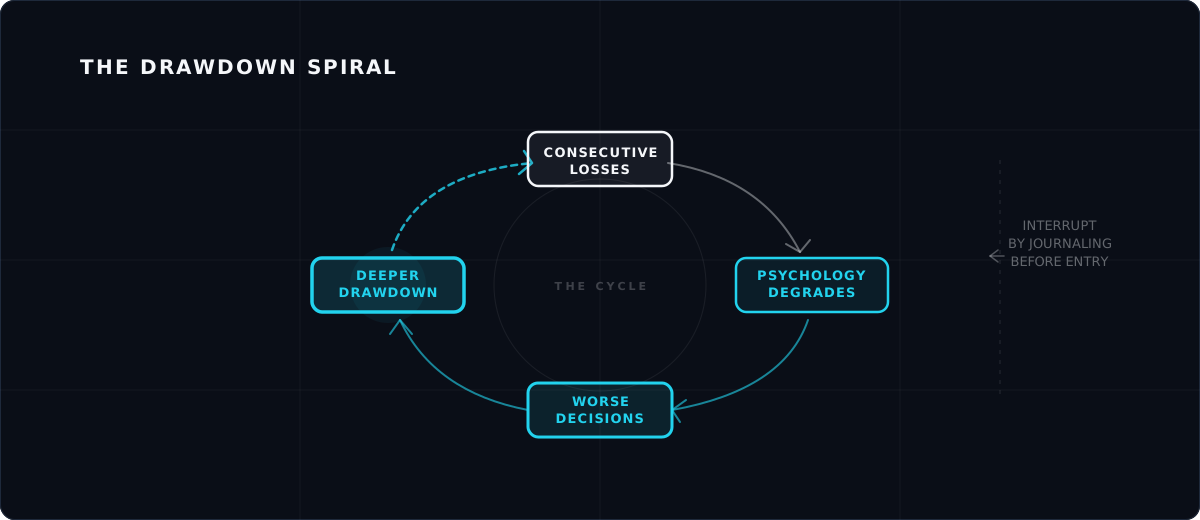
Under repeated losses, decision-making shifts at a neurological level. Threat-response circuitry becomes more active. The prefrontal cortex — the analytical, rule-following part of the brain — cedes ground to faster, emotional processing. The practical consequences:
- Pattern recognition degrades. You start finding signals where there's only noise, searching for "the setup that breaks the streak."
- Risk calibration distorts. You simultaneously want to trade smaller (fear) and larger (to recover faster), producing neither coherent sizing nor coherent avoidance.
- Time horizon collapses. The goal shifts from "execute my edge over the next 50 trades" to "recover from this drawdown in the next session."
The drawdown isn't just taking money. It's actively degrading the cognitive tools you need to stop it.
The Three Mistakes Traders Make When Losses Stack Up
Most traders respond to a losing streak by doing one of three things — all of which extend the drawdown rather than end it.
1. Revenge trading. The attempt to recover losses in the same session or the next one. Revenge trading after a loss is a loss multiplier: positions placed from a recovery mindset are typically oversized, placed outside normal setup criteria, and closed badly.
2. System-switching. Abandoning the current strategy mid-drawdown for a "better" one. The new system has no track record in current conditions, which means you're trading a method you don't understand at the exact moment your judgment is already compromised.
3. Frequency escalation. Increasing the number of trades to "force" the edge to appear. This increases transaction costs without improving outcome probability — and at lower decision quality than when the session started.
All three feel like the correct response. The brain in recovery mode generates urgency: do something, fix this, prove this was temporary. That urgency is the mechanism extending the drawdown, not the market conditions.
Position sizing during drawdowns is where the majority of the damage accumulates — not from any single bad trade, but from the pattern of sizing that emerges under recovery pressure.
Why Drawdowns Feel Different Than Individual Losses
A single losing trade triggers disappointment. A drawdown triggers existential questioning.
The reason is duration. When losses accumulate over days, the narrative your brain constructs shifts from "I had a bad trade" to "I am a bad trader." Psychologists call this an internal, stable, global attribution — you're no longer explaining a discrete event, you're updating your self-model. Left unchecked, that shift is what tips a drawdown into a full trading slump — a rut in your rhythm that outlasts the red on the screen and needs its own way out.
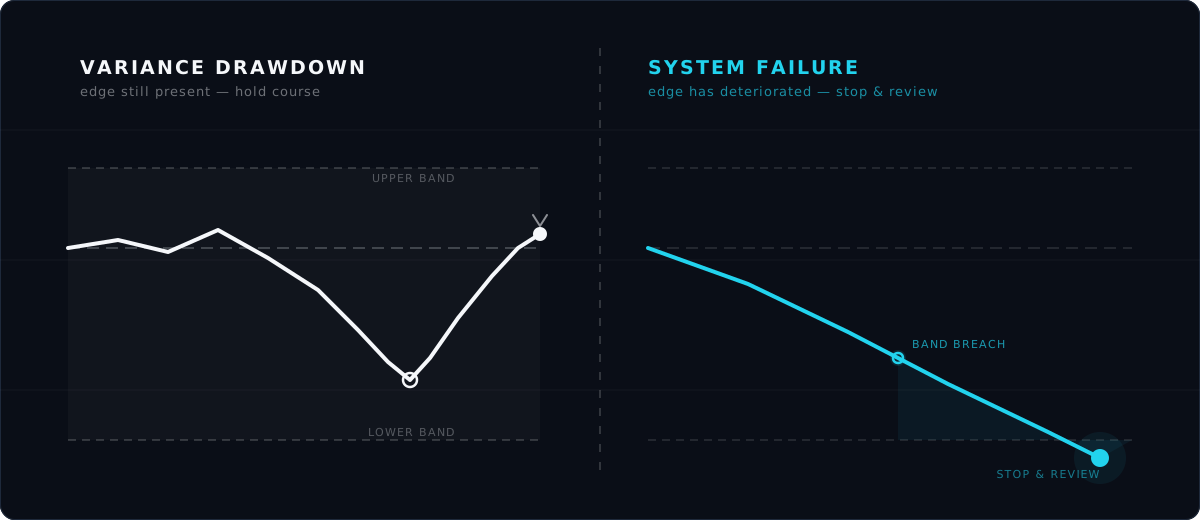
This is one of the central insights in Jared Tendler's work on trading performance. In his mental game coaching framework, Tendler distinguishes between variance (temporary results noise that reflects no systematic problem) and skill problems (systematic errors requiring correction). Conflating the two — treating normal variance as evidence of incompetence — is what converts a recoverable drawdown into a spiral.
The wrong question during a drawdown is "why am I losing?" That question puts you in the position of finding a problem to explain the losses, guaranteeing you'll find one whether or not one actually exists. The right question is: "Is my process still sound?"
Is the Drawdown Variance or a Real Signal?
This is the question traders actually need answered, and the honest answer requires your own data rather than your feeling about it.
Some diagnostic questions worth working through:
- Are your entries still meeting your setup criteria? If yes, the drawdown may be variance in your edge. If no, you're in system drift — a different problem requiring a different fix.
- Has your position sizing changed? Creeping sizes signal recovery mode, not systematic execution.
- Is the pattern of losses different from usual? Losing in new market conditions or a different session time is information. Losing the same setups you normally win with is a smaller signal — potentially a regime mismatch, not a strategy failure.
Dr. Brett Steenbarger writes extensively about this distinction: the difference between a losing streak that's statistically consistent with your edge and one that signals your edge has stopped working is a data question, not a feeling question. Feelings misread both — they call normal variance catastrophic, and they rationalize real edge deterioration as temporary bad luck.
The Practical Framework for Getting Through It
Reduce size, not frequency. Cutting position size roughly in half during a confirmed drawdown preserves capital without forcing you out of the game — you keep collecting process data and stay in the practice reps without accelerating the account damage.
Set a session kill switch before the session opens. A predetermined maximum daily loss — say, three times your average single-trade loss — removes the worst decisions from your control at the worst moments. The rule must exist before the drawdown, not during it.
Journal specifically for drawdown patterns. Write down what the market was doing when you entered, your emotional state, whether the setup met your criteria. After a run of entries, the cause usually becomes visible: a regime shift you didn't adapt to, an instrument behaving differently than expected, an environmental factor (sleep, stress, time pressure) degrading decision quality across the whole stretch.
Separate the process question from the outcome question. Were the entries sound even though they lost? Were exits managed according to plan? A drawdown that involves sound process is recoverable. A drawdown that involves process deterioration is a warning — and if you logged the data, it will show you which one you're in.
MindTradr is a trading psychology journal that logs your emotional state, confidence level, and position size on every trade — making it possible to tell whether the drawdown started with process deterioration or whether the P&L moved first and psychology followed. That diagnostic distinction changes the entire recovery approach. Tracking trading emotions with this specificity is what separates traders who learn from drawdowns from those who just survive them.
Every drawdown ends — through regime change, through recovery of edge, or through correction of genuine process problems. The traders who come out the other side are the ones who stayed systematic when everything in their psychology was pushing them to be reactive.