
Hindsight Bias: Why Every Losing Trade Looks Obvious in Review
You close the losing trade, open the chart in review, and there it is — the signal you missed, plain as day. The resistance level that obviously held. The volume that obviously diverged. In the moment, you'd have called this setup at best a coin flip. Now, twenty minutes after the stop got hit, it looks like it was never really in question.
That gap — between how confident you actually were and how confident you now remember being — has a name: hindsight bias. It's not a minor quirk. It's actively working against the one habit that's supposed to make you better at this: your trade review.
What Is Hindsight Bias in Trading?
Hindsight bias is the tendency to see past events as having been more predictable than they actually were, once you already know how they turned out. Psychologist Baruch Fischhoff first documented the effect in a 1975 study that asked participants to recall the probability they would have assigned to an outcome — before they knew what actually happened. People consistently overestimated how confident they'd been in the outcome that occurred, even when their own earlier written predictions said otherwise.
Fischhoff called this "creeping determinism": once you know how something turned out, your brain quietly rewrites the story so the ending feels inevitable. It doesn't feel like a memory distortion. It feels like insight.
Why Does Every Losing Trade Look So Obvious in Hindsight?
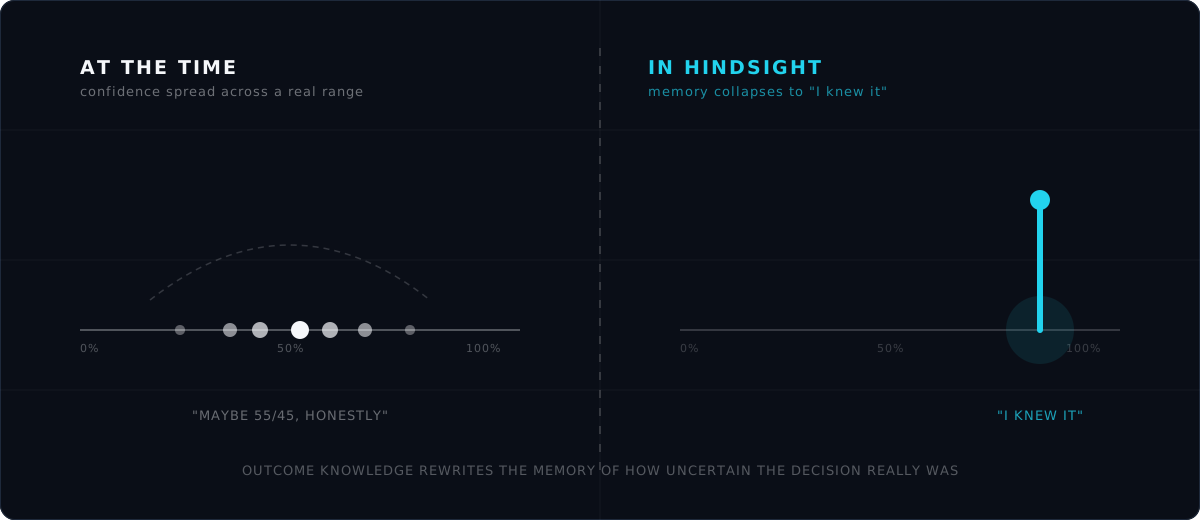
Trading compresses Fischhoff's experiment into minutes instead of years. You take an entry with genuine uncertainty — say, if someone had asked you to put a number on it right before you clicked buy, you'd have called it close to a coin flip, tilted slightly in your favor. The trade goes against you. Reviewing the chart afterward, with the outcome already known, your brain doesn't reconstruct that close-to-even estimate. It reconstructs something closer to "I probably should have known."
The mechanism is memory, not judgment. Once the outcome is known, it gets folded into how the earlier evidence gets recalled — the signals that supported the losing side become more salient, the signals that supported your actual entry fade. You're not lying to yourself on purpose. You're remembering a decision you never actually made, made by a version of you who already knew what would happen.
The Real Cost: A Trade Review That Lies to You
This would just be a curiosity if it stayed out of the review process. It doesn't. Trade review exists to separate genuine process errors from ordinary variance — and hindsight bias corrupts exactly that judgment.
Two specific ways it does damage:
It manufactures lessons that aren't there. A losing trade that was a reasonable decision under real uncertainty gets rewritten as "I ignored an obvious signal." You walk away with a new rule — avoid that setup, distrust that pattern — built on a false memory of how obvious the setup really was. The rule doesn't generalize, because the read of the situation it's based on never actually happened.
It quietly punishes good process. If every losing trade retroactively looks avoidable, you start associating any loss with a mistake, whether or not one occurred. Over time, this pushes traders toward tightening up after any loss regardless of quality — exactly when the process was sound and the outcome was ordinary variance.
Both failures point the same direction: toward second-guessing decisions that were actually fine, and away from the setups that genuinely need fixing.
Hindsight Bias vs. Genuine Pattern Recognition
Not every "I should have seen that" is bias. Sometimes the signal really was there and was genuinely missed — that's real pattern recognition doing its job, and it's exactly what review is supposed to surface.
The distinction is whether you have a record from before the outcome was known. If your notes from the moment of entry show you weighing the same factor you're now calling "obvious," that's a real miss worth learning from. If your notes show no mention of it — or show you rating your confidence at a coin flip — the "obvious in hindsight" feeling is the bias talking, not a real insight.
This is the entire argument for writing things down before you know the answer. Brett Steenbarger, who has written extensively about trader psychology, points to pre-commitment — recording a read on the market before the outcome resolves it — as one of the few interventions with a track record of actually changing behavior, precisely because it gives you something to check your memory against instead of trusting it.
How to Review Trades Without Hindsight Rewriting the Lesson
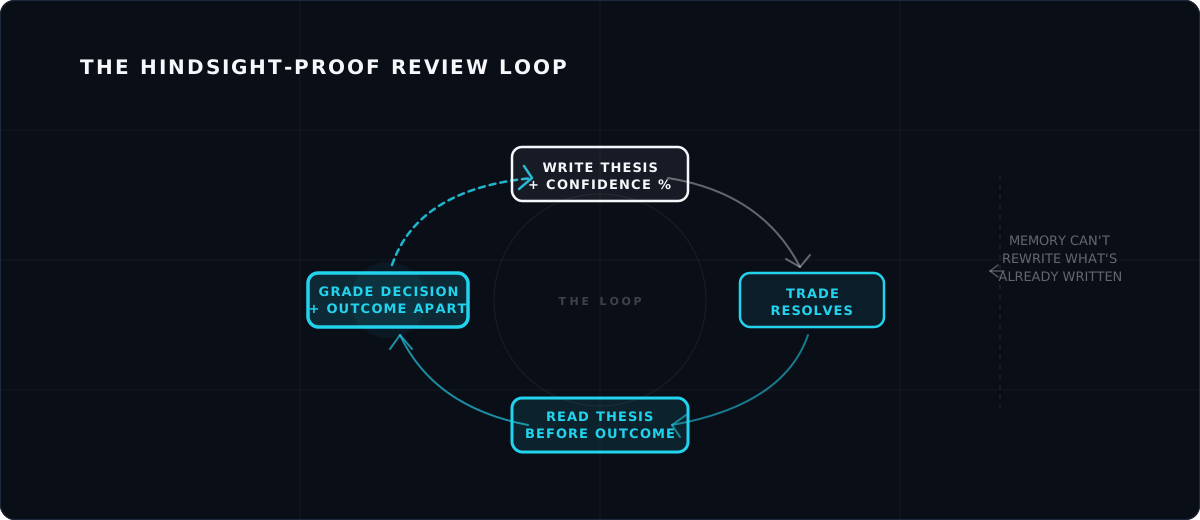
Write your confidence down before you know the outcome. Not after. A one-line note — "moderate confidence, key risk is the earnings print Thursday" — is the only real defense against your own memory later deciding you were sure.
In review, read your entry notes before you look at the result. Reconstruct what you actually believed at the time, in the order you believed it, before the outcome contaminates the read. This single ordering change is the difference between reviewing your decision and reviewing your decision's reputation.
Grade the decision and the outcome separately. A trade can be a good decision with a bad outcome, or a lucky decision with a good one. If your journal only has one column — win or loss — hindsight bias has nothing to correct it against. What you write in a trading journal determines whether review can actually tell the two apart — and grading by result alone is its own trap, one outcome bias creates even when hindsight isn't involved at all.
Treat "it was obvious" as a hypothesis, not a conclusion. If review keeps surfacing the same "obvious" signal after every loss, that's worth investigating — it might be a genuine blind spot. If it's a different "obvious" signal every time, that's the pattern of a brain rewriting the story after the fact, not a trader with a consistent hole in their process.
MindTradr logs your confidence and reasoning at entry — before the market has answered the question — so the trade you review later is the trade you actually took, not the one your memory has quietly upgraded into an obvious mistake. MindTradr is a trading psychology journal built so your review compares real decisions against real outcomes, not a story rewritten after the fact.
The next time a losing trade looks painfully obvious in review, the useful question isn't "how did I miss that." It's "did I actually miss it, or does it only look that way now that I know how it ended." Most of the time, if you wrote it down honestly beforehand, the answer is right there waiting for you — untouched by what happened after.
If you want a review process that isn't fighting your own memory, MindTradr is free to start.