
Outcome Bias: Why Judging Your Trades by Results Alone Will Wreck You
Two trades. On the first, you sized up on a setup you hadn't fully validated, skipped your own invalidation level, and it ripped in your favor for a big win. On the second, you did everything right — clean entry, correct size, respected your stop — and the market chopped you out for a small, forgettable loss. If you only look at the P&L column, trade one was the good one.
That instinct has a name: outcome bias. And left unchecked, it quietly trains you to repeat the trade that should worry you and abandon the one that should reassure you.
What Is Outcome Bias in Trading?
Outcome bias is the tendency to judge the quality of a decision by the quality of its result, rather than by the information and reasoning available when the decision was made. Researchers Jonathan Baron and John Hershey documented the effect in a 1988 study: they gave participants identical decision scenarios — same information, same reasoning — that differed only in how things turned out, and asked them to rate the quality of the decision itself. People consistently rated the decision higher when the outcome happened to be good, even though the decision they were rating never changed.
Trading turns this into a live, repeating feedback loop instead of a one-off lab finding. Every trade closes with an unambiguous number attached to it, and that number arrives fast — often within minutes. Your brain doesn't wait for a careful audit of whether the decision was sound; it grades the decision by the number, because the number is right there and the reasoning is not.
Why Outcome Bias Hits Traders Harder Than Almost Anyone Else
Most decisions in life get slow, noisy, delayed feedback. A career move, a relationship choice, a health habit — you might not know for years whether it was actually a good call. Trading is unusual precisely because the feedback is so fast and so clean: green or red, today, in dollars.
That immediacy is normally trading's advantage — it's what makes deliberate practice possible at all. But it has a cost. You accumulate outcome-based intuitions far faster than you accumulate process-based ones, because the P&L number reinforces itself every single day, while "was this actually a sound decision" only gets asked if you deliberately stop and ask it.
Was That Really a Good Trade, or Did It Just Work?
The useful way to separate the two is a simple grid: decision quality on one axis, outcome on the other. Four combinations fall out of it, and two of them are where outcome bias does its damage — the reckless trade that happened to work, and the sound trade that happened not to.
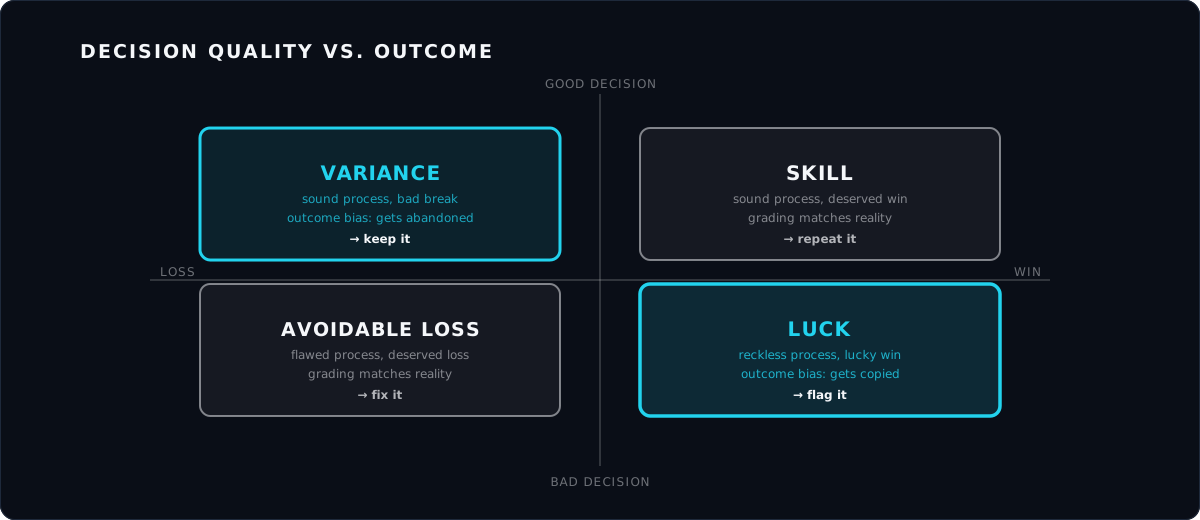
Poker player and decision-science author Annie Duke gave this failure a name in Thinking in Bets: "resulting" — grading the decision by its result instead of by what was knowable at the time. Her point translates directly to trading. A trade can be a good decision with a bad outcome, or a reckless decision with a good one. If your review process only has one column — win or loss — there's nothing in it to tell those two apart.
The Real Cost: You Train Yourself to Repeat the Wrong Trades
Left uncorrected, outcome bias doesn't just misjudge the past — it shapes what you do next.
It rewards the trade that should worry you. When a rule-breaking, oversized, poorly-timed trade wins, the natural read is "that worked." Nothing in the moment tells you it was reckless, because the number says otherwise. That reinforcement makes you more likely to size up again next time conditions merely feel similar — which is exactly how a single lucky outlier gets copied into a habit.
It punishes the trade that should reassure you. A sound, well-sized, plan-following trade that loses to ordinary variance gets filed away as a mistake if the log only tracks results. Traders who do this long enough start tightening rules, adding filters, or avoiding a setup that was never actually broken — chasing away noise instead of fixing signal. Reviewing trades is supposed to catch process errors; outcome bias quietly redirects that review toward punishing bad luck instead.
Both failures point the same direction: toward more of the decisions that got lucky, and less of the decisions that were actually sound.
How to Grade Trades on Decision Quality, Not P&L
Write the decision criteria down before you know how it resolves. A short note at entry — what the setup was, why the size was what it was, where the stop sits and why — is the only real record of the decision you can grade later. Without it, review has nothing to work with except the outcome.
Add a decision-quality field that's separate from win or loss. Something as simple as "followed plan: yes/no" recorded at entry, independent of P&L, gives review a second axis to check the result against.
Review the trades you won but shouldn't have as carefully as the ones you lost. If review only happens after losses, half of the mislearning outcome bias produces never gets examined at all.
Look for repeats, not one-off numbers. A flawed decision that shows up across several trades — regardless of whether each individual one won or lost — is a real pattern worth fixing. A single trade graded purely by its result is not evidence of anything.
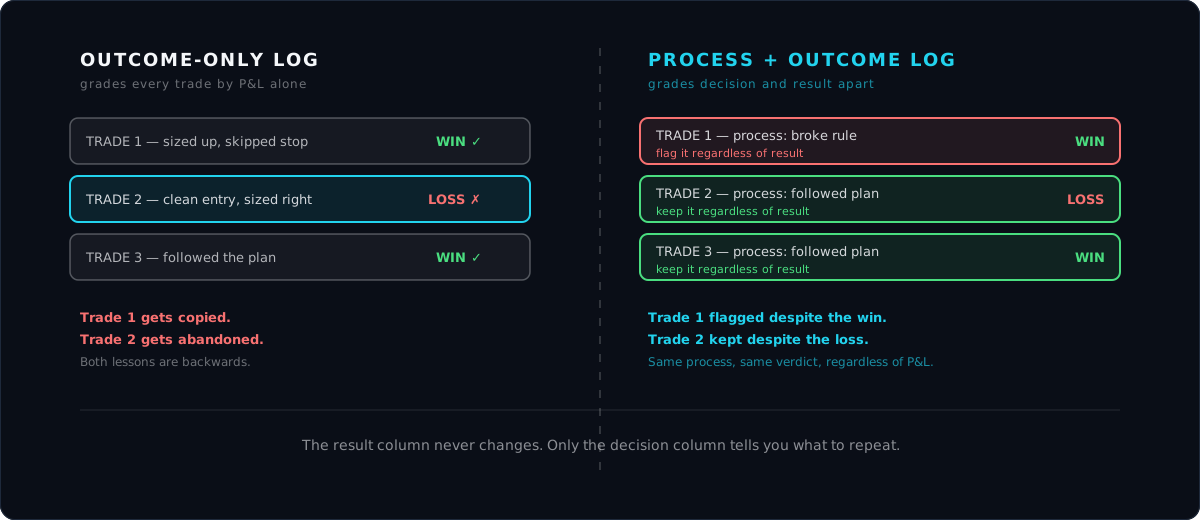
What you actually write in a trading journal is what determines whether this distinction is even possible to make later. A log with only a P&L column can't separate luck from skill no matter how carefully you review it — the information was never captured.
MindTradr is built around exactly this separation: a decision-quality note logged at entry, kept independent from the P&L result that comes in afterward, so a lucky reckless win and a sound careful loss never get graded by the same column. MindTradr is a trading psychology journal that grades the decision and the outcome as two different questions, not one.
The next time a trade works out, the useful question isn't "did that pay off." It's "would I have made the same decision if I'd known in advance it would lose" — because if the honest answer is no, the win didn't vindicate anything. It just delayed the lesson.
If you want a review process built to separate decision quality from luck, MindTradr is free to start.