
Why You Keep Moving Your Stop Loss (And How to Stop)
You set the stop. You know exactly where you're wrong. Price drifts toward that level — and instead of letting it execute, you click. You move it.
Not because of new information. Because of the number.
This is one of the most consistent patterns in retail trading, and one of the most costly. Not because it happens dramatically, but because it feels reasonable every single time it does.
What Moving Your Stop Loss Actually Costs
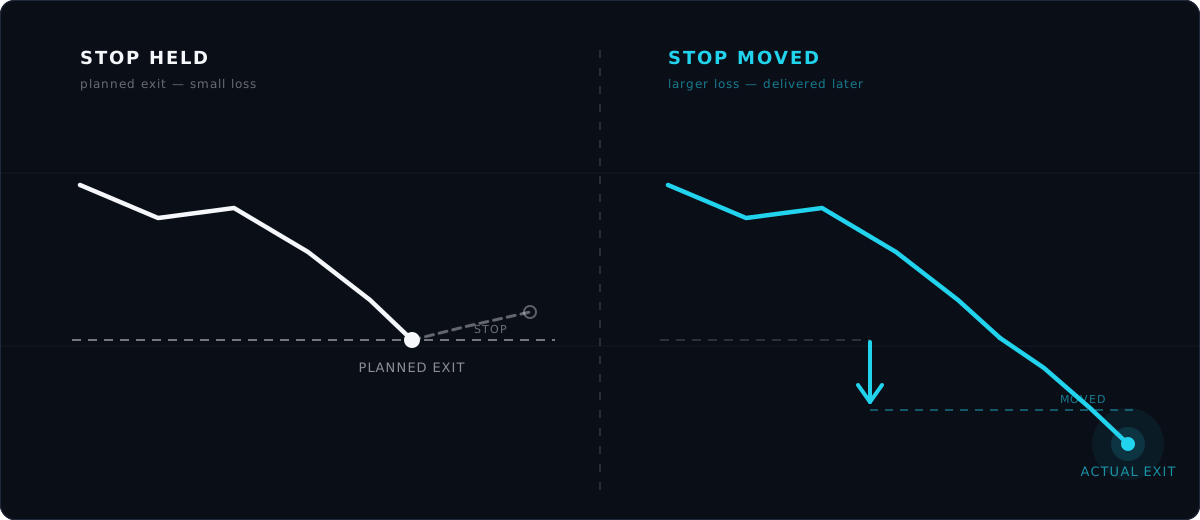
The math is clear, which is what makes this interesting. If you plan a trade at 1% risk and then move the stop to accommodate 2% risk, you've doubled the amount at stake without changing anything about the setup. If you were targeting a 2:1 reward-to-risk ratio, you've just halved your expected value in a single click.
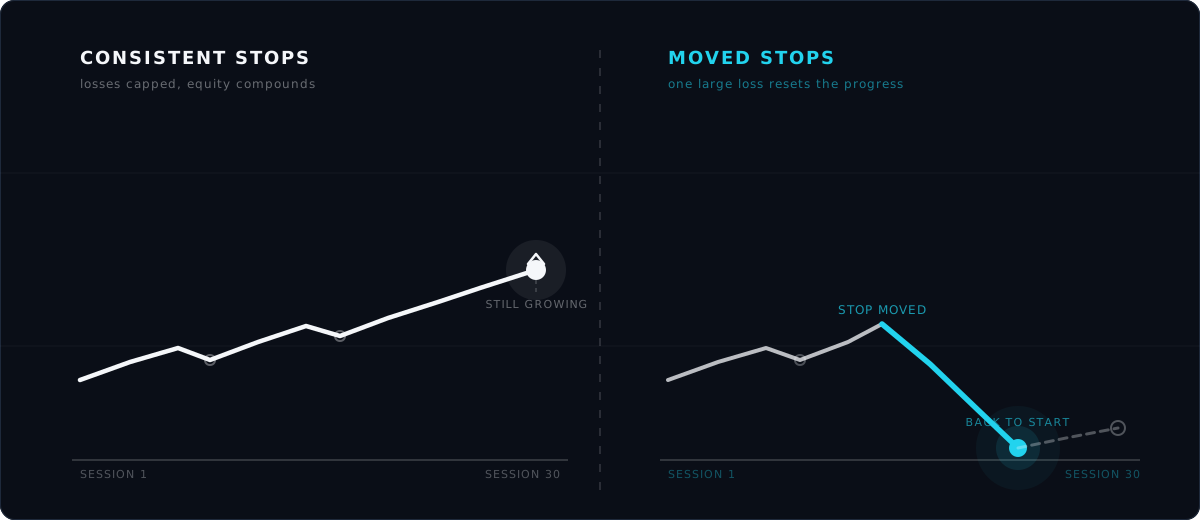
What's harder to feel in the moment is how this compounds. One moved stop looks like a near-miss — a trade you almost closed at a loss but managed. Ten moved stops across two months tells a completely different story: a pattern of risk expansion under pressure, invisible until you lay it out in one view.
This is why the risk-reward ratio isn't just a calculation. It's a constraint that only functions if you respect both sides — including the denominator — every single time.
Why Your Brain Fights the Stop
In 1979, psychologists Daniel Kahneman and Amos Tversky published Prospect Theory, their foundational research on how humans evaluate gains and losses. Their core finding — that losses feel psychologically more painful than equivalent gains feel pleasurable — has held up across decades of research in behavioral economics and decision science.
The mechanism it creates in trading is specific. The moment price approaches your stop, you're facing an imminent realized loss. That registers differently from an unrealized potential loss of the same dollar amount. Moving the stop converts a certain loss into a possible future loss — and the relief of that conversion is real, immediate, and physiological.
Your nervous system is doing exactly what it evolved to do: avoid certain pain. The problem is that the relief is false. You haven't reduced your risk. You've delayed the accounting and made the eventual loss larger.
Dr. Brett Steenbarger, who has worked extensively on the psychology of professional traders, writes about this exact pattern — the way traders confuse emotional relief with rational risk management. The stop move feels like a decision. It's a reaction.
The Three Shapes This Takes
Stop-moving rarely looks like a single deliberate choice. More often it arrives as one of these:
- "Letting it breathe" — a few more ticks of room because the setup was valid and the volatility is just noise. The stop was right; the market is being difficult.
- "Almost there" — price is within a few ticks of the stop and a reversal feels imminent. You widen slightly so you don't exit right before it turns.
- The disguised average-down — you add to the position at a worse price and recalculate the stop on the blended entry. This one doesn't feel like stop-moving at all. That's what makes it the most dangerous form.
All three arrive with a plausible justification at the exact moment honoring the stop would cost something. That timing — the justification appearing precisely when it's most convenient — is the tell.
Does the Market Know Where Your Stop Is?
A common justification for moving stops is "stop hunting" — the belief that large participants deliberately target retail stop clusters before reversing.
It happens in specific contexts, particularly around major levels in thin markets. But the majority of stop approaches have nothing to do with your order. Price moved to that level because of broader market forces.
Even if stop hunting were more widespread, the correct response would be to place the stop more intelligently before entry — not to move it after price has already approached. Moving it under pressure is the reactive version of the same problem: the trade placement was wrong, and the stop move is a cover for that.
How to Actually Hold the Line
These work not because they demand more willpower, but because they move the decision to a time when you're thinking clearly:
Pre-commit the dollar amount before entry. Before you enter, write the maximum dollar loss you'll accept. Not the stop price — the actual dollar figure. When price approaches, the question becomes "Am I willing to lose more than I already committed to losing?" That framing is harder to rationalize around than "do I give it a few more ticks."
Require new information. Set one rule: the stop can only move if something real and objective changed in market structure since entry. Not price proximity. Not urgency. New information. If you can't name it specifically, the stop stays.
Log every moved stop. Not as self-punishment — as data. Every moved stop is a data point about when and why your discipline breaks. After tracking it for 30 sessions, most traders find a clear pattern: stops get moved at specific times, after specific sequences of wins or losses, or in specific instruments. Pattern recognition is what changes behavior, not resolution.
The Stop Is the Plan
Breaking trading rules tends to be incremental rather than dramatic — a slow erosion rather than a single decision to blow up the account. Moving the stop is one of the most measurable forms of that erosion, because it leaves a specific number: exactly how far you moved it, exactly how much the loss grew.
Which also makes it the most correctable. You don't need extraordinary discipline to hold a stop. You need your actual stop data visible alongside your outcomes, so that the pattern can speak in your own numbers rather than in abstract advice.
MindTradr logs stop levels at entry alongside actual exits, so the gap between your planned risk and your actual risk becomes a tracked metric across every session. That gap, once visible, changes the decision — not because of willpower, but because it's no longer abstract.
If you want to start tracking the difference between your planned and actual risk, MindTradr is free to start.