
Trading Patience: Why Waiting Is the Hardest Part of the Job
The setup hasn't triggered yet. Nothing is happening. You've been watching the same chart for forty minutes and the market is quiet. Then a candle forms that's close — not exactly what the plan says, but close enough. And you enter.
Not because the setup was there. Because you couldn't stand the waiting any longer.
This is how most trading mistakes actually happen. Not from bad strategy. From the inability to sit flat when the market hasn't given you a reason to act.
Why Waiting Destroys Your Edge
Trading edge is statistical. It lives in a specific set of conditions, and the moment you take trades outside those conditions, the edge degrades.
Take a simplified example: if your defined setup wins 55% of the time at 1.5R, adding ten entries in marginal conditions — lower win rate, smaller R — doesn't just dilute results slightly. It pushes a profitable process toward breakeven or negative. You've traded more while trading worse.
Mark Douglas, in Trading in the Zone, makes this point consistently: the market produces an endless stream of possible entries, and the edge comes entirely from which subset of that stream you participate in. Patience is the enforcement mechanism. It's what keeps you inside your edge and out of the noise.
Why Waiting Feels Impossible
Doing nothing is harder than it sounds — and the reason is neurological, not motivational.
When nothing is happening, inaction registers as a kind of threat. You've committed time, attention, and real money to being at the desk. Every minute of watching without trading increases what psychologists call the perceived cost of inaction: the feeling that something is slipping past while you do nothing about it.
This is the basis of action bias — the tendency to prefer action over inaction even when inaction is the statistically better choice. Behavioral economics research on professional penalty kicks (Bar-Eli, Azar, Ritov, Keidar-Levin, & Schein, 2007, Journal of Economic Psychology) found that goalkeepers dive on roughly 94% of kicks — far more than the proportion that actually require diving to save. They dive because standing still and watching a goal go in feels worse than diving and missing. The psychological cost of inaction overrides the probability math.
Traders do the same thing. Entering a weak setup and losing feels more purposeful than staying flat and watching the market move without you. Your brain doesn't distinguish purposeful from correct.
The Trades Worth Taking Have One Thing in Common
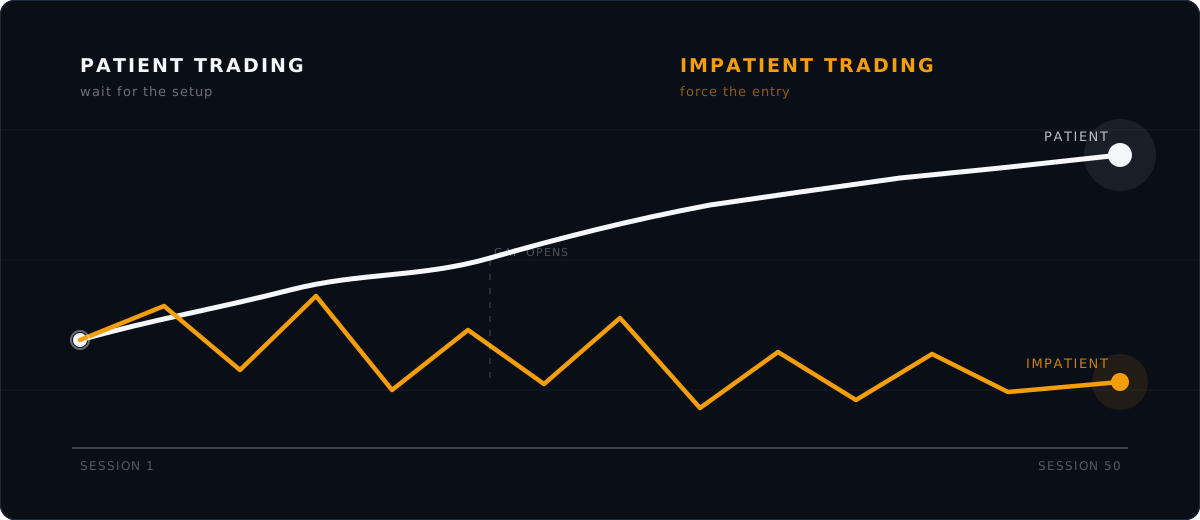
The setups genuinely worth trading share a quality: they're unambiguous when they appear. A clean breakout, a well-defined pullback to a key level, a confirmed signal on your timeframe — these don't require convincing. When the condition is met, you know. The temptation to enter is strongest precisely on the setups that almost qualify.
One calibration that helps: if this exact chart were on someone else's screen right now, would a trader with your edge immediately recognize it as a textbook setup — or would they need your context to see why you entered? Genuine setups are almost always recognizable from the outside. Forced trades rarely are.
This distinction sharpens the more historical data you've reviewed. Without that review, a forced trade and a genuine trade feel nearly identical in the moment. After reviewing months of your own entries, the pattern becomes clear: the profitable ones consistently fit the criteria exactly, and the losing ones consistently look like approximations of them.
How to Build a Waiting Practice
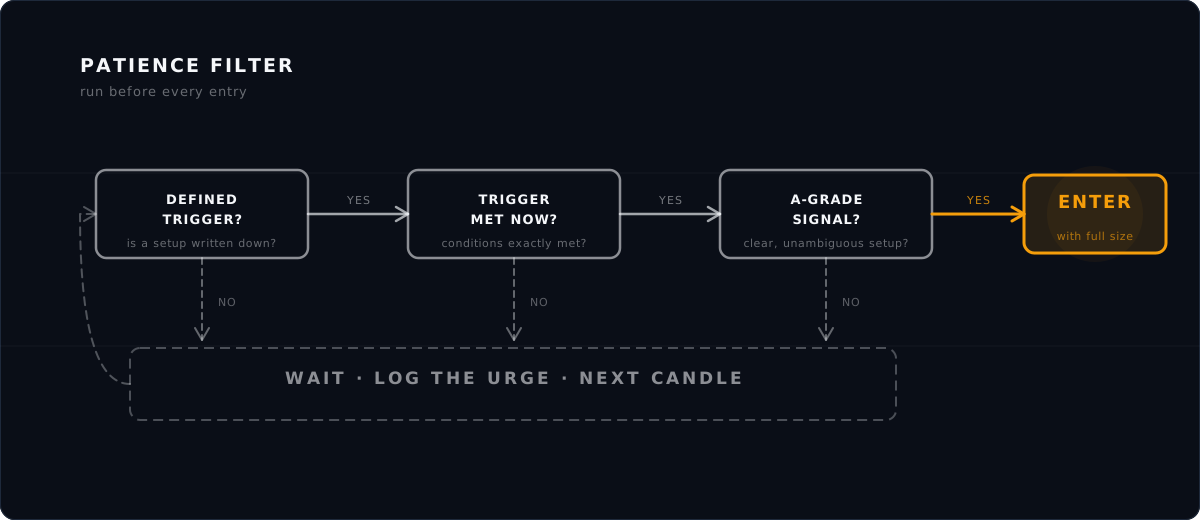
The structural answer to patience isn't willpower — it's reducing the number of real-time decisions you have to make. Every minute at the chart without pre-defined triggers is a minute where impatience can override your plan.
Practical approaches:
- Define your setups before the market opens. Write the specific conditions: "Entry if X happens at level Y, confirmed by Z." If those conditions don't trigger, there is no trade — not a judgment call, just no trigger. This removes in-session negotiation entirely.
- Set a session trade limit in advance. If your edge calls for two or three entries in a session, decide that number before you sit down. Once you've reached it, the session is done. A finite quota forces a higher internal bar on every entry.
- Review flat sessions as data. Sessions where you waited and nothing correctly set up are easy to ignore — they look like nothing happened. In your journal, they're evidence that your process worked. Tracking them creates feedback: every flat session where you held discipline is a session your edge survived intact.
- Log the urge to enter. When you feel the pull toward a setup you haven't fully validated, write it down instead of clicking. After the session, check the outcome. This builds a feedback loop between impulse and result without the cost of the trade itself.
A daily trading routine structured around pre-market setup definition removes an entire category of in-session decisions before they have a chance to arise.
The Data That Builds Patience Over Time
Individual sessions are too short to see whether patience is developing. The pattern only becomes visible across weeks and months of consistent data — which setups you waited for versus forced, and how the outcomes actually differ between them.
This is what a journal does at scale: it separates your genuine edge from your noise, session by session, until the difference is measurable rather than just intuitive. Forced trades almost always look worse in the data than they felt in the moment. So does overtrading — which is usually what impatience produces when it compounds across a full session.
MindTradr logs setup confidence and entry type alongside every trade — mark each entry as planned or unplanned, rate setup quality before the outcome is known, and over time the correlation between impatience and poor results becomes a pattern in your own numbers rather than a theory from someone else's.
Brett Steenbarger, who has worked with professional traders for decades, makes a consistent observation on his blog: the traders who improve most over time are not the ones who find better setups — they're the ones who stop taking the bad ones.
That's what patience does. It's not passive — though the two are easy to confuse, and telling patience from passivity is its own skill. Real patience is the discipline that keeps what you trade limited to what actually has edge.
If you want to start tracking where your patience breaks down, MindTradr is free to start.