
Confirmation Bias in Trading: Why You Only See What You Want to See
The setup looks perfect. You've already decided to buy — and suddenly everything you look at confirms the trade.
The bearish candle? You explain it away. The RSI divergence? You don't notice it. The analyst who disagrees? Obviously hasn't read the chart properly.
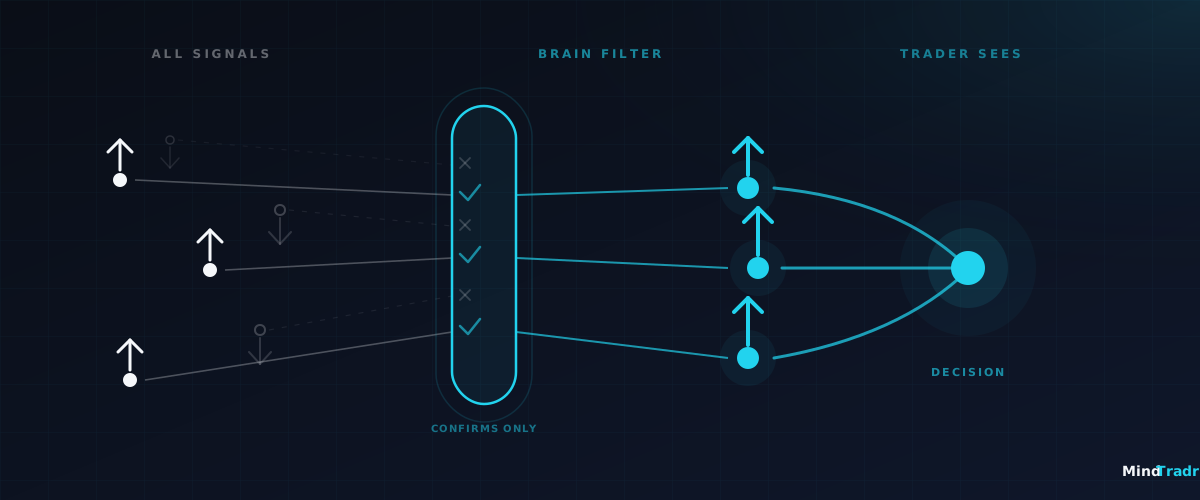
This is confirmation bias in trading: the mechanism by which the mind selectively absorbs information that supports a pre-existing view while discounting, reframing, or simply not registering everything that contradicts it.
It's not a rookie mistake. It's a baseline feature of human cognition — one that gets amplified, not reduced, as your conviction in a trade grows.
Why Your Brain Runs This Filter
When we form a hypothesis — "this is a long setup" — the brain automatically shifts into evidence-collection mode. But the collection is deeply asymmetric.
Confirming evidence gets processed quickly, feels compelling, and strengthens conviction without much friction. Contradicting evidence requires effortful deliberation to even register, and is often reframed as an outlier, discounted as temporary noise, or quietly missed altogether.
Psychologist Peter Cathcart Wason demonstrated this in his 1960 "2-4-6 task" study: participants asked to discover a rule governing number sequences consistently generated examples that confirmed their hypothesis and almost never tested sequences that might falsify it — even when one disconfirming test would have revealed the answer immediately. The bias toward confirmation over falsification was near-universal.
The market is a 2-4-6 experiment running in real time, all day, with your capital on the line.
How Confirmation Bias Shows Up in a Live Trade
The pattern unfolds in predictable stages:
Before entry, you identify a bullish setup. The act of analysis creates attachment. You become invested in the thesis — not just intellectually, but emotionally.
During research, you look for corroborating signals: news flow, sector context, other timeframes. Bullish signals surface first and feel compelling. Bearish signals appear later, get more critical scrutiny, and are more easily dismissed as context-dependent or already priced in.
At entry, you execute. Now you have skin in the game, and the bias amplifies. Price moving your way feels like confirmation of your read. Price moving against you feels like temporary noise — a shakeout before the real move.
While holding, you extend exit criteria because each minor recovery "confirms" the thesis. Each sustained adverse move gets reframed. You're no longer evaluating the position — you're defending it.
At exit, usually too late. Often well past the original stop.
This reinforcing loop is how confirmation bias drains accounts — not in one dramatic mistake, but through a hundred small reframings that make the logical outcome feel impossible to accept until the damage is done.
The Conditions That Make It Worse
Confirmation bias is a baseline cognitive pattern, but three situations amplify it sharply:
Social commitment to the thesis. Traders who have shared a call publicly — in a Discord, a trading group, a journal post — face social confirmation pressure on top of cognitive confirmation pressure. Admitting the trade is wrong means admitting public error. The cost of updating the belief goes up sharply.
Rich narrative setups. "The macro rotation into defensive names makes this breakout high probability" creates a story that's nearly impossible to cleanly falsify. A simple level either holds or breaks. A narrative has infinite reframings available — the timing is off, the catalyst is delayed, the sector rotation hasn't started yet. Narratives make confirmation bias nearly invincible.
Low-information sessions. During illiquid markets, sparse data is especially vulnerable to being read through the confirmation lens. Three bullish prints in a thin afternoon session feels like trend confirmation. Statistically, it's almost always noise.
Conviction vs. Bias: A Practical Distinction
Not all persistence in a trade is confirmation bias. Experienced traders hold through pullbacks based on genuine probabilistic assessment, not wishful thinking.
The distinction lives entirely in timing: conviction is pre-defined. Bias is rationalization built in real time.
If you wrote down before entry that a pullback to level X was within the expected range and manageable, holding through it is discipline. If you decide "this pullback is fine" while it's happening — because it needs to be fine — that's bias at work.
Anchoring bias frequently runs alongside confirmation bias in these situations: the entry price becomes the anchor you're waiting for price to return to, and confirmation bias keeps supplying reasons why it will. The two biases reinforce each other in the same live position.
This is exactly why the trading journal habit matters: it forces explicit documentation of what would make you wrong before the trade is live and before the P&L starts moving. A written invalidation condition is much harder to rationalize away than a mental one. The journal doesn't make you immune to bias — it makes the bias visible after the fact so you can trace it.
Brett Steenbarger, who has coached professional traders extensively and writes about performance psychology on his blog, has consistently pointed to this pre-commitment discipline as one of the most reliable behavioral interventions available to active traders.
Can You De-Bias a Live Trade?
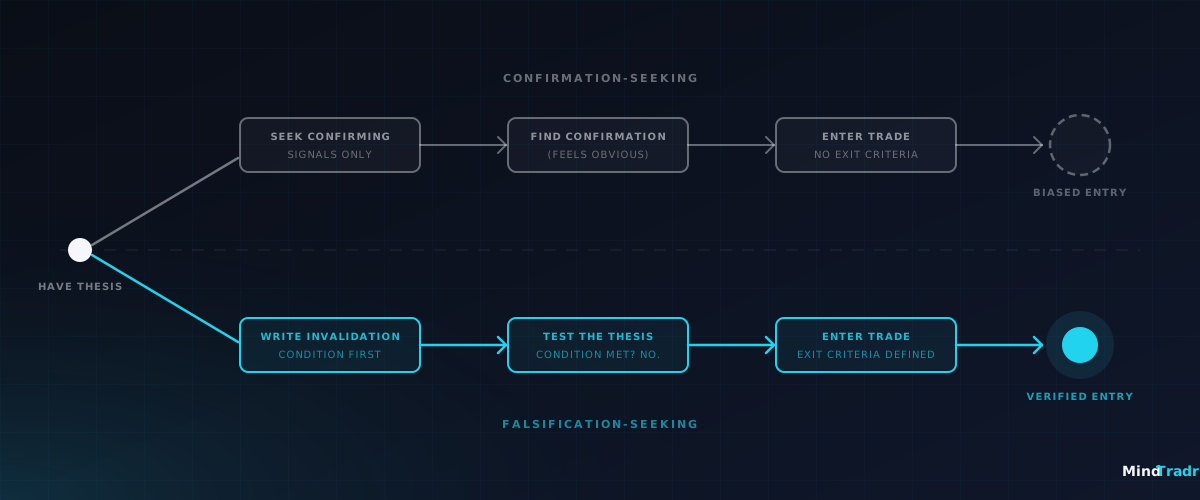
Partially. One technique with genuine cognitive science backing: consider the opposite hypothesis before entry, explicitly and in writing.
Make the bearish case as forcefully as you can. Write it down. What would have to be true for the short to be correct? What price action would invalidate this setup? What level, if breached, proves the thesis wrong?
This shifts the brain from confirmation-seeking to falsification-seeking. It doesn't eliminate confirmation bias — but it creates a competing cognitive process that gives contradictory evidence a fighting chance of registering.
The second lever is an analysis time limit. There's a well-documented effect where the longer you spend researching a setup, the more attached you become to it — the research itself creates the attachment. A rule like "if I've spent more than 30 minutes on this analysis, I require a written bearish case before I can enter" functions as a practical circuit breaker.
What Systematic Traders Do Differently
Traders who manage confirmation bias most effectively don't have less of it — they've built external systems that partially compensate for it.
The structural habit that makes the biggest difference: separate the research phase from the decision phase. Analysis happens with your thesis openly stated. The decision to enter happens only after a written bearish case has been reviewed. If the bearish case can't be convincingly dismissed in writing, the trade waits.
Tracking emotional states around your trade decisions adds another layer of signal. When you log your pre-trade mental state consistently, you can identify which conditions — high confidence, post-win enthusiasm, impatience — correlate with your most biased decisions. The bias doesn't disappear, but it gets flagged by your own data.
MindTradr builds this structure into the pre-trade entry: every position requires a stated invalidation condition before it logs as open. When you review the session afterward, you're comparing your actual exit behavior against your pre-stated criteria — not rationalizing backward from the P&L. MindTradr is the external record your in-session biased brain cannot rewrite.
The One Question That Interrupts the Loop
Before every trade, one question cuts through most of the bias:
"What would make me wrong about this?"
Not "what would change my target." Not "what would give me a reason to take partial profits." What would invalidate the entire thesis? Be specific. Write the answer down before you enter.
If you can't answer that question clearly, you don't have a trade — you have a directional bet dressed in setup language. Confirmation bias thrives in the absence of falsifiability. Give it one, and you've already interrupted the most dangerous part of the loop.