
FOMO vs JOMO: Learning to Love the Trades You Don't Take
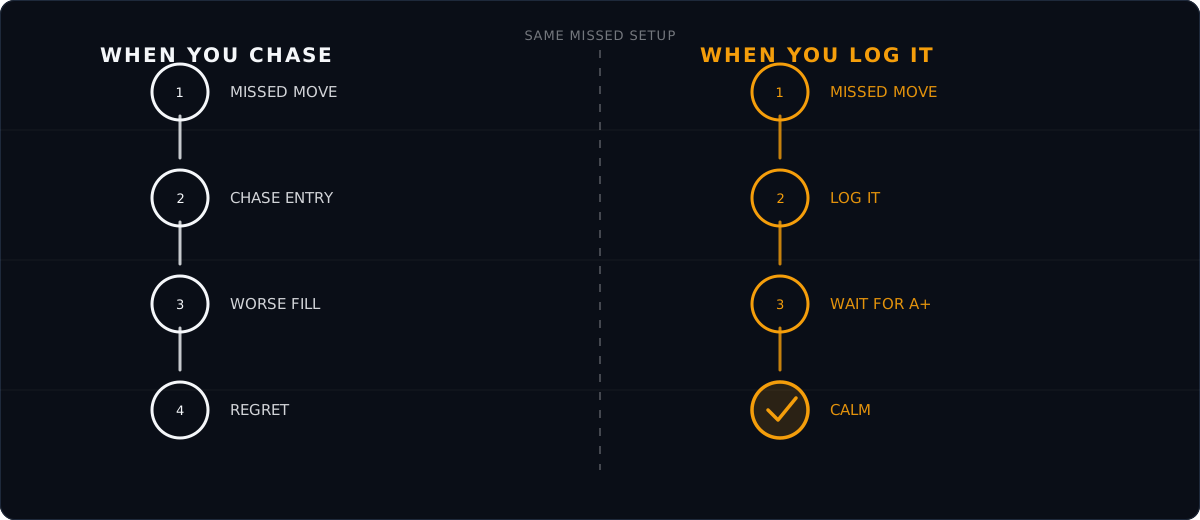
A setup runs without you. You watch the candle close, the move extend, and somewhere in your chest a familiar tightness shows up. That's FOMO. Now imagine the exact same missed move producing nothing at all — no tightness, just a shrug and a glance at the next chart. That's JOMO: the joy of missing out.
Most traders have felt both. Almost none of them know which one their brain defaults to, or that the default is trainable.
What FOMO and JOMO Actually Mean for a Trader
FOMO trading is the urge to enter a position not because you have an edge, but because something is moving and you can't stand watching from the sidelines. It's covered in depth in why traders chase moves they already missed — the short version is that your brain treats a missed move like a social threat, not a data point. That same social wiring is what makes comparing yourself to other traders so corrosive — it's FOMO stretched across an entire career instead of a single candle.
JOMO is the inverse response to the same trigger: a setup disappears, and instead of urgency you feel relief. Not because you don't care about money — because you trust that the next valid setup is more important than this particular missed one. JOMO isn't indifference. It's confidence that your process doesn't depend on catching every move.
The trigger is identical in both cases. The only thing that changes is the story your brain tells about what the missed move means.
Why Does Skipping a Trade Feel Worse Than Losing One?
This seems backwards until you look at the mechanism. A loss on a trade you took has a clean narrative: you took a risk, it didn't work, you move on. A trade you skipped that then runs has an open-ended narrative — there's no resolution, just an ongoing tally of "what I could have made," which your brain is free to inflate indefinitely.
Dr. Brett Steenbarger, who has spent decades working with professional traders on performance psychology, writes about this pattern as a byproduct of how attention works under uncertainty: an unresolved outcome keeps generating intrusive thoughts long after a resolved one has been filed away. A missed trade is unresolved by design — you'll never know exactly how it would have gone with your actual entry, size, and exit discipline applied. That open loop is what makes it feel worse than a clean loss, even when the math says otherwise.
The Setup You Didn't Take Is Still Doing Its Job
Here's the reframe that actually sticks: a trading plan's job isn't to catch every move, it's to filter out the moves that don't meet your criteria. When it filters out a move that happened to work, the plan didn't fail — it did exactly what a filter does. Filters reject some good things along with the bad ones. That's the cost of having a filter at all, and it's a cost worth paying given what the alternative looks like.
The test that separates a real miss from FOMO bait is the same one used for entries: can you write the setup in one sentence, after the fact, using only the information you had before it moved? If yes — clean range, valid level, volume confirming — then you skipped a trade that met your criteria late, and that's worth reviewing for next time. If the honest answer is "I didn't have a setup, it just started moving," there was nothing to miss. You can't have FOMO over a trade that was never valid in the first place.
How to Train the JOMO Response
You don't get JOMO by trying to feel calmer. You get it by changing what happens right after the urge shows up.
- Log every missed setup the same way you log a taken trade. Setup, level, why you didn't take it. This converts an open loop into a closed one — the act of writing it down is what your brain was missing, not the act of entering.
- Separate "missed because no setup" from "missed because hesitated." The first is your filter working. The second is useful information about your execution speed, not a reason to chase the next one harder.
- Review missed trades on a delay, not in the moment. Looking at a missed trade an hour later, after the emotional charge has faded, gives you an honest read on whether it actually met your criteria.
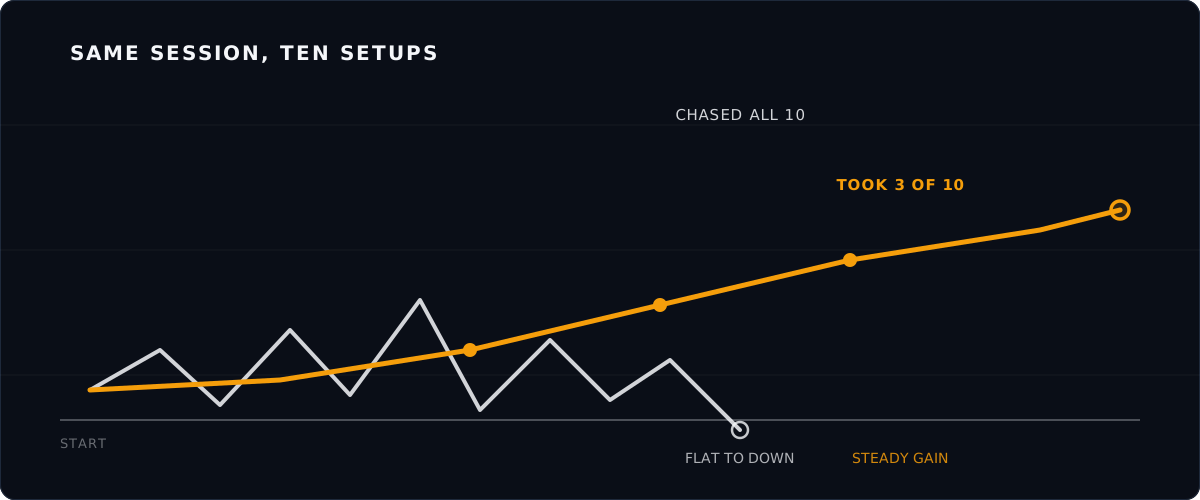
- Track the outcome distribution of trades you skip. Over enough logged setups, a pattern emerges: some skipped trades would have worked, some wouldn't have, and the skipped ones rarely look as one-sided in review as they felt in the moment.
That last point is the one that does the actual retraining. Position sizing tends to creep up right after a string of FOMO entries, because each chase feels like it has to make up for the last miss. Once you can see, in your own log, that missed setups aren't a uniform parade of money left on the table, the urgency behind chasing the next one starts to lose its grip.
FOMO and JOMO Are Both Just Data, If You Track Them
Jared Tendler, whose mental game coaching work treats trading performance as a skill built from logged patterns rather than willpower, makes a related point about tilt: the feeling doesn't go away because you decided it should — it goes away because you can finally see the pattern that triggers it. FOMO and JOMO are the same trigger pointed in opposite directions, and the only way to know which one is winning is to log both.
This is exactly the gap MindTradr is built to close. MindTradr is a trading psychology journal that lets you log skipped setups alongside taken trades, tag the reason you passed, and review how those missed trades actually resolved — so "FOMO vs JOMO" stops being a feeling you guess at and becomes a pattern you can see in your own history.
You won't catch every move. You were never supposed to. The traders who last are the ones who made peace with that and kept logging anyway.
If you want to start tracking the trades you skip — not just the ones you take — MindTradr is free to start.