
The Gambler's Fallacy: Why 'I'm Due for a Win' Is Costing You Trades
Four losing trades in a row. Same setup, same rules, same process — it just isn't working today. On the fifth one, something shifts. The market "has to" turn. You size up a little, just to make the recovery count.
That's not a trading strategy. That's the gambler's fallacy, and it's one of the most common — and most expensive — reasoning errors in trading psychology.
What Is the Gambler's Fallacy in Trading?
The gambler's fallacy is the belief that a random process becomes more likely to produce an outcome it hasn't produced recently. At a roulette table, it's betting red because black just hit five times. In trading, it's subtler but just as costly: believing a losing streak makes the next trade more likely to win — that the market, or the setup, "owes" you a reversal.
The trap feels more reasonable in trading than at a casino table, because markets aren't roulette wheels. Trends, momentum, and mean reversion are real phenomena. But your individual trade outcomes, if you're trading a defined setup with defined risk, are governed by that setup's edge under current conditions — not by how many times it failed you this week.
The Coin Flip Research Behind Why "I'm Due" Feels True
This isn't a new observation. Amos Tversky and Daniel Kahneman named the underlying mechanism in their 1971 paper Belief in the Law of Small Numbers: people expect small samples of random events to "self-correct" the way large samples do. Flip a coin four times and get four tails, and most people feel — wrongly — that heads is now overdue. Each flip is independent. The coin has no memory. Neither does the market's next candle.
The finding gets more interesting with real money on the table. In a 2005 study of actual casino behavior — The Gambler's Fallacy and the Hot Hand: Empirical Data from Casinos, by Rachel Croson and James Sundali — gamblers bet against recent streaks at meaningfully higher rates the longer a streak ran, even though the wheel's odds never changed. The same dataset showed the opposite error in how gamblers read their own winning runs. Both come from the same source: humans are pattern-detection machines, and truly random sequences don't provide the patterns we're built to find. Winning streaks have their own version of this trap — the gambler's fallacy and the hot hand fallacy are mirror images of the same flawed instinct.
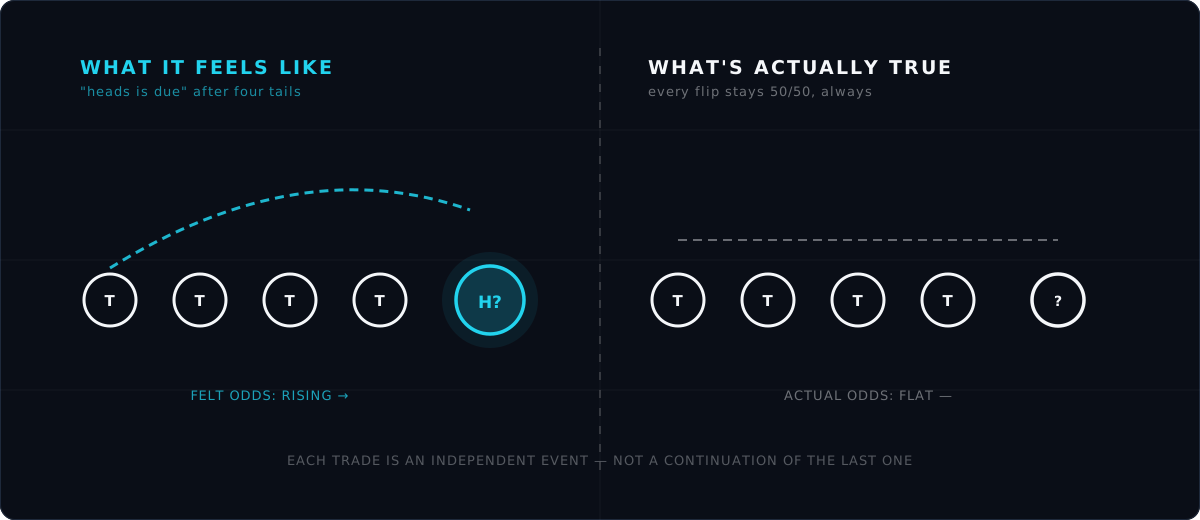
Why Does the Market Feel Like It Owes You a Win?
Because losing hurts, and the brain wants relief. A string of losses creates two things at once: a real dent in the account, and a felt sense of unfairness. "I've done everything right and it keeps not working" easily slides into "so the next one has to work." That's not analysis — it's the mind bargaining with probability to reduce discomfort.
The bargain is attractive because it doesn't require you to change anything. If the streak is simply "due" to end, you don't need to question your setup, your sizing, or your read of current conditions — you just need to keep going, maybe a little bigger, until the math evens out. Revenge trading after a loss runs on exactly this logic: the belief that undoing the loss is more urgent than reassessing the trade in front of you.
How the Fallacy Actually Shows Up in Your Trading
It rarely announces itself as "I believe in the gambler's fallacy." It shows up as:
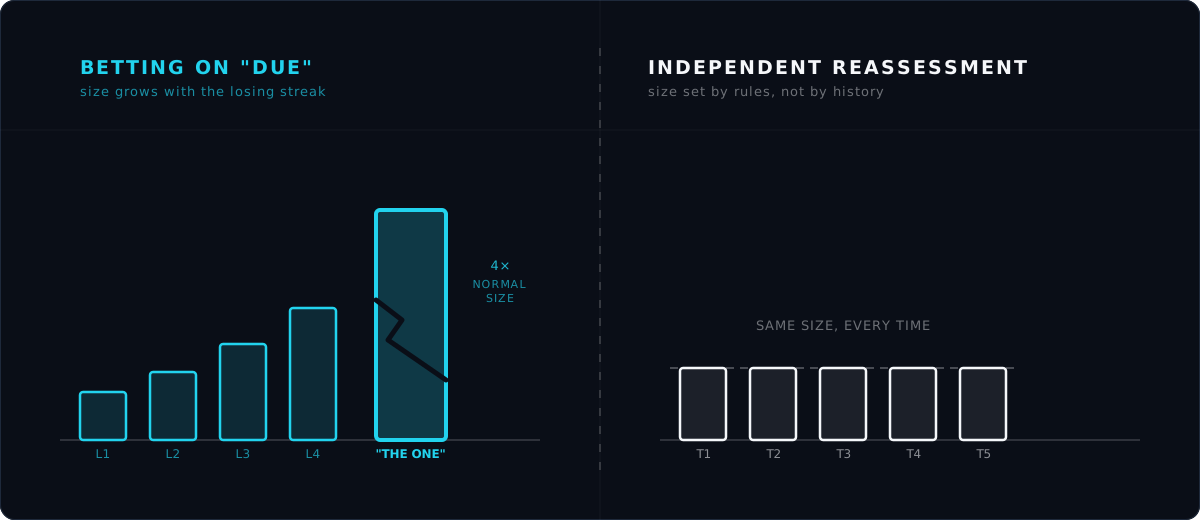
- Sizing up after a losing streak to "make the recovery trade count" — betting reversal is overdue instead of keeping size constant
- Averaging down into a losing position because "it's fallen enough, it has to bounce"
- Skipping your checklist on the next setup because "this one feels different after all those losses"
- Treating the next trade as a continuation of the streak instead of evaluating it independently, as if it inherits credit from the trades before it
None of these are irrational on their face. They only become the gambler's fallacy when the only justification is "it's been a while" — not a fresh read of the setup actually in front of you. It shares a root with a related trap: the illusion of control, where a trader believes their own attention or actions can influence a purely random-feeling outcome — different flavor of the same instinct to find a pattern, or a lever, where none exists.
Markets Aren't a Roulette Wheel — So Where's the Nuance?
Here's what makes this trap easy to fall into for traders specifically: markets genuinely do have streaks that mean something — trending regimes, volatility clusters, momentum. So "conditions have changed" is sometimes true. The mistake is treating the passage of losses as evidence that conditions have changed, rather than checking the conditions themselves. The mirror-image error is recency bias — reading a losing streak as proof the setup is broken and standing down from valid trades — where the gambler's fallacy bets on a reversal, recency bias bets the streak will simply continue.
The test is simple: would you take this exact trade, at this exact size, on a clean account with no history today? If yes — because the setup, level, and risk check out independently — take it. If the honest answer is "I've lost four in a row and this feels like the one," that's the fallacy talking, not your edge. Dr. Brett Steenbarger makes a related point in his writing on probabilistic thinking in trading: traders who separate the noise of individual outcomes from the signal of their process are the ones whose edge survives contact with a losing streak.
What Actually Helps
Fix your size before the session, not during it. Decide position size from your written rules before you see any setups — not adjusted mid-session based on how the last few trades went.
Journal the reason for each entry, not just the outcome. If you can't write a reason that doesn't reference your recent win/loss count, don't take the trade yet.
Track your post-loss trades separately. Reviewing entries that immediately followed a loss — tracking the emotional state behind each one — tends to reveal the pattern in a way memory alone won't. MindTradr logs position size and emotional state on every trade, which makes it possible to see, in hindsight, exactly which entries were reasoned and which were "due."
The gambler's fallacy is comforting because it turns bad luck into a countdown you can win just by staying at the table. Trading doesn't work that way. Every setup earns its own entry, on its own terms, no matter how many came before it.
If you want a clearer picture of which of your trades are process and which are "I'm due," MindTradr is free to start — no credit card, no commitment.