
Winning Streaks Lie: The Psychology of Hot Hands in Trading
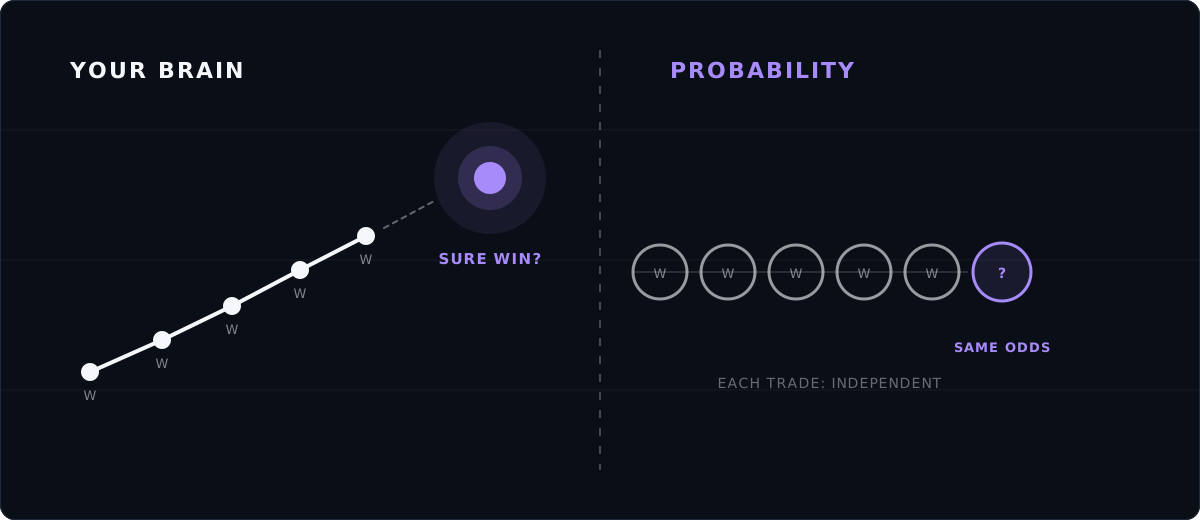
Five consecutive winning trades. The market feels legible. Your entries are crisp. You've finally figured something out.
That feeling is real. The conclusion it leads to — "I should size up, this streak is going to continue" — isn't.
What the Hot Hand Fallacy Is (and Why It Belongs in Your Journal)
In 1985, psychologists Gilovich, Vallone, and Tversky published a landmark study on basketball players — specifically on whether a player who had just made several shots in a row was more likely to make the next one. The answer shocked sports fans: statistically, no. The "hot hand" was an illusion. Sequential hits were distributed the same as random chance would predict.
Trading isn't basketball. Your edge isn't a fixed probability per shot. But the cognitive bias — the feeling that recent performance predicts near-future performance — operates exactly the same way in your decision-making. When you've strung together wins, your brain constructs a narrative: I understand this market. I'm in sync. The streak is evidence of superior execution.
There's a mirror-image version of this bias for losing streaks: the gambler's fallacy, the belief that a string of losses makes the next trade more likely to win. Both errors come from the same broken instinct — reading a pattern into a sequence that doesn't have one.
Some of that narrative may even be true. But you can't separate skill from variance during a five-trade window. That's the whole problem.
Why Winning Streaks Are the Most Dangerous Moments in a Session
Losing streaks attract attention. Traders journal their losses, review their setups, ask what went wrong. Winning streaks get celebrated — which means they get far less scrutiny than they deserve.
Here's what actually happens, cognitively, during a winning streak:
- Confidence outpaces evidence. Three wins provide almost no statistical signal about your edge — yet your subjective certainty about the next trade rises sharply.
- Stop discipline loosens. When you feel sharp, stops start to look like obstacles rather than rules. "This one's different. I'll give it more room."
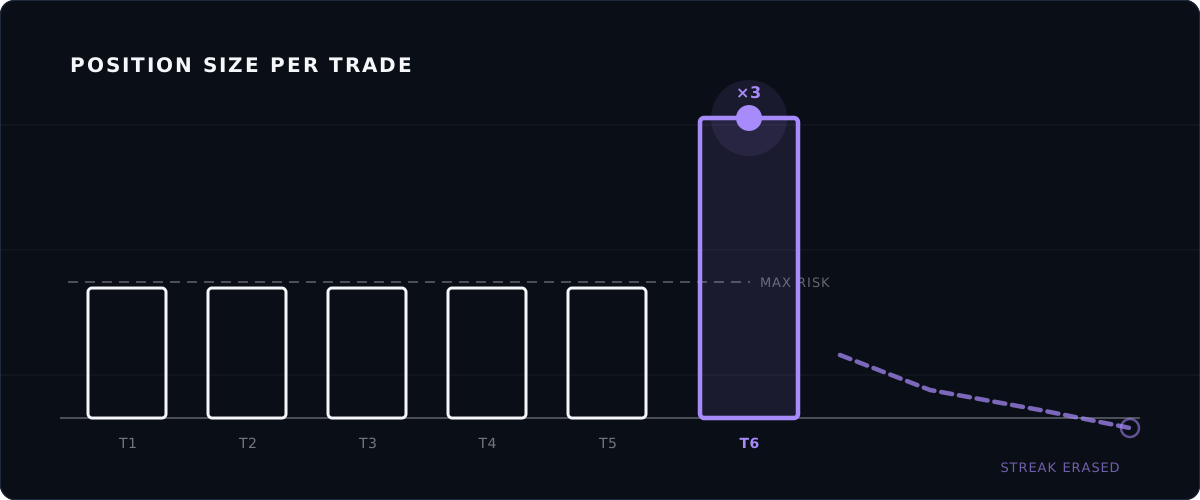
- Position sizes inflate. This is the fatal one. Each win adds invisible pressure to be bolder on the next trade.
The streak doesn't end on a loss. It ends on an oversized loss — the trade where you finally bet big because you were "sure." Position sizing under winning streaks is the exact mechanism that converts a hot streak into a devastating drawdown.
Is the Streak Real? How to Tell Variance from Skill
This is the legitimate question, and it deserves a direct answer.
Short streaks — three to seven trades — are almost always variance. Markets can cooperate with a specific style for days at a time without implying any improvement in your edge. If your setup works well in trending conditions and the market has been trending, you'll string wins together. When the regime shifts, the streak ends.
A longer run — twenty or thirty trades with consistently above-expectation results, across different market conditions — starts to carry real signal.
The honest test: would you trust this streak if the last five trades were losers? If a five-loss run would make you review your system, the five-win run deserves the same scrutiny. Same sample size. Same statistical weight.
Dr. Brett Steenbarger, who has worked extensively with professional traders on performance sustainability, makes this point in his writing on trading performance: consistency in process predicts durability, not consistency in recent outcomes. Results are noisy. Process isn't.
What Should You Do Differently When You're on a Streak?
The naive answer is "nothing — just keep executing." That's mostly right, but it misses a crucial step.
What you should actually do:
- Check your position sizes. Are they creeping up? Compare your last five trade sizes against your rolling average. If they're inflating, you're already in the danger zone.
- Read your journal entries from the winning trades. Are you following your rules precisely, or bending them in ways that happened to work this time?
- Pre-set the next session's size before you open a chart. The moment you decide position size while looking at a setup that "feels obvious," your streak has already compromised your risk management.
- Name the feeling. Write down: "I am on a five-win streak and I feel invincible." That act of labeling tends to interrupt automatic behavior before it becomes a decision.
Jared Tendler, whose mental game coaching framework is one of the most rigorous applied treatments of variance in performance contexts, describes this as the "tilt of winning" — the emotional state that causes overextension, not just the tilt of losing that traders typically guard against. Both states produce the same downstream effect: irrational deviation from process at the worst possible moment.
The Part of the Streak That Actually Matters
This isn't an argument for pessimism about winning streaks. They contain genuinely useful information — just not the information your instincts reach for first.
What a streak does tell you:
- Your style may be well-matched to the current market regime
- Your execution process is working — entries, sizing, exits are aligned
- Your emotional state is probably calm and focused, which helps performance
What a streak does not tell you:
- How the next trade will go
- That you should bet more aggressively
- That you've permanently upgraded your edge
The traders who protect winning streaks from becoming the setup for their worst drawdown are the ones who keep asking the same questions on trade 7 as they did on trade 1. Their size stays constant. Their process stays visible. Their journal keeps them honest.
MindTradr is a trading psychology journal that logs your confidence level, emotional state, and position size on every trade — so when you look back at a streak, you can see exactly when your sizing started to drift and what you were feeling when it happened. Trading after a big win involves the same cognitive hazard, and the same fix: your written record as the reality check that instinct reliably skips.
Streaks end. The only number that matters is how you were sizing when they did.