
How Much Money Do You Need to Start Trading? (Honest Answer)
Everyone asks this question and gets a different answer. $500. $2,000. $25,000. It depends entirely on who you ask and what they're selling.
The honest answer isn't a number at all. It's a ratio — and most beginning traders get the ratio wrong before they fund their first account.
The 1% Rule: Start With Risk, Not Capital
Before you can know how much capital you need, you need to decide how much you're willing to risk on a single trade.
The near-universal starting point is 1% of account per trade. If your account is $5,000, you risk $50 on any given trade. If the trade hits your stop, you lose $50 and the account absorbs it without drama. Run 100 losing trades in a row — statistically almost impossible with any real edge — and you're still in the game.
This isn't a rigid law. Experienced traders range from 0.5% to 2%, depending on strategy, conviction, and market. But 1% is the right starting point because it gives you enough runway to learn without a single mistake being catastrophic.
Now run the math backwards. Your minimum viable position size is the smallest trade you can actually execute in your target market, given lot sizes, commissions, and typical stop distances. If that minimum position requires $100 of exposure, you need $10,000 in your account for the trade to fit inside 1% risk. With $1,000, that same trade represents 10% of your capital. That's not managed trading — that's gambling with extra steps.
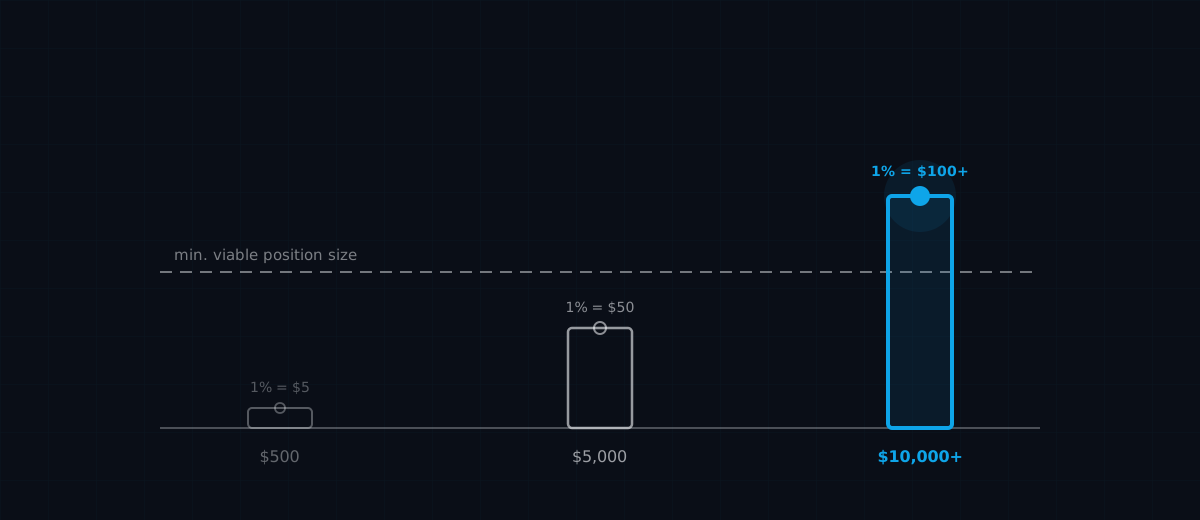
The number you're looking for is wherever 1% of your capital ≥ your minimum viable position size. That's your floor. The exact figure depends entirely on which markets you're trading and how they're structured.
Does the $25,000 Rule Apply to You?
If you're in the United States, trading equities, and planning to day trade, it might.
The Pattern Day Trader (PDT) rule, enforced by FINRA, requires a minimum $25,000 account balance if you execute four or more day trades within a five-business-day period in a margin account. Fall below that threshold and your broker restricts day trading until you deposit more.
This rule applies specifically to: US accounts, margin accounts, and equities or options. It does not apply to futures, forex, cryptocurrency, or cash-only equity accounts (though cash accounts have their own settlement-cycle constraints).
Most of the "$25,000 to start trading" advice you encounter is accurate for one narrow scenario: US equity day traders on margin. For everyone outside that box — swing traders, futures traders, forex traders, non-US traders — the rule is irrelevant. The 1% math is your real constraint, not any regulatory threshold.
The Psychological Minimum Is Different From the Mathematical Minimum
Here's what the math doesn't capture: you need to be able to afford to lose the starting balance.
Not "technically afford." Psychologically afford. Capital you can mentally write off as tuition if the first year goes badly behaves differently under pressure than capital you might actually need.
When the account contains money that genuinely can't be replaced, loss aversion fires at a different intensity. Stops get moved "just this once." Position sizes become emotional rather than mathematical. This is also why trading a small account is emotionally harder than a large one — the smaller the balance, the bigger every normal loss feels as a percentage of it. Jared Tendler, who coaches professional traders on the mental game, argues in The Mental Game of Trading that the perceived replaceability of capital is one of the most underappreciated variables in execution quality. When a loss feels genuinely unrecoverable, rational risk management gets overridden by something closer to survival mode.
The question to ask yourself: Could I look at this account at zero and call it tuition? If the honest answer is no, you're not trading with available capital — you're trading with money that belongs to your nervous system, not your strategy.
The Prop Firm Path: Trade Without Providing the Capital
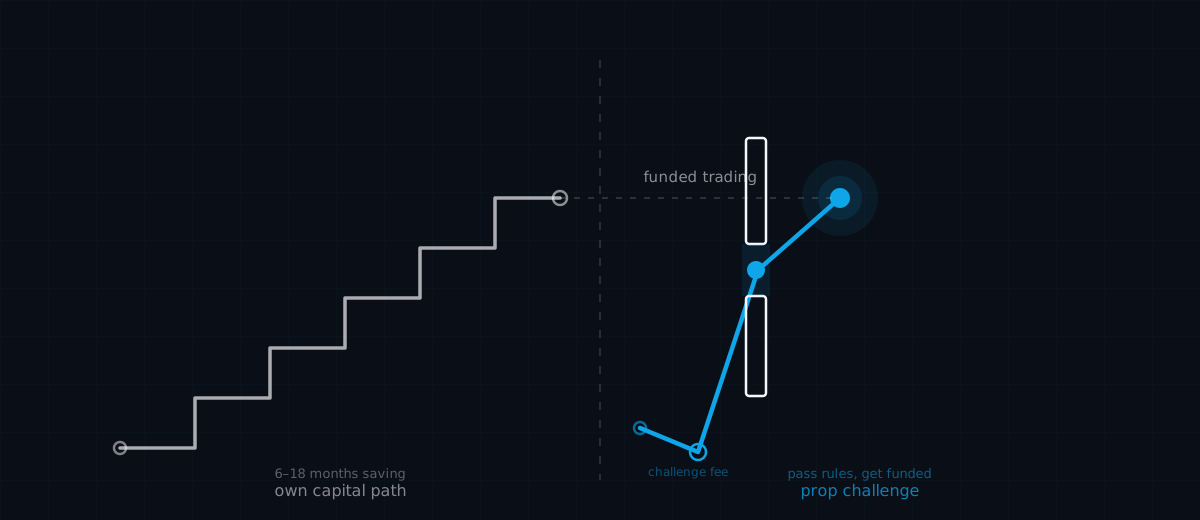
If you have the process but not the capital, funded trader programs offer a structural alternative.
You pay a challenge fee (typically $50–$500 depending on account size), trade a simulated account under defined rules — profit target, maximum drawdown limit — and upon passing, receive access to a funded account where you keep a percentage of the profits.
The appeal is structural: you're tested on process, not on your ability to fund a large account. The catch: prop challenges are genuinely demanding, and the psychology of trading a prop firm challenge is distinct from regular self-funded trading in ways that catch most applicants off guard.
What to Do When You Don't Have Enough
Starting undercapitalized is worse than waiting. A $200 account with 10% risk per trade isn't learning to trade — it's learning habits that will actively hurt you once you're managing real size, because position sizing at those ratios forces you to behave irrationally just to participate.
The better path with limited capital:
- Trade a demo account with realistic sizing discipline. Paper trading doesn't replicate the psychology of real stakes, but it builds mechanical fluency: platform execution, setup recognition, process habits. Use it for what it's good for.
- Save toward a capital base that makes 1% risk viable for your target market. There's no shortcut — the number is whatever makes the math work.
- Log the emotional difference when you eventually go live. The gap between your demo behavior and your live-money behavior is your actual learning edge. MindTradr is a trading psychology journal that tracks your emotional state, sizing discipline, and rule adherence on every trade — so that gap becomes visible as data you can act on, not a vague sense of being worse than you should be. Start free before your first live trade.
Your Actual Number
Here's the calculation:
- Identify your target market
- Find the minimum viable position — smallest trade, typical stop distance, net of commissions
- Divide that position size by 0.01 (your 1% risk limit)
- That's your minimum starting capital
For US equity day traders: add the $25,000 PDT requirement on top of whatever that math produces.
For everyone else: the 1% math is the only constraint that matters, and getting it right before you fund the account is among the most useful things you can do with the time you spend saving toward it.
Risk-reward ratio is the other side of this calculation: once you know how much you're risking per trade, your target R:R tells you what edge you need to be profitable over time. Position sizing psychology explains why traders who calculate these numbers correctly often break the rules the moment a setup feels like it deserves more.
The capital question has a formula. The discipline question is harder — and it starts the moment the first real dollar is on the line.