
Small Account, Big Emotions: Why Trading $500 Is Harder Than $50,000
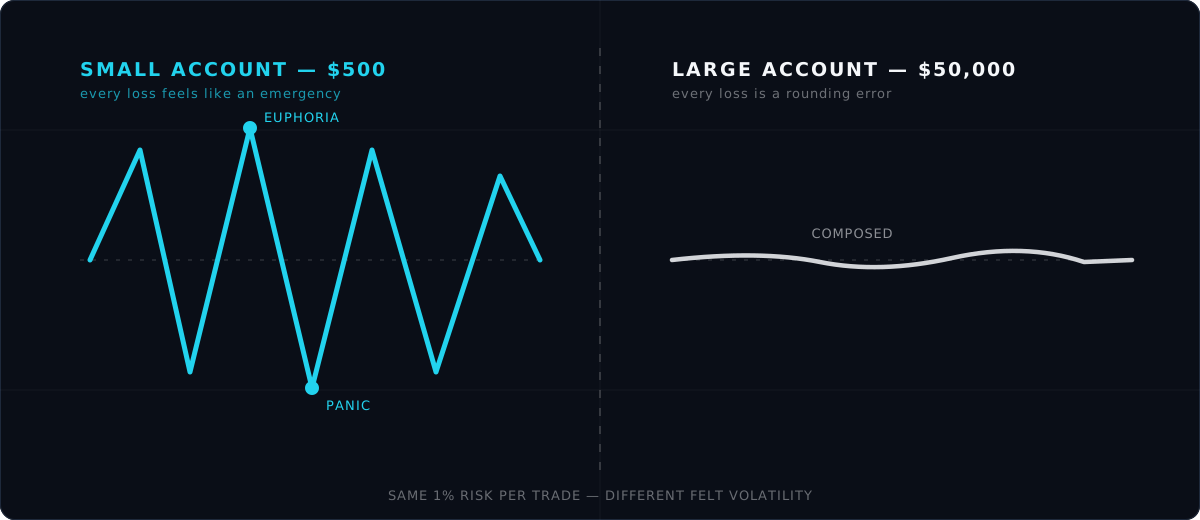
A $50 loss lands. On a $50,000 account you'd never feel it — a rounding error, gone by the next candle. But this is a $500 account, and that same $50 just took a tenth of everything you have. Your chest tightens, your next order gets bigger, and a trade you'd have skipped an hour ago suddenly looks like the one that makes it back.
Nothing about the market changed. What changed is the size of the number relative to your account — and your nervous system runs on the relative number, not the absolute one. That's the whole problem with a small account: the dollars are smaller, but the emotions are bigger.
Why a Small Account Feels Bigger Than It Is
This isn't about how much money you need to start — that's a capital-and-ratio question I've covered separately in how much money you need to start trading. And it isn't the streak-driven sizing problem from position sizing psychology, where wins tempt you to size up. This is narrower and sneakier: even trading correctly, at fixed risk, a small account punches your emotions far above its weight.
Here's why. Your brain doesn't process P&L in dollars. It processes it in percent of what you have — and it processes losses far more loudly than gains, which is the core of loss aversion in trading. On a small account, every honest, by-the-book loss is a large percentage event, so it hits with the emotional force of a disaster even when it's a perfectly normal outcome.
The trader with $50,000 risking 1% loses $500 and shrugs. The trader with $500 risking that same 1% loses $5 — and should shrug too. But almost nobody trades $500 at 1%. Five dollars a trade feels pointless, so the small-account trader risks 10%, 20%, sometimes half the account on a single idea. Now every loss is genuinely account-threatening, and the emotions are telling the truth.
Why Is Trading a Small Account Harder Than a Large One?
Because a small account quietly forces you into oversized risk, and oversized risk is where composure goes to die.
The math is brutal but simple. To make a small account "feel worth it," you crank up risk per trade. High risk per trade means:
- Each loss is a big chunk of the account, so it triggers a genuine survival response — tunnel vision, racing pulse, the urge to fix it now.
- Recovery math turns vicious. Lose 20% and you need +25% to get back. Lose 50% and you need +100%. The deeper you dig, the steeper the climb.
- You can't take enough trades to let your edge play out, because two or three losers in a row can end the account before probability has a chance to work.
So the small-account trader isn't emotionally weaker — they're operating in conditions that would rattle anyone. The account structure manufactures the panic.
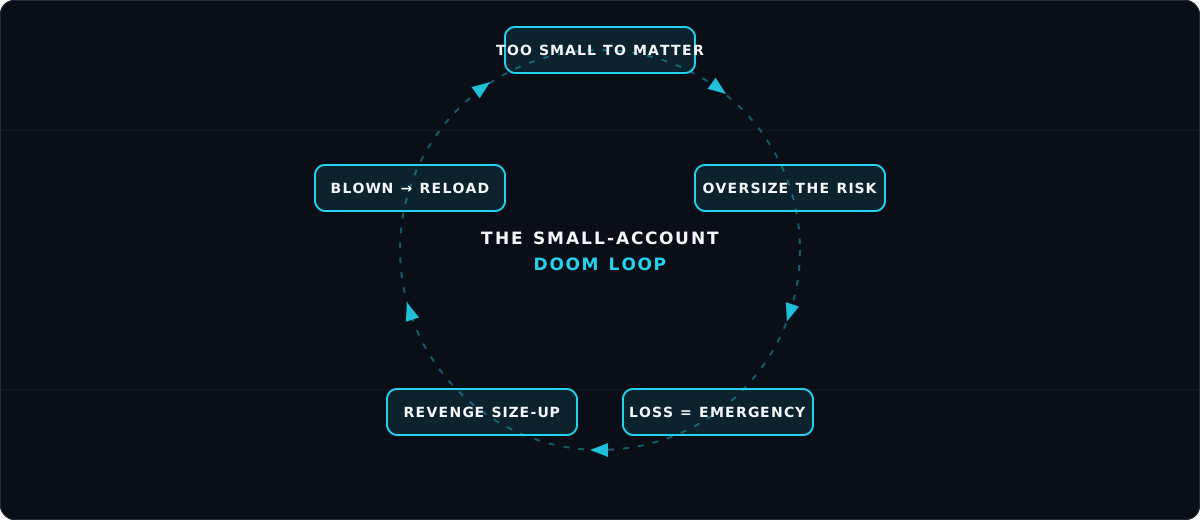
The Small-Account Doom Loop
Left unmanaged, a small account doesn't just feel worse — it drives a self-reinforcing spiral that most blown accounts follow step for step:
- The account feels too small to matter, so you risk a big slice per trade to "grow it fast."
- A normal loss lands hard because it's a big percentage of the account.
- The loss feels like an emergency, so you size up further to make it back in one move — the exact setup for revenge trading after a loss.
- Variance does what variance does, and two or three of those oversized trades in a row end the account.
- You reload another small account, and the loop starts again — same size, same panic, same result.
The loop isn't a character flaw. It's what happens when the account is too small for the risk you're taking, and the felt urgency of a small balance keeps pushing that risk higher.
How to Trade a Small Account Without Losing Your Head
You don't fix this by feeling calmer on command. You fix it by changing the conditions that make you panic:
- Risk in percent, not dollars. Pick a fixed fraction — 1% to 2% — and let the dollar amount be as small as it is. Five dollars of risk that keeps you in the game beats fifty that ends it.
- Reframe the goal. A small account's job isn't to make you rich. It's a flight simulator for your process — the place to prove you can execute the plan before the numbers get real.
- Judge the process, not the balance. Score whether you followed your rules, not whether the account grew this week. On a small account, one good trade barely moves the balance, so the balance is a terrible scoreboard.
- Log the emotion, not just the trade. Note your mood, sleep, and stress next to each entry, so you can see when a big-percentage loss — not a real edge — is driving your next click.
That last one is where the trap becomes visible. In MindTradr, you log your emotional state, sleep, and stress alongside each trade, so you can look back and see which entries were clean reads and which were your small balance screaming at you to make it back. It's the same composure muscle behind every other part of the process (more on that in trading composure) — and it's exactly what Mark Douglas argues in Trading in the Zone (2000): consistency comes from treating each trade as one sample in a long series, which a small account, with its loud losses, makes almost impossible to feel until you deliberately practice it. Brett Steenbarger makes the practical version of the point on his TraderFeed blog: trade small enough that your decisions stay rational, then scale only as your process — not your impatience — earns it.
A small account isn't a smaller version of a big one. It's a harder version, and the traders who survive it are the ones who protect their composure before they try to grow the balance.
MindTradr is a trading psychology journal that logs your mood, sleep, and stress next to your trades, so you can see when the size of your account — not your edge — is steering your decisions.
If you want to trade a small account without letting it trade you, MindTradr is free to start.