
Loss Aversion in Trading: Why Losing $1,000 Hurts More Than Winning $1,000 Feels Good
You just hit your stop. The trade cost you $400. That number doesn't feel like $400 — it feels considerably larger.
Meanwhile, the $550 winner you closed three days ago has already faded to background noise. The loss is still there, vivid, playing in a loop. The math says you're ahead. The feeling says otherwise.
This is loss aversion, and it is not a personality flaw. It is one of the most documented patterns in behavioral science, and it shapes almost every trading decision you make.
What Loss Aversion Actually Is
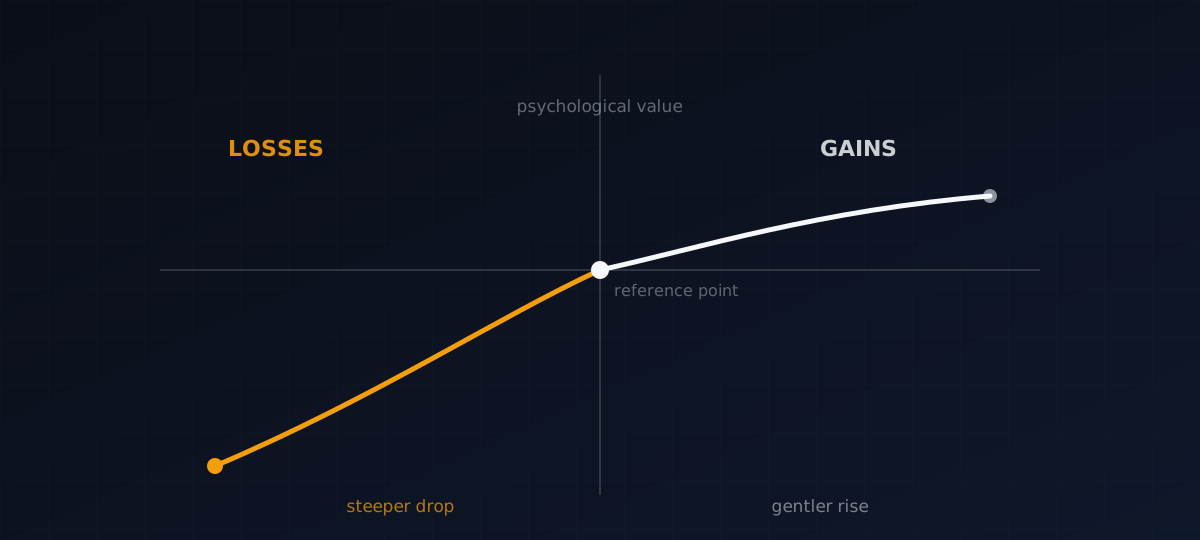
In 1979, Daniel Kahneman and Amos Tversky published "Prospect Theory: An Analysis of Decision under Risk" in Econometrica — a paper that changed how economists and psychologists understood human decision-making under uncertainty. One of its central findings: the psychological pain of losing a given amount is meaningfully greater than the psychological pleasure of gaining the same amount.
The value function is asymmetric. Below the reference point (usually your entry price, your current account balance, or last session's close), the curve drops more steeply than it rises above it. Losses loom larger. The brain treats a $400 loss and a $400 gain as qualitatively different events — not just arithmetically different ones.
This is not timidity. It shows up consistently across cultures, experience levels, and income brackets. Traders who have been in the markets for years still carry it. It is a feature of the cognitive architecture that runs under the strategy.
Why Your P&L Doesn't Feel Proportional
Because of this asymmetric value function, your emotional ledger never adds up the same way your financial ledger does.
A string of small wins followed by one moderate loss will feel like a terrible week — even if the week was net positive. A losing month followed by recovery feels harder than the equivalent winning month felt good. The brain does not average out; it weights the loss entries more heavily.
More dangerously, the asymmetry distorts how you evaluate open positions in real time. When a trade is profitable, your reference point shifts upward and any pullback registers as a potential loss from that new peak. When a trade moves against you, the threat response activates — and it escalates the longer the position runs against the plan.
Traders who track their emotional state report this directly: sitting in a losing trade feels urgent in a way that sitting in a winning trade simply does not. That urgency is not a market signal. It is coming from the loss aversion response, and it often arrives before any rational case for action exists.
How It Shows Up in Your Actual Trades
Loss aversion produces two specific, observable patterns in trading execution.
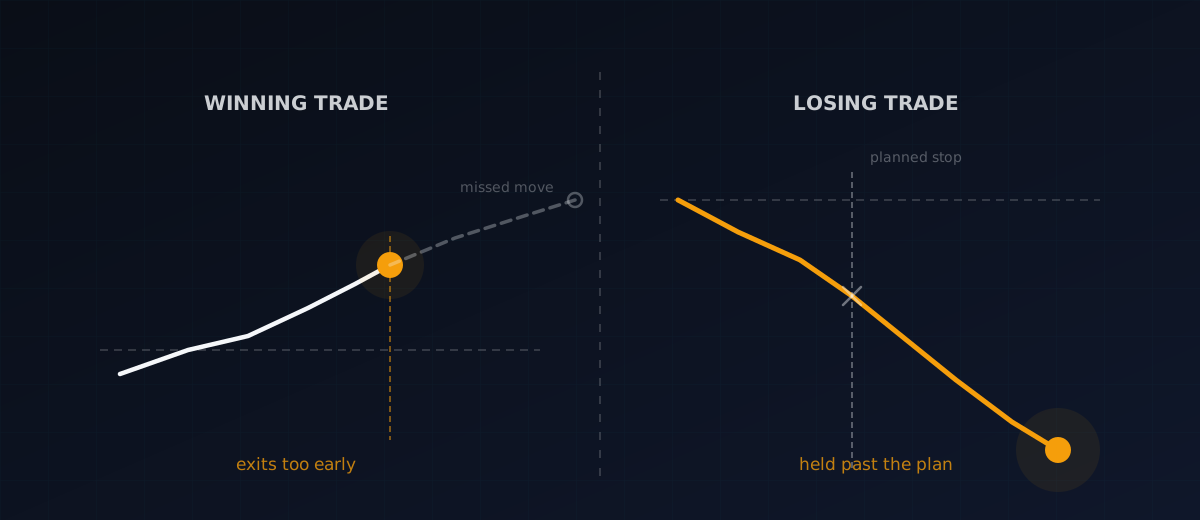
Cutting winners too early. Once a trade is profitable, loss aversion applies forward pressure: the fear of losing the current gain. The unrealized profit becomes a new reference point, and any adverse tick registers as a loss relative to that peak. The result is exits well before the target, at the first sign of hesitation in price, driven by the urge to lock in before the gain disappears. This is not discipline. It is avoidance of loss from a shifted reference point.
Holding losers past the plan. Closing a position that is underwater converts an unrealized loss into a real one — and that finalization is psychologically costly in a way that staying in the position is not, at least not yet. The brain resists exit. Many traders will hold a position well past any rational basis for the original thesis, not because new information supports the hold, but because exit means accepting the pain the open position is only threatening.
The practical result of both patterns combined: profits get cut short and losses get extended. This is the exact inverse of sound risk management, and it is the natural behavioral output of a loss-averse cognitive system applied to live markets.
Mark Douglas addresses this pattern directly in Trading in the Zone — his argument that consistent execution requires a probabilistic mindset is, in large part, an argument for building systems that bypass the real-time loss aversion override.
Is Loss Aversion Always the Enemy?
Not entirely. Some sensitivity to downside risk is a legitimate function of good risk management. Traders who feel no emotional response to losses often have a different problem: they take risks without adequate feedback, and the feedback loop that should deter reckless sizing simply does not fire.
The issue is not having loss aversion. The issue is when it overrides the plan at the exact moment the plan was designed for. Most trading systems fail not in their design but in their execution — specifically in the live moments when loss aversion takes over and rewrites the decision in real time.
The tell: you move a stop loss further away without any new information about the trade thesis. You are not adjusting for the market; you are adjusting to delay the emotional cost of finalization. The loss that was $300 just became $500 while you were managing the feeling.
For what happens after the stop finally does get hit — and loss aversion pushes toward immediate re-entry to "get it back" — the revenge trading psychology cycle starts exactly there.
What You Can Actually Do About It
Loss aversion does not disappear through self-awareness. But you can build structure that limits its influence on execution.
Pre-define your exits before the trade. When stop and target levels are set before you are emotionally invested in the outcome, exit becomes automatic rather than discretionary. The in-the-moment loss aversion response fires anyway — but it has nothing to act on. The decision has already been made by a calmer version of you, and execution follows the earlier plan. This is why pre-defined mechanical stops are more reliable than mental stops in practice: not because the levels are better calibrated, but because they bypass the override.
Track exit pattern across sessions, not just trade entries. Many traders analyze entry quality carefully and never examine the pattern of actual exits. Logging the reason at exit — did this trade close because the thesis failed, or because the position was uncomfortable? — is what builds the data to identify loss aversion in your own behavior. After enough sessions, patterns become visible that are impossible to catch in the moment.
Reframe what you are measuring. Instead of tracking open P&L relative to entry, evaluate the trade relative to the planned maximum risk. You are either at 1R, within your risk, or not. Whether the position is currently up or down is noise about the path, not information about whether the original thesis is intact.
MindTradr is built around this kind of behavioral documentation — logging not just what the trade did, but what you did and why. MindTradr is a trading psychology journal designed to make invisible biases like loss aversion visible in your own data, so you see the pattern across sessions rather than just feeling it in the moment. If loss aversion is systematically cutting your winners short and extending your losers, the data surfaces that before your account balance has to.
For more on how stop placement decisions get distorted under loss aversion pressure, stop loss psychology covers the specific mechanics of why moving stops is so compelling in the moment and so costly over time.
The feeling that losses hurt more than gains help is not irrational. It is deeply calibrated, just for a different environment. The work in trading is building systems that keep that calibration from making your execution decisions.
If you want to start tracking what your exits actually reflect — the plan or the feeling — MindTradr is free to start.