
Trading Composure: The Skill That Actually Compounds
The trade is 40% underwater and moving the wrong way. Your stop is still where you put it, the thesis hasn't actually broken — but your chest is tight and your cursor is hovering over the exit button anyway. Some part of you wants to close it just to make the discomfort stop.
What you do in the next ten seconds isn't a strategy question. Your system already told you what to do. This is a composure question — whether you can hold a plan while your nervous system is screaming at you to abandon it.
That skill, more than any setup, is what separates the traders who last.
What Trading Composure Actually Is (And What It Isn't)
Trading composure is the ability to keep your decisions attached to your process while under emotional load — a drawdown, a fast tape, a trade that's printing green and daring you to get greedy.
It's easy to confuse with two neighbors, so let's separate them cleanly:
- Composure is not discipline. Discipline is the system you build in advance — the checklist, the fixed size, the session end time. Composure is what lets you execute that system when your heart rate is up. You can read more on building the system itself in discipline vs motivation; this post is about the moment the system meets your nerves.
- Composure is not the absence of emotion. Composed traders still feel fear and greed. They just don't act from those states automatically. The failure mode where emotion fully hijacks the wheel has its own name — trading tilt — and composure is precisely the muscle that keeps you from getting there.
Put simply: discipline decides what you'll do, composure determines whether you actually do it when it's hard.
Why Composure Is the Skill That Compounds
Most traders spend years hunting a better edge. But an edge is a fixed asset — once you have a valid one, refining it gives diminishing returns. Composure is different: it multiplies whatever edge you already own.
Here's the mechanism. Your realized results are your edge minus the leakage from decisions made in compromised states — the widened stop, the revenge re-entry, the size-up after a win. Every unit of composure you gain shrinks that leakage across every future trade you'll ever take. That's what compounding means: the same skill paying off thousands of times.
A trader with a mediocre edge and high composure will quietly outlast a trader with a great edge who blows up his risk model twice a year. The market doesn't pay you for knowing the right move. It pays you for making it under pressure.
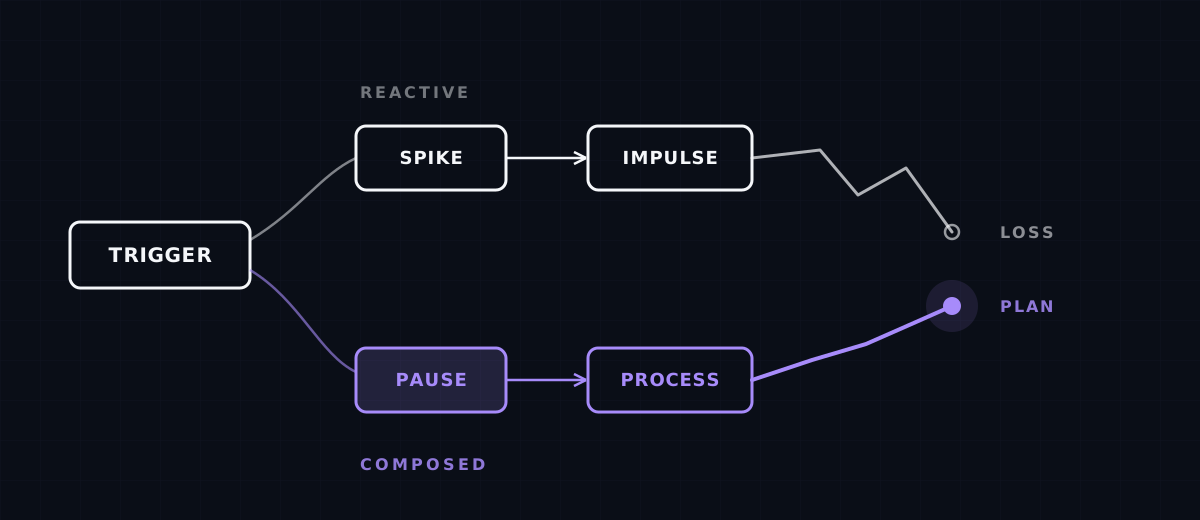
What Does Losing Your Composure Actually Cost You?
Run the tape on a single ordinary bad moment. A trade goes against you, composure slips, and you move the stop "just to give it room." Now trace the second-order damage:
- You've turned a planned, small loss into an unbounded one.
- You've taught your brain that stops are negotiable, making the next override easier.
- You've corrupted your journal data — the loss no longer reflects your actual system, so the feedback loop learns nothing.
The direct cost is the extra money on that one trade. The real cost is the three habits you just reinforced. Composure failures aren't isolated events; they compound in the wrong direction exactly the way composure gains compound in the right one.
This is why staying level is a risk-management tool, not a soft skill. The best stop-loss in the world is worthless the moment you decide, mid-trade, that it doesn't apply today.
How to Build Trading Composure Rep by Rep
Composure isn't a personality trait you either have or don't. It's trained the way any state-regulation skill is trained — under controlled load, in reps, with feedback. A few things that actually move it:
- Pre-decide the pressure moments. Write down, before the session, exactly what you'll do when a trade hits your stop or runs 2R in profit. A decision made cold holds far better than one made hot.
- Name the state out loud. "I'm feeling FOMO right now." Labeling an emotion measurably reduces its grip — it shifts you from being the feeling to observing it. This is the practical core of what Mark Douglas calls trading without fear in Trading in the Zone.
- Insert a physical pause. One slow breath before any unplanned action. It's not woo — it's the two seconds that let your prefrontal cortex get back in the room before your amygdala places the order.
- Review the moment, not just the P&L. After the session, ask where composure slipped, not just whether you were green. The trade outcome is noise; the state you were in when you decided is the signal.
Trading coach Brett Steenbarger, who has worked with prop and hedge fund traders for decades, argues on his blog that emotional self-control isn't about suppression — it's about building enough self-awareness that your states become information instead of commands. That reframe is the whole game.
Composure Lives in the Gap Between Trigger and Trade
There's a gap between what happens to you and what you do about it. When you're reactive, that gap is zero — trigger and action are the same event. Building composure is the slow work of widening that gap until there's room to choose.
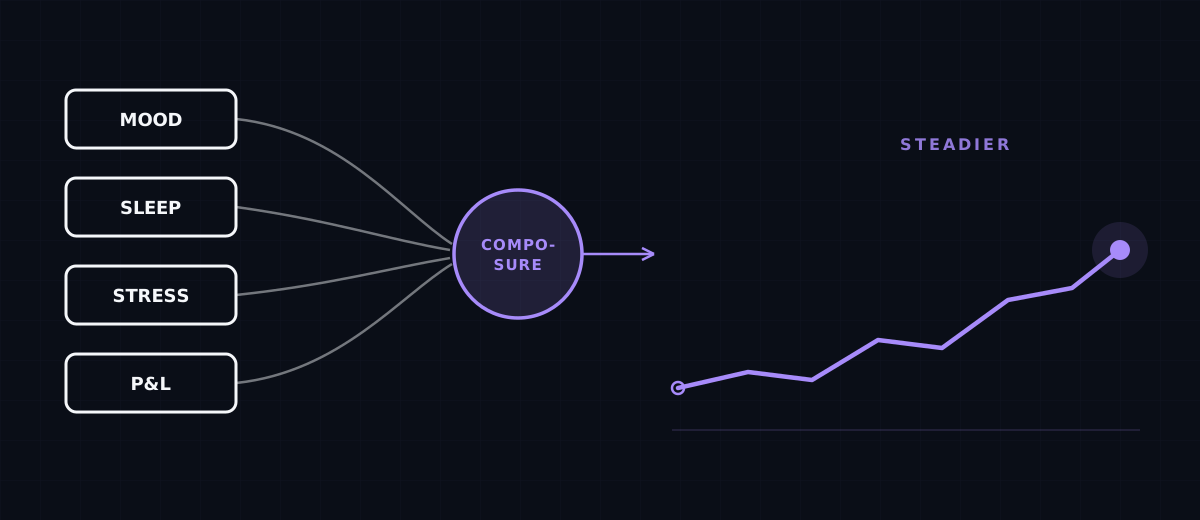
You widen it by making the gap visible. That's mostly a tracking problem: if you only log entries, exits, and P&L, your compromised moments disappear into the numbers. Log the state alongside the trade — your mood, your sleep, your stress level going into the session — and the pattern behind your worst decisions stops being invisible.
This is exactly the loop MindTradr is built around: you record how you felt next to what you did, so the correlation between a short-sleep, high-stress morning and a blown stop becomes something you can see across weeks instead of re-discovering trade by trade. Related work on why you should track your emotions goes deeper on the logging habit itself.
Composure is quiet. It doesn't feel like winning — it feels like nothing happening when something wanted to. But run that "nothing" across a thousand trades and it becomes the largest edge you'll ever build.
MindTradr is a trading psychology journal that logs your emotional state, sleep, and stress alongside your P&L, so you can see which mental states break your composure — and trade from a steadier one.
If you want to start tracking the states behind your decisions, not just the decisions themselves, MindTradr is free to start.