
Discipline Beats Motivation: Building a Trading Practice That Survives Bad Days
Every trader knows this moment: the book fired you up, the video clicked, the big win convinced you to commit. You feel it — that clean, electric certainty that this time it will be different.
Then Tuesday comes. The setups are murky. You're tired. The last two trades stopped out and nothing new is setting up. The plan says stay at the desk until 11:30. Everything in you says close the laptop and try again tomorrow.
What you do in that moment decides far more about your long-term results than anything that happens on a good day. Whether you do it comes down to one question: are you running on motivation, or on systems?
Why Motivation Is the Wrong Foundation for a Trading Career
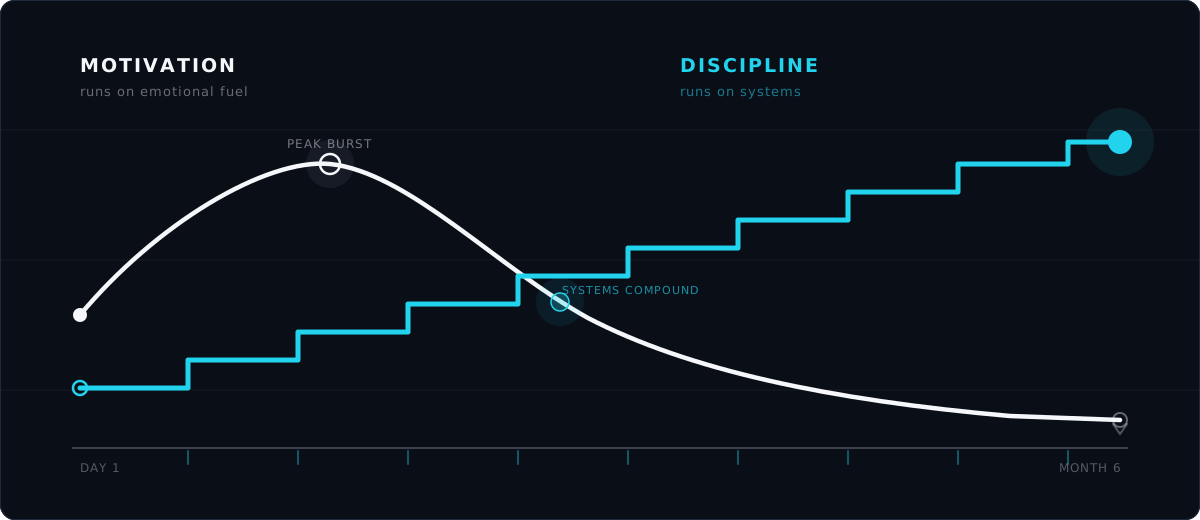
Motivation is an emotional state, and emotional states are reactive, intermittent, and unreliable on a schedule. They peak after wins, after reading someone else's results, after a strong morning and a clean chart setup. They bottom out on grey days when nothing is working and the market feels genuinely random.
The problem isn't that motivation is weak. It's that it's unpredictable. You can't know when it will show up or how long it will stay. And the market doesn't wait for it.
Discipline is the alternative — not a feeling but a set of behaviors you execute regardless of how you feel. The pre-market scan runs whether you're energized or dragging. The journal entry closes the session whether the trade was a winner or a blowout. The position size stays fixed whether you feel sharp or foggy.
James Clear, in Atomic Habits, frames this precisely: you don't rise to the level of your goals, you fall to the level of your systems. For traders, the system is the discipline. Consistent profitability is the byproduct of that system running — including on the days you'd rather not show up.
The Real Test: What Happens on Bad Days
You can evaluate any trading practice by how it behaves when you least want to follow it.
Bad days come in predictable forms: the session after a losing trade, the stretches when the market's rhythm doesn't match your style, the weeks when sleep has been bad and focus is shallow. Every trader has them. The difference between traders who compound over years and those who wash out isn't how they trade on good days — it's what they do on the bad ones.
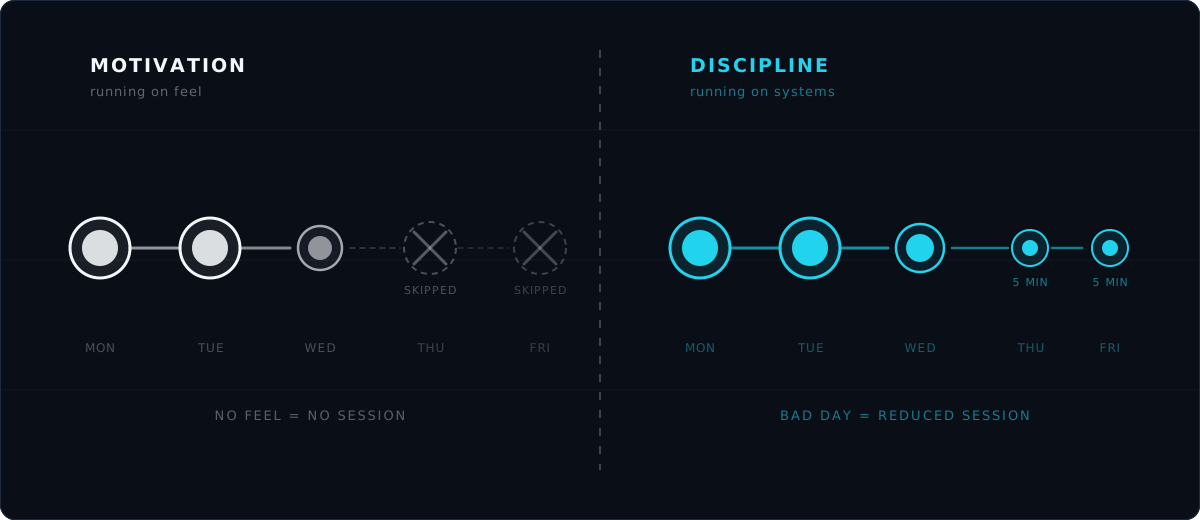
The motivation-based protocol on a bad day is effectively nothing. If the feeling isn't there, the session gets skipped. The journal doesn't get filled. The pre-market scan doesn't happen. Each skip is low-friction in the moment and high-cost in aggregate: the missing data breaks the feedback loop, and without the feedback loop, the bad days teach you nothing.
The discipline protocol on a bad day is different: reduced but unbroken. A five-minute pre-market scan instead of thirty. Two sentences in the journal instead of a paragraph. A position traded at minimum size just to maintain contact with the process. The goal isn't to perform well on a bad day — it's to not erase yourself from the system entirely.
That gap is what compounds.
What "Trading Discipline" Actually Looks Like
Discipline sounds abstract until you define it as specific behaviors. And it isn't willpower — willpower depletes under stress, precisely when you need it most. Discipline is external structure built before the bad day starts.
Concrete examples:
- A pre-session checklist that runs on a fixed trigger. Not an inspiring checklist — a procedural one. Check bias, identify setups, note key levels. Two minutes. Same every session.
- A fixed session end time. The session ends at a clock time, not when you decide you're done. This removes in-session negotiation with yourself about "just one more look."
- A journal entry as the last action of every session. Not a long entry. A date, one sentence about session quality, a P&L figure. Closing the loop matters more than the depth of what you write.
- Position sizing set in advance. Your size doesn't change based on recent performance. You decide it before you open a chart — before you see a setup that feels obvious.
A daily trading routine built around these behaviors doesn't need motivation to run. Once the habit is encoded, the behaviors fire on their own — the procedural system runs in place of the motivational one.
Does Motivation Help at All?
Yes — but for design, not execution.
The energy spike after a breakthrough insight, after studying your setups, after a session that finally clicked — use that state to build the structures that will run in its absence.
When motivation is present:
- Write the pre-session checklist you'll actually follow on a hard day
- Set session time limits and put them in your calendar as non-negotiables
- Build the journal template that's fast enough to use when you're drained
- Decide position sizes for the next quarter, in advance, before you've seen the results
When motivation is present, you're building for the future version of yourself who won't have it. That's the right use of it. Not trade execution. Not sizing decisions. Not whether to stick to the rules today.
Brett Steenbarger, who has coached professional and prop traders for decades, makes a version of this point consistently on his blog: sustained performance in trading comes from sustained process, not sustained motivation. The mental edge is structural, not emotional.
The Journal as a Discipline Mechanism
A trading journal isn't a motivational tool — it's a closed-loop feedback system. And the feedback loop only works when the data is continuous.
Overtrading, revenge entries, impulsive size-ups — these patterns almost always look different in the journal than they feel in the moment. But the pattern only shows up in complete data. Journals kept only on good days, or only when motivated, produce gaps that hide the exact behaviors causing the losses.
The traders who plateau are often the ones who journal selectively. The traders who improve journal every session regardless of quality, because the pattern — when it appears — is always in the consistent data.
MindTradr is a trading journal built around this feedback loop — log your emotional state, setup quality, and position confidence alongside your P&L, and the correlations between mental state and performance become visible across weeks, not just single sessions.
Building a Practice That Survives
The goal isn't to be motivated every morning. The goal is to build something that runs even when you're not.
That means writing down the minimum viable session you can execute on your worst day — and treating that version as the baseline, not the exception. The full session on good days. The minimum on bad days. Never skip twice in a row.
- Write the minimum viable session protocol now, while motivated
- Execute it unchanged on bad days — don't negotiate
- Review the pattern monthly, not after single sessions
Motivation comes and goes. The market doesn't wait for it. The traders who are still compounding when everyone else has burned out are the ones who built the systems that run without it. Run that system long enough and the output is trading consistency — showing up the same way across hundreds of sessions, not because of how you feel that morning, but because the structure runs regardless.
If your trading is currently running on motivation, the question isn't whether you're disciplined enough — it's whether you've built the structures that make discipline automatic. That's where to start.
If you want to begin tracking your session quality and emotional state alongside your trades, MindTradr is free to start.