
Trading Consistency: The One Trait That Separates Professional Traders
Traders obsess over entries. Over finding the setup that works. Over backtesting win rates and optimizing every edge of the system.
Meanwhile, the one thing that actually separates the traders who last from the ones who don't isn't the edge itself — it's how consistently it gets applied.
What Consistency Actually Means (It's Not Winning Every Day)
Professional traders don't win every session. Hedge funds don't win every month. No strategy on earth posts green results on a reliable schedule.
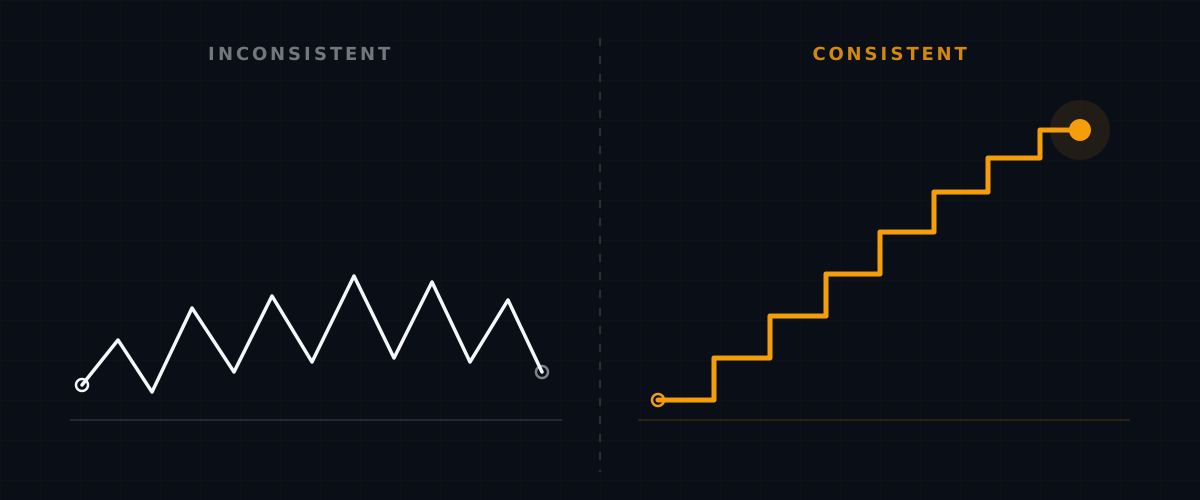
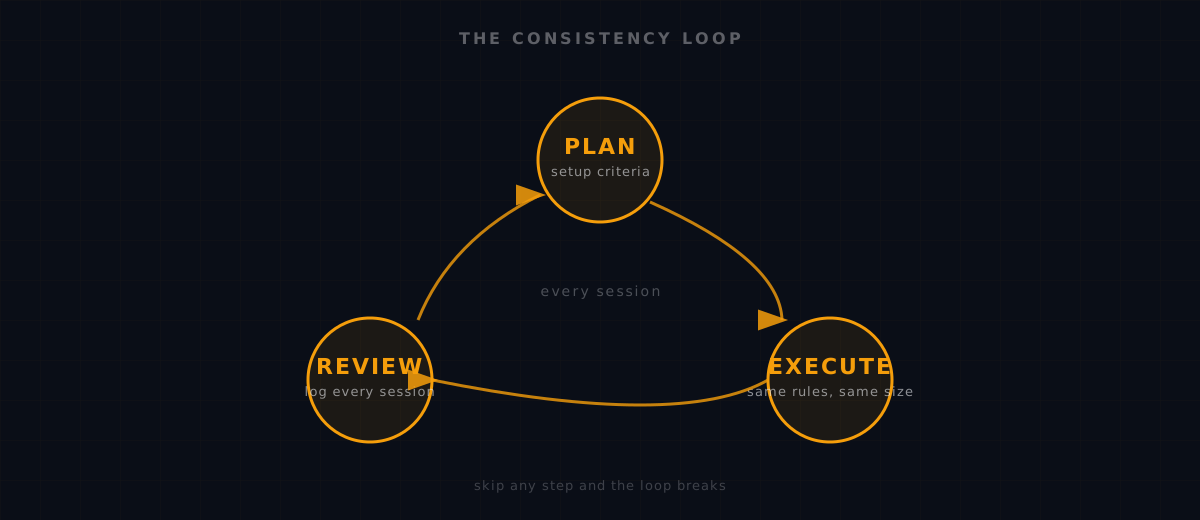
Consistency means applying the same process, session after session, regardless of what happened yesterday. The same pre-session checklist whether you're on a four-win streak or coming off back-to-back losses. The same position-size formula regardless of how obvious the setup feels. The same post-session journal entry whether the trade was clean or a mess.
The results will vary — that's the nature of probabilistic markets. The process should not.
This is the distinction that sounds obvious and is almost universally ignored: traders naturally adapt their behavior in response to results, when what they should be adapting is the process in response to evidence. Those are not the same thing.
Why Inconsistency Is the Default
The market looks like it's sending feedback about your method. A run of losers feels like proof that something's wrong. A run of winners feels like confirmation that you've finally figured it out. Both interpretations are overwhelmingly noise when you're looking at a week or a month of trades.
Your brain is a pattern-matching machine trying to navigate a genuinely probabilistic environment. The instinctive response to that friction is to adapt — to tweak, to switch, to start doing what's working now. That adaptation, applied prematurely, is the mechanism of inconsistency.
Taken to its extreme, that same instinct is what drives strategy hopping — abandoning an entire system, not just a single rule, right as its normal variance is still running its course.
Mark Douglas, in Trading in the Zone, identified this as the central error: treating market randomness as information about your method rather than as the expected output of a valid edge. When traders can't distinguish noise from signal, they change their process in response to noise — disrupting the one thing they actually need to keep stable.
The Three Doors Inconsistency Walks Through
Entry behavior is the obvious one: taking setups that don't meet your criteria because there's been a drought and urgency is building, or because a setup almost qualifies and you're bored. Every trading system has entry rules. Consistency is executing them — not expanding them when the session is slow.
Position sizing is the quieter one. After wins, sizes creep up: "I'm feeling sharp, I'll size up a bit." After losses, they drop: "I need to protect capital." Both moves feel rational. Both erode an edge over time, because they introduce a non-stationary variable (how you feel about recent results) into what should be a fixed risk formula. A consistent trader pre-commits to the same risk per trade before opening the chart.
Post-session review is the one that gets dropped when it matters most. The session that went badly is exactly where the most useful data lives — what broke down, which decision was emotional, where the plan got abandoned. When the journal gets skipped on bad days, the feedback loop closes precisely when it should be learning.
What Consistent Traders Actually Track
If you're measuring consistency by your daily P&L, you're measuring the wrong thing. P&L is the output of process plus variance. On any given session, variance dominates. Across a hundred sessions, process dominates.
Consistent traders tend to track process metrics instead:
- Did I take only setups that met my stated criteria?
- Did I size each trade at my pre-committed risk per trade?
- Did I exit based on the plan or based on in-session emotion?
- Did I complete the post-session review?
Those four questions say nothing about whether today was profitable. They say everything about whether the edge will still be intact in six months. Performance is the lagging indicator. Process adherence is the leading one.
Building Consistency Into the System, Not the Personality
The common mistake is treating consistency as a character trait — something you either have or you don't, something disciplined people carry around while the rest struggle.
That framing fails in practice. Everyone's willpower degrades under stress, fatigue, and a losing stretch. The traders who show up the same way regardless of conditions aren't necessarily more virtuous — they've built external structure that enforces consistent behavior before the willpower question ever comes up.
A daily trading routine built around fixed triggers removes the in-session negotiation about what to do next. Position size set before you open a chart eliminates the negotiation about how much to risk on this specific setup. A post-session template with five fields — not a blank page — makes the review fast enough that skipping it requires more effort than doing it.
Discipline in trading is the engine. Consistency is the output when that engine runs without interruption long enough to accumulate a meaningful data set.
One Question That Reveals Your Actual Consistency Level
Over your last twenty sessions: how many followed your full pre-session checklist, your exact position-sizing formula, and included a completed post-session review?
If the answer is close to twenty, that's a genuinely consistent practice. If it's roughly half — depending on how the session went, how tired you were, whether the result felt worth analyzing — that's where most traders are. And that gap, not a better entry signal, is where most improvement lives.
The honest answer to that question is more diagnostic than most backtests.
MindTradr is a trading journal built around this feedback loop — log your process inputs (emotional state, setup quality, position confidence) alongside your P&L on every session, and the correlations between mental state and performance become visible across weeks, not single days.
MindTradr is a trading psychology journal that logs your process inputs — emotional state, setup criteria, and position sizing decisions — so you can track whether you're trading consistently, not just profitably.
If you want to start closing the loop on your sessions, MindTradr is free to start.