
Overconfidence Bias in Trading: Why Your Last Win Made You Reckless
A few good trades in a row change how a setup feels. Entries that used to require a checklist start to feel obvious. Charts that used to need three confirmations start to feel readable at a glance. Nothing about the market changed. What changed is how certain you feel about your read of it.
That gap — between how accurate you actually are and how accurate you feel — is overconfidence bias, and it's one of the most consistently documented errors in behavioral finance.
What Is Overconfidence Bias in Trading?
Overconfidence bias is the tendency to overestimate the accuracy of your own judgment, knowledge, or predictive ability. It shows up in trading as overprecision: believing your read on a setup is more reliable than your actual track record supports.
Daniel Kahneman describes a version of this in Thinking, Fast and Slow, recounting his work with a group of investment advisors at a wealth management firm. Their year-to-year performance showed close to no meaningful correlation — the advisors who ranked at the top one year were essentially no more likely to rank at the top the next. Yet every advisor in the room believed, sincerely, that skill explained their results. Kahneman calls this the "illusion of skill": the confident feeling of competence persists even when the evidence for it is statistically indistinguishable from chance.
Trading reproduces that illusion constantly, because every trade closes with a number attached, and a run of good numbers feels exactly like proof — whether or not it is.
Why Trading Manufactures Overconfidence Faster Than Almost Any Other Skill
Most skills give you slow, ambiguous feedback. Trading gives you fast, unambiguous feedback: green or red, today. That speed is normally an advantage — it's what makes deliberate improvement possible at all. But it also means a short run of wins reaches your sense of self-assessment long before enough trades have accumulated to say anything statistically meaningful.
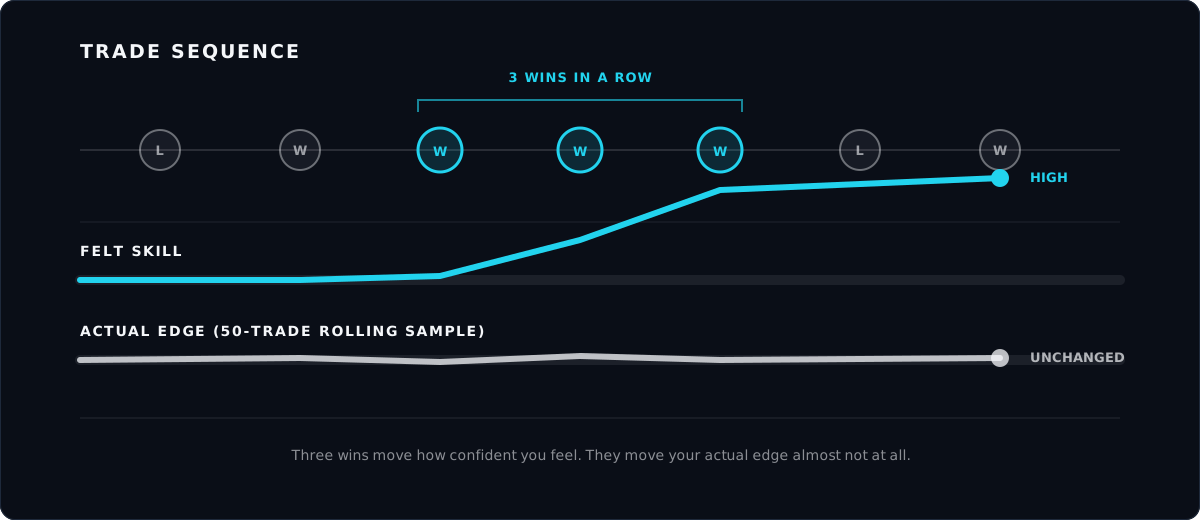
Three or four winning trades tell you almost nothing about whether your edge improved. They tell you the market cooperated with your style for a few days. The hot-hand psychology behind winning streaks covers this specific mechanism in depth — the short version is that your brain treats a small, noisy sample as if it were a large, reliable one, because that's how pattern recognition works under uncertainty. It fills gaps with a story, and "I've gotten better" is a much more satisfying story than "I got lucky for a few days."
Is It Confidence, or Is It Overconfidence?
This is the question worth sitting with, because the honest answer isn't "confidence is bad." Confidence built on a large, reviewed sample of trades — a plan you've followed for months, with a track record to back it — is legitimate and useful. It's the input that lets you hold a position through normal noise instead of second-guessing every tick.
Overconfidence is different. It's confidence that inflated on a small, recent, cherry-picked sample — usually right after the sample happened to go your way. A useful test: would you trust this same feeling if the last few trades had been losses instead of wins? If the honest answer is no, the feeling isn't tracking your edge. It's tracking your mood.
What Overconfidence Actually Costs
Overconfidence rarely announces itself as a single reckless trade. It shows up as a slow erosion of process:
You skip steps you'd normally require. The checklist that used to gate every entry starts to feel like it's slowing you down, because you're "seeing it clearly" without it.
You size up without new evidence of edge. Position sizing is where this shows up most concretely — the setup didn't get better, but your willingness to risk more on it did.
You trade more often. Terrance Odean and Brent Barber's research on individual investors — most notably their study on overconfidence and trading volume — found that investors who traded more frequently, often the more overconfident ones, tended to see meaningfully lower net returns than those who traded less. More conviction produced more activity, and more activity produced worse results, not better ones. That finding has held up as one of the more robust patterns in behavioral finance research on retail trading.
The overlap with plain overtrading is not a coincidence — overconfidence is one of the main engines that drives it. You don't feel like you're gambling when you take an extra marginal trade. You feel like you're capitalizing on a read you've earned. And when that earned read goes against you, the same certainty curdles into ego — the need to be proven right that keeps you in a losing position long after the edge is gone.
How to Keep Confidence From Becoming Overconfidence
Pre-commit your process before the session, not during a streak. Your checklist, your size, your entry rules — decide them when no trade is open and no recent result is coloring the decision. Overconfidence has no chance to distort a rule you can't renegotiate mid-session.
Grade the decision, not just the result. A trade that worked because you skipped your own checklist is not evidence the checklist is optional — it's evidence you got away with it once. Logging "followed process: yes/no" separately from the outcome is what makes that distinction visible later instead of invisible in the moment.
Track confidence as its own number. Rating your certainty on every trade, independent of size or outcome, gives you a record to check against reality afterward. When a self-rated 9-out-of-10 confidence trade loses as often as a 5-out-of-10 one, that gap is the whole story — and it only shows up if you wrote the number down before you knew the result.
Ask what a stranger would do. If you described this exact setup and this exact size to another trader with no stake in the outcome, would they take it, or would they ask why you're sizing up? Removing your own emotional investment from the question tends to surface the answer fast.
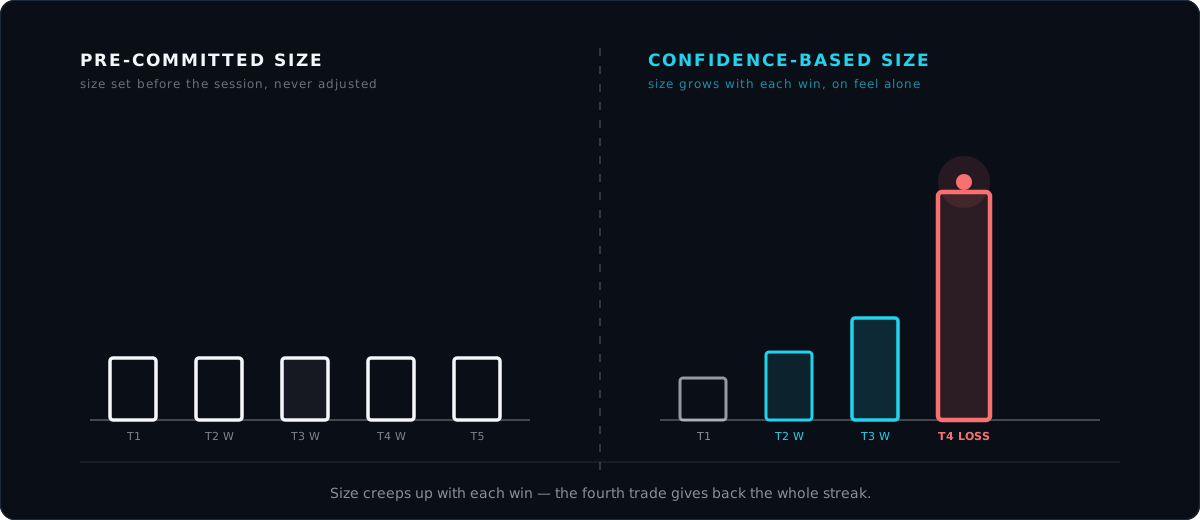
MindTradr logs your confidence rating and whether you followed your process on every trade, independent of the P&L that comes in afterward — so a streak that's quietly inflating your sizing shows up in your own numbers before it shows up in your account balance. MindTradr is a trading psychology journal built to separate how sure you felt from how sound the decision actually was.
The next time a setup feels obvious because of how the last few trades went, the useful move isn't to trust the feeling more. It's to check whether the feeling is tracking your edge or just your mood — because the market has never once cared which one it is.
If you want a journal that tracks confidence and process alongside your results, MindTradr is free to start.