
Strategy Hopping: Why You Keep Abandoning Systems Right Before They Work
Every trader who's been at this more than a year has a graveyard of abandoned systems somewhere. A breakout strategy that worked for a few weeks and then didn't. A mean-reversion setup that looked airtight in the backtest and got shaky in live conditions. A moving-average crossover someone raved about in a trading group, tried for a handful of sessions, then quietly dropped.
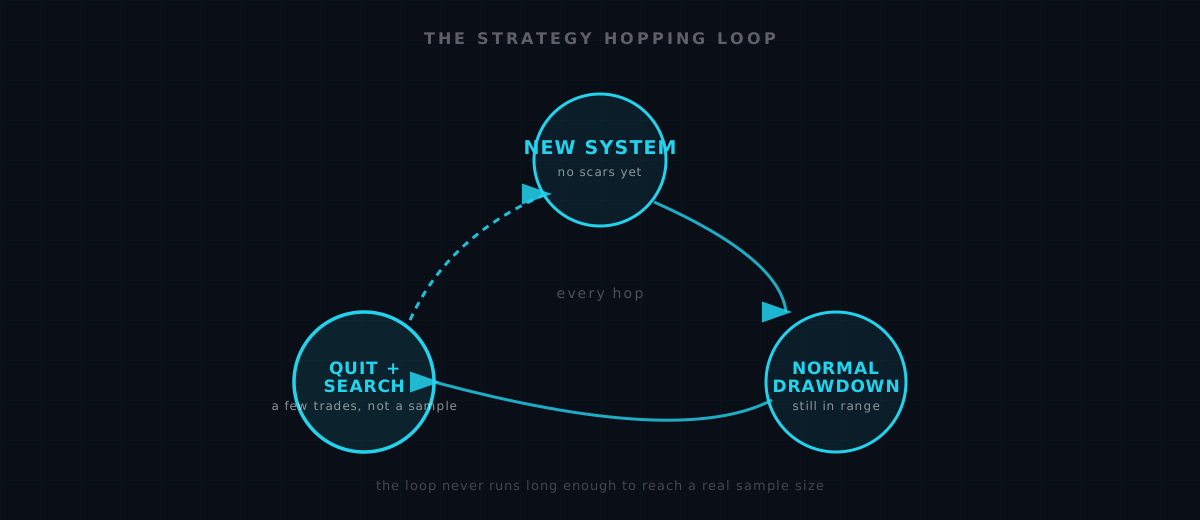
Most of those systems didn't fail. They got abandoned mid-drawdown — the exact kind of losing stretch that any valid edge produces on a long enough timeline. The system didn't break. The trader just didn't stay long enough to find out.
This pattern has a name: strategy hopping — jumping from system to system, never running any single one of them long enough to know whether it actually works.
Why Every New Strategy Feels Better Than Your Last One
A brand-new strategy carries no personal scar tissue. You haven't lived through its losing streaks yet, so in your head it doesn't seem to have any — it reads as pure, undiluted potential. Compare that to the system you're currently running, which you've just watched miss a few trades in a row and which now feels, emotionally, like it's "not working," even though a short losing stretch is unremarkable for a system with a genuine edge.
Van Tharp, who has spent decades researching what separates traders who last from traders who don't, frames system quality as something measured over a defined sample of trades — not something you feel out session by session. The instinct to chase a newer, shinier system is exactly the instinct that framing warns against: judging an approach by how it feels right now instead of by its behavior over time.
There's also a selection effect at work. You mostly hear about other people's systems when they're winning — the setup shared after a good week, the screenshot posted at the top of a run. You never see their drawdowns, so the new strategy looks cleaner than the one you're living inside of, warts and all.
The Quit Point Is Almost Always the Same Point
Here's the part that should be unsettling: strategy hopping doesn't happen randomly. It tends to happen at a remarkably consistent point — a handful of consecutive losses, or a modest drawdown, that feels like proof of failure but sits well within the normal range for a system with a real edge.
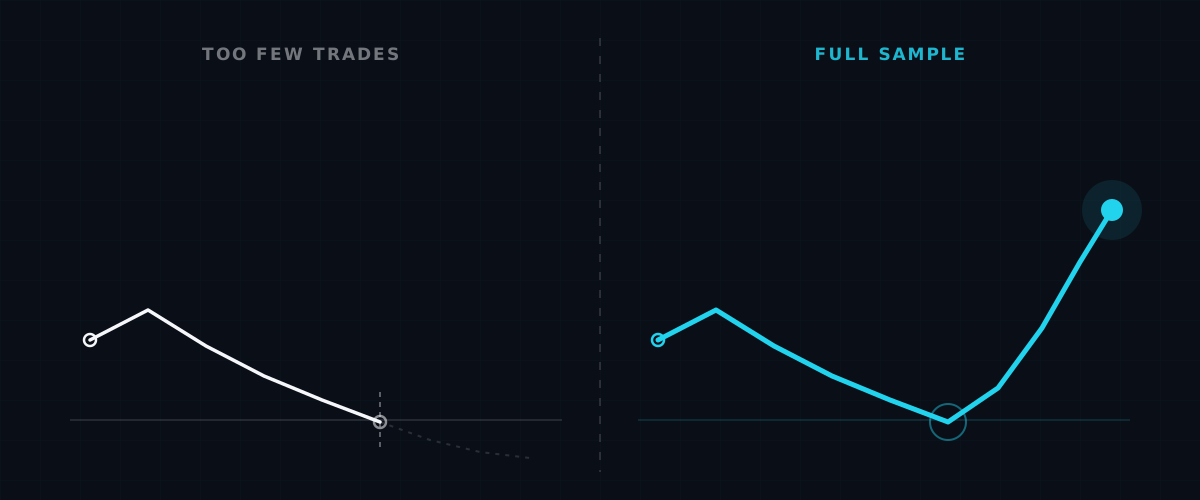
The underlying error is a version of what Amos Tversky and Daniel Kahneman called the belief in the law of small numbers — the tendency to treat a small sample as though it reliably represents the underlying probability distribution. A handful of trades isn't a sample. It's noise with a story attached to it. The same reasoning error shows up in gambler's fallacy thinking: expecting a short run of results to resemble the long-run average, when short runs are precisely where randomness dominates.
Is It Ever Right to Abandon a Strategy?
Yes — but the criteria for "this is actually broken" should be set before you start trading it, not decided emotionally in the middle of a losing week.
A strategy is genuinely broken when the market condition it depends on has structurally changed — a mean-reversion system built for range-bound conditions applied to an instrument that has started trending persistently, for example. That's a regime change, and it's a legitimate reason to stop.
A strategy is not broken just because the last several trades lost. Telling those two situations apart requires a sample size decided in advance, on a calm day — not three losses deep, with the next trade already loaded.
How to Tell the Difference Before You Quit
The fix isn't more conviction or more willpower in the moment. It's a pre-commitment, made before you're emotionally inside the drawdown:
- Define the system's rules completely before the first trade. Entry, exit, position size — written down, not held loosely in your head.
- Decide the sample size you'll wait for before judging it. Not "I'll know if it's working" — an actual number of trades, chosen while you're calm and have no position open.
- Log every trade under that system's name, separate from your overall P&L. A rough stretch inside a real sample looks completely different from the same rough stretch viewed in isolation.
This is exactly the gap MindTradr is built to close — tag each trade with the strategy you were running, and the aggregate performance across every session under that tag becomes visible, not just the last few trades that happen to be top of mind. Instead of asking "does this feel like it's working," you get to ask what the data across the full sample actually says — a much harder question to talk yourself out of.
What Strategy Hopping Actually Costs
The direct cost is the obvious one: extra commissions and spread every time a new system gets set up, and a permanently short track record for every approach you've tried, because none of them ever accumulates enough trades to say anything meaningful.
The quieter cost is that you never find out which of your abandoned systems actually had an edge. Some of them probably did. A trading plan that specifies not just what you trade but how long you commit to evaluating it is the only way to answer that question honestly — instead of carrying around a permanent, unresolved suspicion that the right system is still out there, one hop away.
MindTradr is a trading psychology journal that lets you tag every trade with the system you were running, so you can see aggregate performance across weeks — not just the feeling left over from your last few trades.
If you want to start separating what a strategy actually does from how the last few trades felt, MindTradr is free to start.