
Pre-Market Anxiety: Why Your Heart Races Before the Open
The market hasn't opened yet. Nothing has moved. You haven't placed a trade, you haven't put a dollar at risk — and your heart is already racing.
This is pre-market anxiety, and it shows up in nearly every serious trader's morning whether they name it or not. It's the tightening in your chest in the final minutes before the bell, the shallow breathing at 9:28 while you're watching the countdown. What makes it strange is that it arrives before any threat has actually materialized.
The even stranger part: understanding exactly why it happens makes it considerably easier to manage.
What Your Body Is Doing Before the Open
The stress response doesn't require a current threat. It anticipates one.
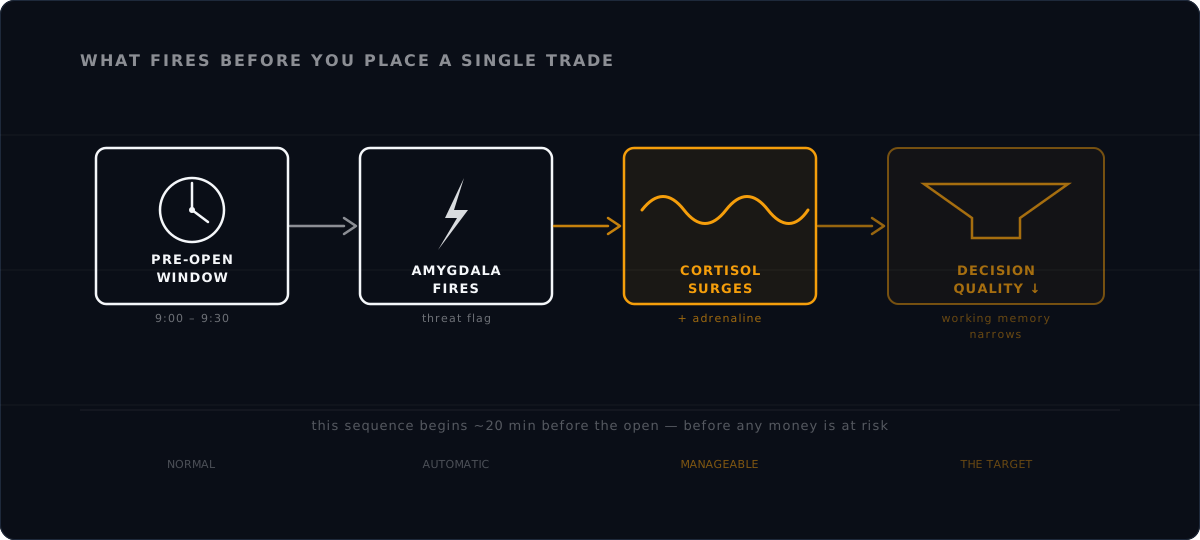
When your brain recognizes the conditions that reliably precede danger — in this case, the sequence of "market open approaching, real money on the line, outcome uncertain" — it starts loading the stress response early. Cortisol and adrenaline begin releasing before you've placed a single order. Your heart rate climbs. Attention narrows.
This is the same mechanism that makes your palms sweat in an elevator before a job interview, not during it. The amygdala doesn't wait for the event; it flags the pattern that signals the event is coming and begins preparing the body. For traders, the pre-market window is that pattern — a signal your nervous system has learned to treat as the start of something high-stakes.
The response is real and physiological. It's not something you can simply decide away by telling yourself to calm down, because the cognitive centers that would receive that instruction are already partially offline — displaced by the stress cascade the amygdala already started.
Why the Open Specifically Triggers This
Not all trading hours create this reaction equally. Traders who track their emotional state usually notice that the anxiety concentrates in a narrow window: roughly the last 20-30 minutes before the open.
What makes the open specifically anxiety-inducing isn't the money itself. It's the uncertainty of the transition. Closed markets are static. The moment the bell rings, conditions become active and ambiguous simultaneously. Your brain reads that shift as the moment where decisions will matter and errors will cost — and it wants to be physiologically ready for that before it arrives.
Dr. Brett Steenbarger, who has spent years studying the psychology of professional traders, writes about this readiness activation — the arousal that precedes performance states in trading. The problem isn't the activation itself; it's when the arousal overshoots what the task actually requires.
Does a Racing Heart Hurt Your Trading?
Not automatically. This is where the distinction matters practically.
The Yerkes-Dodson relationship — established in behavioral research in 1908 and replicated across performance domains since — describes a curved relationship between physiological arousal and performance quality. At low arousal, performance suffers because engagement is absent. At moderate arousal, performance peaks: attention is sharp, reaction time is calibrated, pattern recognition is clear. At high arousal, performance degrades because the stress response starts consuming the cognitive resources that trading requires.
Pre-market anxiety is the push toward the right side of that curve. For some traders, the activation lands at a productive level — heightened focus without impairment. For others, especially on high-stakes days — a scheduled news event like FOMC or a jobs report — or after a recent losing streak, the pre-open arousal tips past useful into disruptive.
The clearest signal that you've crossed the line: you're compulsively checking positions or your watchlist — not to gather new information, but because your nervous system wants to feel like it's doing something. That behavior typically accompanies impaired judgment, not enhanced focus. If you've ever entered a position in the first few minutes of a session without a proper setup just because watching felt worse than acting — that's high arousal driving execution decisions.
For the full picture of how this stress accumulates through a session, stress and trading performance covers the cortisol and adrenaline mechanisms in detail. Pre-market anxiety is often where that cortisol accumulation begins — before the session clock even starts, before any market risk has been taken.
How to Reset Before the Bell
You can't eliminate the anticipatory stress response. You can change its calibration.
Three interventions that actually work in the pre-open window:
Controlled breathing, 3-5 minutes. Long exhales (4 seconds in, 6-8 seconds out) activate the parasympathetic nervous system — the counterweight to the stress response. This isn't relaxation breathing; it's a deliberate physiological intervention to lower baseline arousal before you start making decisions. The shift in heart rate variability is measurable within minutes. This is why it's a repeatable tool rather than a vague suggestion.
Write one sentence about your current state. Not market analysis, not a setup summary — just where you are right now. Anxious. Flat. Residually frustrated from yesterday. Still sharp from last week's run. The act of labeling the state shifts it from background noise to something consciously registered. That alone often reduces intensity, because named emotions are processed differently than unnamed ones.
Set one behavioral rule before you open a chart. A specific if-then commitment made before exposure to the market — "if I feel the urge to enter before my setup confirms, I will wait one candle" — pre-loads your decision-making in a calmer state. The morning routine for traders that consistently blocks bad early trades works on exactly this principle: decisions made before the stress response fires are more likely to reflect your actual trading standards.

The Anxiety Is Giving You Information
This is what MindTradr is designed to make visible. MindTradr is a trading psychology journal that lets you log your pre-session emotional and physical state alongside your actual trade data. After a month of entries, the pattern in your own numbers tells you more than any general principle can: which pre-open states correlate with your cleanest sessions, which states consistently precede your worst, and whether your current morning is one to trade at full conviction or scale back.
Pre-market anxiety isn't a personality flaw or a sign that you're not built for this. It's your threat-detection system running on schedule, calibrated for an environment it wasn't designed to navigate. What separates experienced traders isn't an absence of that chest tightness before the open. It's the habit of noticing it, naming it, and running a brief reset before the first decision clock starts.
The open comes for everyone. The question is which version of you shows up for it.
If you want to start logging your pre-open state and see how it maps to your actual results, MindTradr is free to start.