
Your Trading Plan Survives Until the First Candle
You wrote the plan on Sunday. Risk 1%, wait for the retest, no trades before 9:45, stop at the swing low. It felt airtight. Then Monday's first candle rips through your level, the number in the corner turns red, and by 9:52 you're in a trade you never scripted — bigger than planned, no defined stop, chasing.
The plan didn't fail. It just never made it past the opening bell.
This is the plan-execution gap: the distance between what you decided when the market was closed and what you actually did when it was open. It's a different problem from not having a plan — if you're still building yours, start with what a trading plan is. This post is about the plan you already wrote and keep abandoning.
Your Trading Plan Survives Until the First Candle
A plan is written by your calm, rational self on a quiet afternoon. It's executed by a different person entirely — one running on adrenaline, staring at a moving P&L, with money on the line and a countdown in their chest.
Those two people are not the same trader. The calm one gets to write the rules. The stressed one gets to break them. And the market only ever meets the second one.
That gap is why "just follow your plan" is useless advice. Nobody plans to override their plan. The override happens in the moment, driven by state, not by a change of strategy. You didn't decide the rule was wrong. You just stopped being the person who could follow it.
Why Does the Plan-Execution Gap Open?
Because a written rule and a live impulse are stored in completely different parts of you, and under pressure the impulse wins by default.
Mark Douglas built his whole framework around this in Trading in the Zone: the problem isn't market knowledge, it's the collision between your rules and your fear/greed response when real money is moving. A few specific things widen the gap:
- Live P&L hijacks the plan. The moment you're watching the open number tick, you're managing a feeling, not a trade — which is its own separate leak worth not watching mid-trade.
- Vague rules can't be executed. "Wait for confirmation" isn't a rule, it's a vibe. If it isn't specific enough to check in two seconds, pressure will define it for you.
- The plan lives in your head. An intention competes with impulse in real time. A written, pre-committed rule is much harder to argue with mid-candle.
- No trigger, no action. Most plans say what you'll do but never when — so the "when" arrives and you improvise.
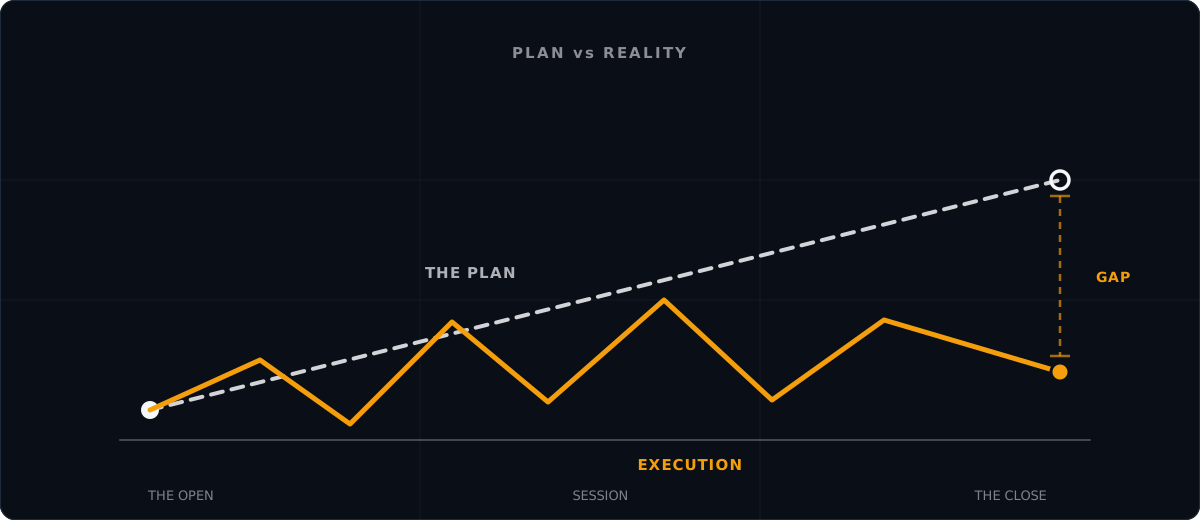
The pattern is always the same shape: two lines that start at the same point and end far apart. Not because the plan was wrong, but because nothing enforced it when it counted.
The Gap Is a Behavior Problem, Not a Knowledge Problem
Here's the uncomfortable part. If you've broken the same rule five times, you don't have a strategy problem — you have an execution problem wearing a strategy costume. Rewriting the plan for the sixth time feels productive, but you already knew the rule. Knowing was never the issue.
This is exactly where breaking your trading rules comes from: the rules were real, the pressure was realer. The fix isn't more knowledge. It's making the correct action easier to take than the impulsive one at the exact moment of pressure.
That means the gap is measurable and trainable — which is good news. You can't fix "be more disciplined." You can fix "I override my stop when I'm down on the day." One is a personality verdict; the other is a specific, repeatable behavior with a specific trigger.
Close the Gap With Pre-Commitment
The research-backed tool here is the implementation intention — Peter Gollwitzer's work showing that "when situation X happens, I will do Y" beats a general goal by a wide margin, because you decide the response before the pressure arrives. Traders call it pre-commitment. Same mechanism.
Turn every soft intention into an if-then your stressed self can't wriggle out of:
- Attach the rule to a trigger. Not "manage risk" — "if price hits my stop, I'm out, no reassessment."
- Pre-commit the exit before entry. Stop and target go in when the position opens, while you're still calm.
- Define your no-trade conditions. "If it's before 9:45 or I'm down two trades, I don't take anything."
- Make the plan physical. On screen, on paper, in your journal — anywhere but only in your head.
- Review the gap, not the P&L. After the session, ask one question: did my execution match my plan? The result is noise; the adherence is the signal.
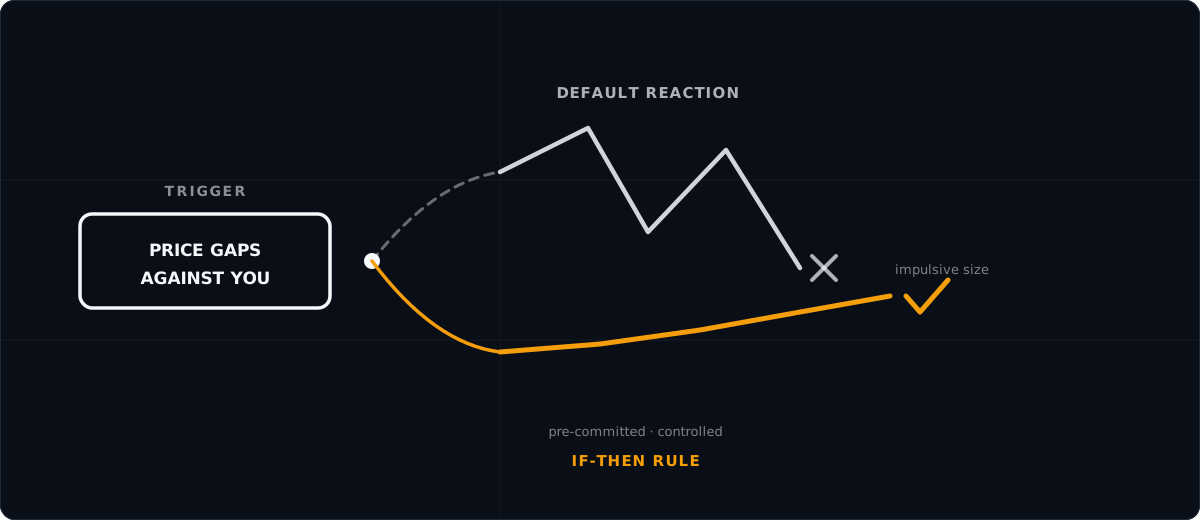
Notice none of this changes your strategy. It changes the conditions under which you execute it — which is the only lever that actually moves the gap. Pairing it with a repeatable daily trading routine means you read the pre-committed rules back to yourself before the open, when they can still steer you.
Most traders can't even see which state pulls them off plan — is it revenge after a loss, boredom in a slow tape, or the itch to size up on a win? If you want to find out which pattern is costing you the most, MindTradr's quick quiz maps your behavior to the exact moment your execution tends to slip.
Measure the Gap Before You Can Shrink It
You can't close a gap you can't see. The reason the plan-execution gap stays invisible is that most journals only log the trade — the entry, the exit, the P&L — and never the plan it was supposed to follow, or the mood and stress you were in when you broke it.
That's the whole reason to log both. When your plan sits next to your actual fills, and your composure — mood, sleep, stress — sits next to your P&L, the gap stops being a vague feeling of "I keep messing up" and becomes a specific, coachable pattern: I override my stop on short-sleep days when I'm already red. That you can work on.
MindTradr is free to start — no credit card required. MindTradr is a psychology-first trading journal that tracks your plan adherence and emotional state alongside your P&L, so you can see the exact gap between what you planned and what you actually did.