
The Trading Self-Sabotage Pattern: Why You Blow Up Right Before Consistency
Three weeks of disciplined trading. Rules followed, sizes appropriate, winners held to target. The equity curve is climbing — and for the first time in months, something like rhythm feels possible.
Then, in a single session, you size up on a setup you would normally pass, move a stop because the trade "feels" right, and hand back most of the month's gains before the close.
This isn't bad luck. This is trading self-sabotage — and it follows a pattern precise enough to predict.
What Trading Self-Sabotage Actually Looks Like
It rarely arrives as one catastrophic decision. The sequence is subtler than that.
A run of clean trades produces elevated mood and a loosening grip on process. The next setup is close enough — not quite the full checklist, but close. Position size drifts upward because the account can "afford it." A stop gets moved because this one really does feel different.
None of these feel like self-sabotage in the moment. Each deviation from the plan is just small enough to seem defensible. The size-up feels like appropriate confidence. The moved stop feels like good judgment, not a rule violation.
The signature that reveals this as a pattern rather than isolated mistakes: the deviations cluster when performance is good, not when it is struggling. A bad week tends to tighten behavior — pain raises attention. A strong week loosens the rules in ways that eventually produce a loss disproportionate to the streak that preceded it.
For more on how this erosion unfolds trade by trade, why you keep breaking your trading rules covers the three types of rule-breaking in detail — including incremental drift, which is where self-sabotage typically begins.
Why Does It Happen Right Before Breakthrough?
The timing is the counterintuitive part. Why does this pattern activate specifically when performance is improving?
Mark Douglas addresses this directly in Trading in the Zone (2000) through the concept of the trader's internal belief system. Performance that consistently exceeds the trader's established self-concept creates psychological dissonance. The results are inconsistent with the internal story — and something in the system works to resolve that inconsistency by pulling performance back toward baseline.
This doesn't manifest as a conscious decision to fail. It manifests as gradual behavioral drift that can be rationalized at every step, until the results do what the internal narrative predicted.
The same mechanism connects to self-handicapping — a concept introduced by Jones and Berglas in their 1978 paper in Personality and Social Psychology Bulletin. Self-handicapping describes the tendency to create conditions that make failure more probable, which protects the ego's explanation for that failure: "I lost because I oversized, not because I lack the ability." In trading, this operates without the trader recognizing it consciously. The criteria drift, the size drift, the stop movement — each one builds conditions that make a disproportionate loss more likely, and each one arrives with a justification that sounds like experience rather than avoidance.
Brett Steenbarger, whose Trader Feed blog documents decades of working with professional traders, describes how performance identity — the internal story a trader holds about who they are and what they deserve — often acts as an invisible ceiling that behavioral drift enforces. The patterns appear in professionals and beginners alike because the mechanism is psychological, not skill-related.
Is This Self-Sabotage or Just Bad Luck?
The market generates losses regardless of what any trader does. How do you distinguish a market-driven loss from a self-sabotage loss?
The distinguishing feature is whose choices created the conditions for the outcome.
Market-driven losses happen when process was sound — the setup was real, size was appropriate, the stop was placed correctly — and price moved against the position anyway. That is the market doing what markets do.
Self-sabotage losses happen when the conditions for the loss were created by the trader's own deviations from the plan. Size too large for the account's stated risk parameters. Setup entered without the full criteria met. Stop placed beyond the original level. These are choices that diverge from the trader's own standards, and the loss magnitude reflects those choices, not just market movement.
A practical diagnostic: after a significant loss, review the entry criteria, position size, and stop placement. Ask honestly whether you would have taken this exact trade during a flat, emotionally neutral week. If the answer is "probably not," the loss has your fingerprints on it.
The Loop and Why It Keeps Repeating
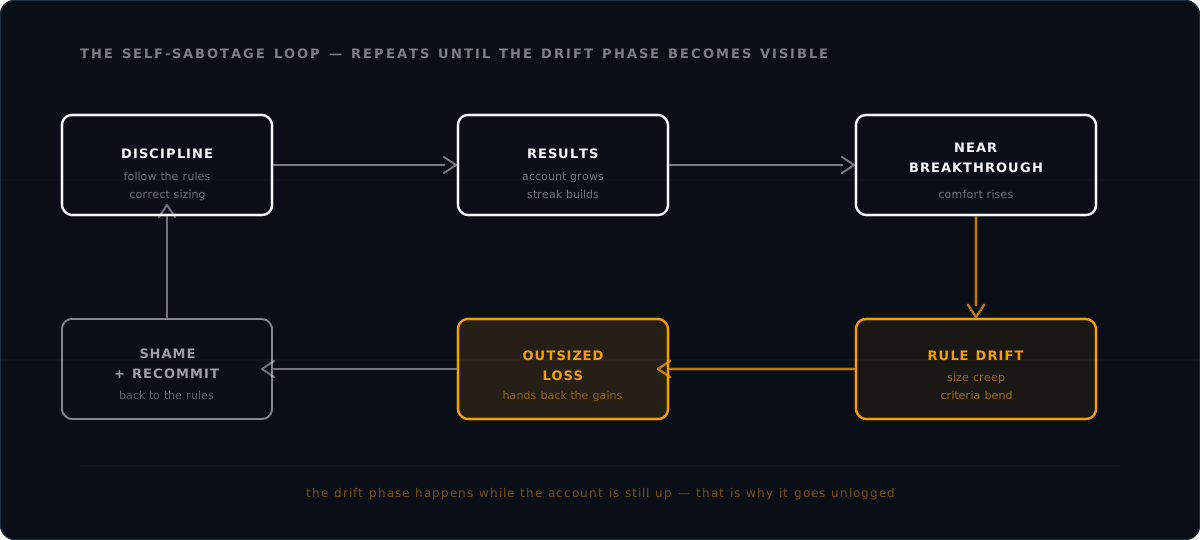
Once the pattern is visible, its structure becomes clear:
- A difficult period produces recommitment to the rules
- Rule-following produces results — the account improves
- Improving results create comfort and loosened attention to process
- Small deviations begin: size creep, criteria drift, stop adjustments outside the plan
- A disproportionate loss follows
- Shame and recommitment — back to step 1
The reason the cycle repeats is that it almost always ends at step 6 without identifying what happened at steps 3 and 4. The loss is treated as the problem. The loss is the outcome. The drift phase is where the problem actually lived.
Most post-trade review focuses on the losing trade itself: what was wrong with the entry, why the stop was hit. But the self-sabotage pattern typically started several sessions earlier, in small deviations that felt irrelevant to record because the account was up at the time. The drift is invisible precisely because it's disguised by improving P&L.
How to Break the Cycle Without More Willpower
The solution is not greater resolve. Telling yourself "this time I will not deviate" is exactly the willpower-reliant commitment that fails under positive performance pressure — the same pressure that triggered the drift in the first place.
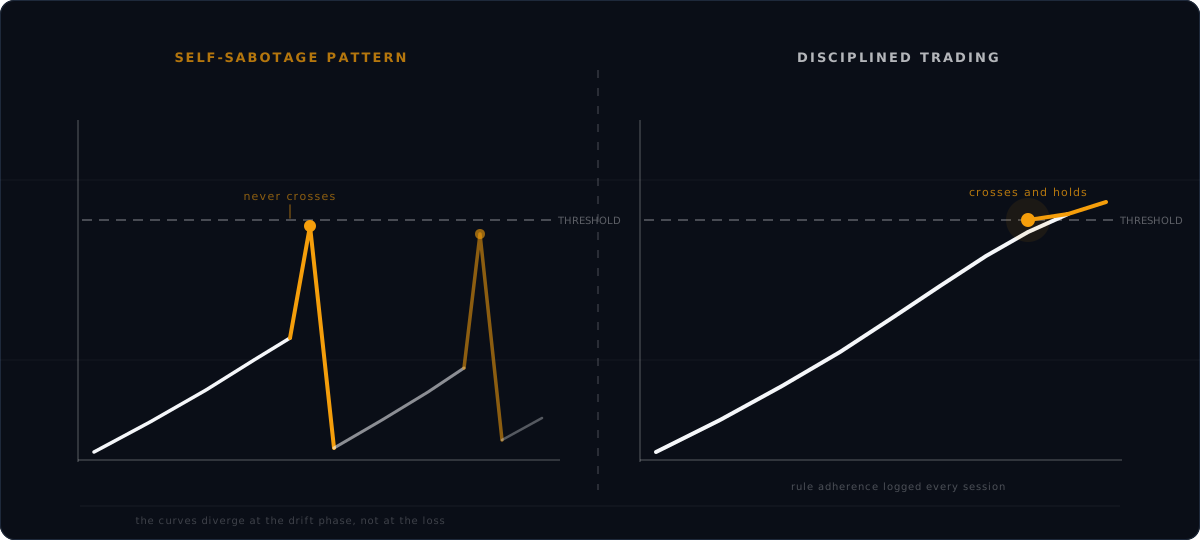
Track rule adherence separately from P&L. At the end of each session, ask one yes/no question: did you follow your rules today, regardless of whether the day was profitable? Over weeks, a run of "borderline but technically fine" sessions becomes visible before the equity curve tips downward.
Review winning sessions as critically as losing ones. The signal for self-sabotage lives in the sessions where the account was up but the rules were bending. Building a trading practice that survives bad days makes this point directly: the discipline that matters is the discipline exercised during good conditions, not the resolve you find after the damage is done.
Name the character running your drift. The cycle is the same for everyone, but the deviation that kicks it off is personal — for some it's revenge sizing, for others it's an ego-driven refusal to close a loser. Learning to spot which of the six trading saboteurs tends to hijack your good weeks turns "I drifted again" into a specific, catchable pattern.
Define a "drift alert" threshold in advance. Decide specifically what constitutes a size deviation, a criteria shortcut, or a stop adjustment outside the plan. Write it down — not to enforce with willpower, but so you have a pre-defined prompt to pause and examine what is happening in the current session before the deviation compounds.
The Pattern Needs to Be Made Visible
MindTradr is built to do exactly this: track the behavioral data session by session that signals the drift phase before it becomes a crash. A trading psychology journal that logs emotional state, rule adherence, and session behavior gives you the signal during the buildup, not only in the post-mortem. The invisible phase of the cycle — the sessions where P&L looked fine but the rules were bending — becomes legible.
Self-sabotage in trading is consistent enough to be a learnable pattern. And learnable patterns, once visible, can be interrupted. The cycle keeps repeating only because the drift phase remains invisible, disguised by a temporarily improving account. Making it visible is the entire intervention.
The traders who break the loop are the ones who stop treating the loss as the event and start treating the drift as the signal.