
Ego Is Expensive: Why Needing to Be Right Costs You Money
The stop is right there on the chart. Price traded through it ten minutes ago. You know exactly where the line was — you drew it yourself, before the trade, when you were calm. And you're still in the position, because closing it now means admitting the call was wrong.
That last part is the whole problem. Somewhere between entry and now, the trade stopped being about money and started being about you — about whether your read of the market was correct. That's ego in trading, and it's one of the most expensive passengers you can carry into a position.
Ego Isn't Confidence — It's the Need to Be Right
Confidence is believing your process is sound. Ego is needing this specific trade to prove it. The two feel similar from the inside and produce opposite behavior.
This is a different failure mode than overconfidence bias, which inflates your certainty after a few wins. Ego needs no winning streak — it shows up the instant a position moves against you and turns your exit into a confession. Where overconfidence makes you take the trade, ego makes you refuse to leave it.
- Confidence lets you take a stop without flinching, because the plan already expected some losers.
- Ego treats the stop as a personal defeat, so you widen it, or quietly delete it.
The tell: would you still be in this trade if a stranger had put it on for you? If the honest answer is "no, I'd have closed it," you're not managing a position anymore. You're defending a prediction.
Why Does Being Right Feel More Important Than Making Money?
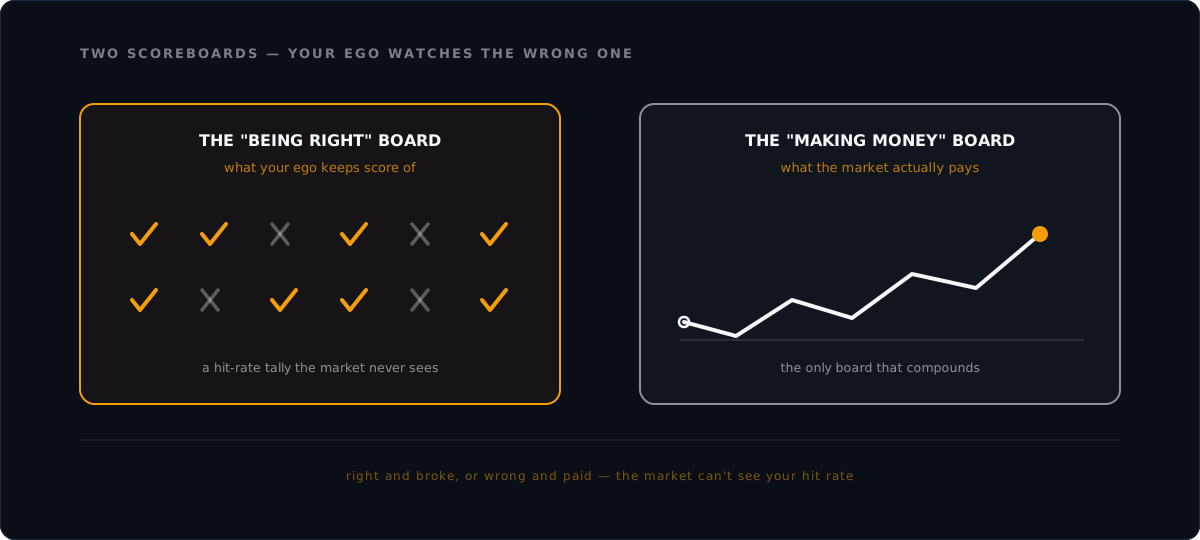
Because your brain keeps two scoreboards, and it cares about the wrong one.
One scoreboard tracks dollars. The other tracks your hit rate — how often your calls turn out correct. In trading these two come apart constantly: you can be right and make nothing, or wrong and get paid. Mark Douglas built much of Trading in the Zone around exactly this split — the compulsion to be right is fundamentally at odds with a probabilistic game, where any single trade's outcome is close to random.
The market only pays out on the dollar scoreboard. Ego keeps score on the other one. Every time you let a losing trade run to avoid marking an "L" on the being-right board, you're paying real money to protect an imaginary record.
Where Ego Leaks Money
Ego rarely shows up as one dramatic blow-up. It leaks, in small, deniable ways:
- You move your stop to avoid being stopped out — turning a planned small loss into an unplanned large one. This is the machinery behind the sunk cost fallacy in trading: the more the position has cost you, the harder it is to admit.
- You add to losers to lower your average, so a smaller bounce "proves you right" instead of just cutting the loss.
- You cut winners early to lock in the being-right feeling before the market can take it back — banking the ego win, capping the money.
- You revenge trade to get back to even, because a red day feels like a verdict on you rather than an ordinary outcome in a variance-heavy game.
- You argue with the tape — holding a short because the rally "shouldn't" be happening, as if the market owed your analysis an apology.
Selling winners early and holding losers too long is documented enough to have its own name — the disposition effect — and ego is a big part of why it's so sticky. Every one of these moves trades the money scoreboard for the ego scoreboard, and the market only ever settles on one of them.
The Ego Trade, Step by Step
The pattern is almost always the same loop:
- You take a position with a clear invalidation.
- Price moves against you toward the stop.
- Exiting now means being wrong — and that stings more than the loss itself.
- You renegotiate the plan: widen the stop, add size, "give it room."
- The position is now about pride, not the setup — and the loss you eventually take is bigger than the one you refused.
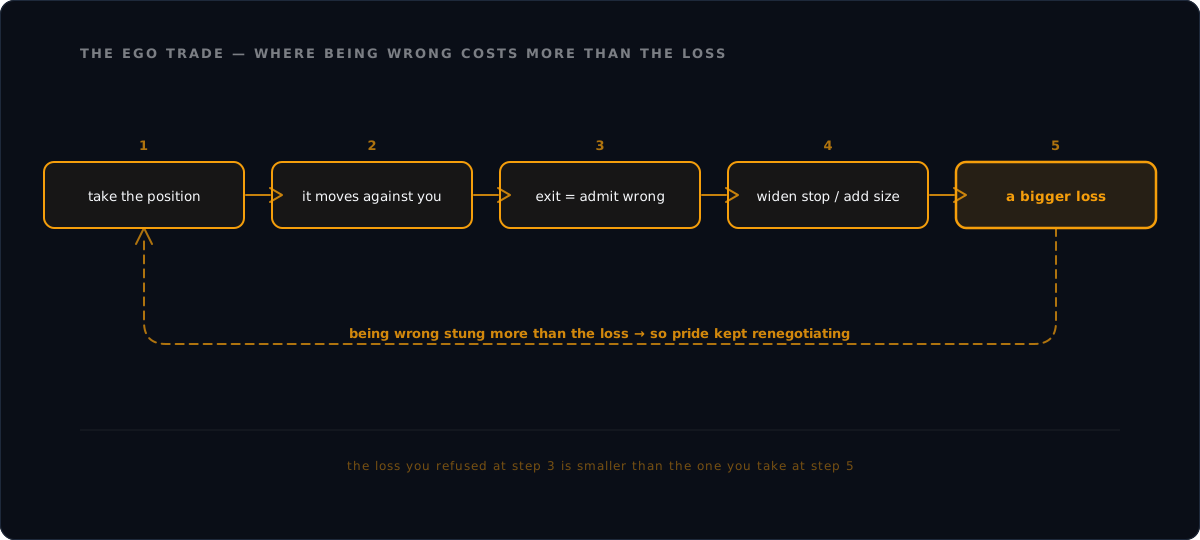
Notice step 3. The loss is not what hurts most — being wrong is. That's the ego tax, and you pay it whether or not you can see it on the ticket. When being wrong on a single trade starts to feel like a verdict on you as a person, ego has hardened into something deeper — see when trading identity becomes a liability.
How to Take Ego Out of the Trade
You can't delete ego. You can make it irrelevant to your decisions by moving the important choices to a moment when your pride isn't on the line.
- Pre-commit the exit before entry. A stop decided when no position is open is a decision your ego never got a vote on. Honoring it later is execution, not surrender.
- Grade the decision, not the outcome. A good trade that lost is a win on the only scoreboard that compounds. Logging "followed process: yes/no" separately from P&L is how you starve the being-right reflex.
- Rename the stop. It isn't proof you were wrong. It's the price of finding out — the cost of a single sample in a probabilistic game.
- Watch your state, not just your number. The urge to defend a position spikes when you're tired, tilted, or already down on the day. Brett Steenbarger has argued for years on his TraderFeed blog that your emotional reactions are data about your process, not commands you have to obey.
This is where the tool earns its place. In MindTradr, you log the yes/no process check and your mood, sleep, and stress next to each trade, so the positions you held for pride instead of edge stop being invisible. Over enough sessions the pattern is hard to deny: your worst holds tend to cluster on the days your ego was loudest. That awareness is the start of composure — the ability to be wrong quickly and cheaply instead of right expensively (more on that in trading composure).
The best traders aren't the ones who are right most often. They're the ones who've made being wrong so cheap it barely registers.
MindTradr is a trading psychology journal that logs your mood, sleep, and stress next to every trade, so you can see when you're trading your edge and when you're just defending your ego.
If you want to catch the trades you're holding for pride instead of profit, MindTradr is free to start.