
From Challenge to First Payout: A Funded Trader's Psychological Journey
Every funded trader describes the same moment: the confirmation email arrives, and the first thought isn't "I did it." It's quieter and colder: don't blow this now.
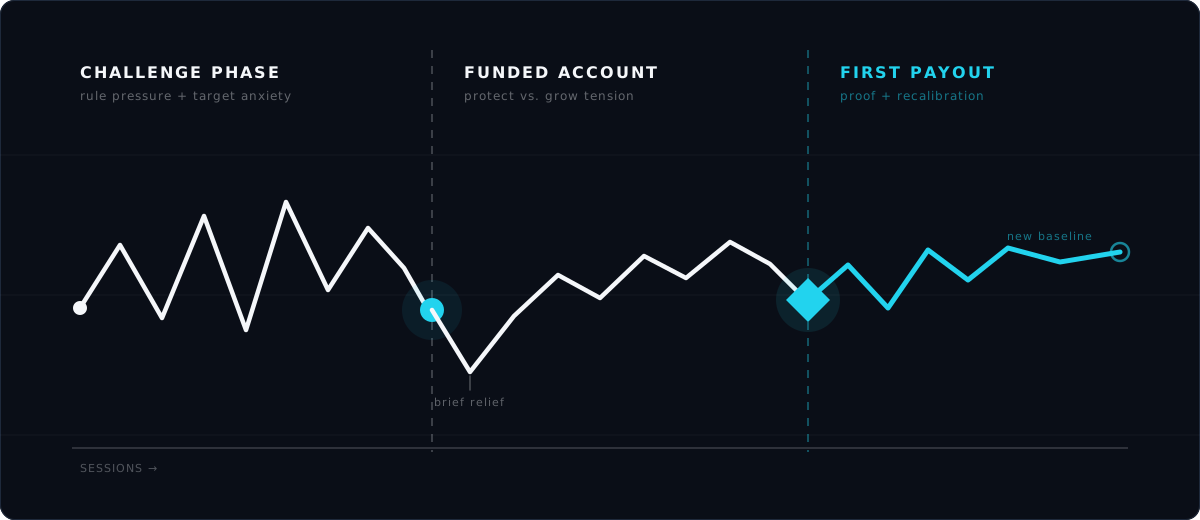
The challenge phase asks one question — can you follow rules under pressure? The funded account asks a harder one: can you sustain that under an entirely different kind of pressure? These aren't the same skill, and most traders discover the difference the hard way.
What the Challenge Phase Actually Tests
A prop firm challenge is a psychological endurance test dressed as a trading exercise. You're racing toward a profit target while defending against a drawdown limit — simultaneously pressing the accelerator and watching the brake. That dual constraint creates a cognitive load unlike anything in personal trading.
The traders who pass challenges consistently treat them like any other trading week. Same position sizing, same pre-session routine, same stop logic. The challenge mechanics are guardrails, not the game itself. When you start playing the challenge instead of trading your system, the decision-making has already degraded — it just hasn't shown in the numbers yet.
For a deeper look at what specifically breaks traders in the challenge phase, the prop firm challenge psychology breakdown covers the three most common traps in detail.
The Mindset Shift When You First Get Funded
Getting funded doesn't feel like the finish line. It feels like the start of a more expensive problem.
The funded dashboard shows real numbers: real drawdown percentages, real profit splits that mean real access if the account stays alive. That shift in context changes how decisions feel, even when nothing about the underlying strategy has changed.
The first session on a funded account is often difficult — not because the setups are worse, but because the psychological weight of "now this matters" overrides the trained behavior that earned the account. Entries that were automatic during the challenge become hesitant. Setups that would have been clear get second-guessed at the trigger.
Jared Tendler, in The Mental Game of Trading, documents how sharp transitions in trading environment can temporarily reverse behavioral progress that took months to build. Moving from challenge to live funded account is exactly this kind of transition. Expecting some friction in the first weeks isn't defeatist — it's calibrated.
"Other People's Money" Is the Wrong Mental Model
The most common psychological trap for new funded traders is treating the account as borrowed money they need to apologize for risking.
This framing is counterproductive. The firm set the rules. You agreed to them. Inside those rules, your job is to trade your system — the same system that passed the challenge. The moment you start shrinking sizes below your plan to "protect the firm's money," or passing on valid setups because you feel undeserving of the opportunity, you've stopped executing your system. You're managing emotions at the cost of performance.
The prop firm's money is not more sacred than your plan. Your plan is what earned the account. Your plan is what protects the account.
The Two Pressures That Kill Funded Accounts
Once funded, traders face a new version of the dual-pressure problem they navigated during the challenge.
Challenge pressure was: hit the profit target, don't breach the drawdown limit. Funded account pressure is subtler: grow the account without losing access, consistently enough to hit payout thresholds — while maintaining the same process indefinitely.
These feel similar but produce different failure patterns:
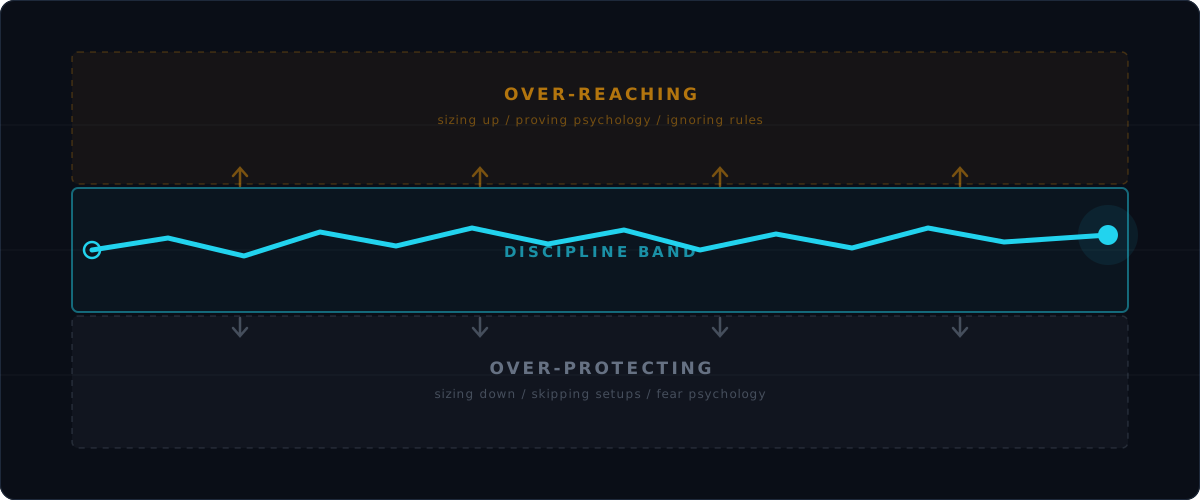
Over-protecting (fear psychology): sizing down below your plan, skipping valid setups, treating every losing day as an existential threat. The account flatlines or slowly erodes from missed opportunity and low-confidence undertrading.
Over-reaching (proving psychology): sizing up after a winning week, taking setups outside your criteria because you feel sharp, letting a hot stretch convince you the rules are guidelines rather than constraints.
Both patterns are predictable after a strong start. Both are driven by emotional state rather than system logic. The discipline that keeps funded accounts alive long-term is the same discipline that sustains a trading practice on bad days — not heroics, but unbroken process.
What the First Payout Actually Does to Your Psychology
The first payout is the most psychologically significant milestone in the funded trader journey — and not only in straightforward ways.
For many traders it creates a genuine shift: the system works, the proof is in the account, and the motivation to protect the process intensifies. That response is constructive.
But a different pattern also appears: once a payout has been received, some traders implicitly start treating the account as house money. The perceived downside of losing access shrinks because they've already extracted value. Position sizes drift upward. Session ending times extend. Setups that wouldn't have passed criteria before the payout start making the cut.
The payout is real evidence that the system is working. It is not permission to revise the system. The traders who build multi-year funded accounts treat the first payout as a data point confirming the process — not a credential that changes it. It's also the moment the money finally becomes real, which is why the psychology of actually withdrawing profits matters as much on a funded account as it does on a personal one.
Why Do Funded Accounts Fail in the First Few Months?
Funded traders describe a consistent pattern across communities: the psychological tests don't stop at the funded milestone — they intensify and change character.
The reasons for early funded account failures are almost never strategic:
- The relief of finally being funded leads to complacency in early sessions
- A bad day triggers the same revenge trading sequence that ends losing streaks badly in any trading context
- Position sizes drift upward gradually, unnoticed, until a single session damages weeks of gains
- The journal gets neglected because results feel automatic for a while — and the feedback loop breaks precisely when it matters most
The solution isn't more chart analysis. It's maintaining the feedback loop that a funded account makes harder to keep intact — because higher stakes raise the emotional noise floor, making objective self-review less natural than it was during the challenge.
MindTradr is built around this feedback loop — tracking emotional state alongside trade execution so the drift between how you're feeling and how you're trading becomes visible before it shows up in the P&L. When you can see that sizing has been creeping on days when focus is low and setups are thin, you can correct course before it becomes a breach.
That correlation — between mental state and decision quality — isn't something the prop firm dashboard shows you. It's the data that keeps the account alive.
The Real Journey Starts After the Gate
Getting funded is a credential. Keeping the account and collecting that first payout is a practice.
The traders still collecting payouts a year after their first aren't the ones who peaked for the challenge — they're the ones who treated the challenge as a calibration for the actual work. Same position sizing. Same routine. Same journal. Different number on the dashboard.
The first payout matters. But it's evidence of a system, not the system itself. Keep building the system.
If you want to track your psychological state through the funded account phase and catch emotional drift before it costs you access, MindTradr is free to start.