
Session Selection: Matching Your Trading Hours to Your Brain
It's 2:30 in the afternoon and you're staring at a chart that made perfect sense at 9:45. Same setup, same rules — but now you're forcing it, second-guessing the entry, clicking too fast. Nothing about the market changed. What changed is you.
Most traders pick their hours by accident: whenever the market is open, whenever they're off work, whenever the "action" is. Almost nobody picks by the one variable that actually decides trade quality — when their own brain is sharp. That choice has a name: session selection.
Your Brain Isn't Awake All Day (and Neither Is Your Edge)
Alertness is not a flat line you top up with coffee. It runs on a daily curve — a rise after waking, a peak, a well-documented afternoon dip, and a decline into the evening. Your prefrontal cortex, the part that follows rules and weighs risk, is measurably better at some hours than others.
This is a different lever from the two you've probably already read about. It's not sleep and trading performance — that's about how rested your baseline is on a given day. And it's not a morning routine for traders — that's the process you run inside a session. Session selection sits underneath both: which hours you sit down at all. You can be fully rested, run a flawless routine, and still trade your worst simply because you chose a window your brain doesn't show up for.
The uncomfortable part: the market doesn't care when you're sharp. It opens on its schedule, not yours. Your job is to find the overlap.
What Is Your Chronotype, and Why Does It Decide Your Best Hours?
Your chronotype is your biological preference for when to be alert and when to sleep — the difference between a natural early riser and someone who doesn't come alive until evening. It isn't a discipline problem or a habit you can simply override. In Why We Sleep, Matthew Walker explains that chronotype is largely genetic: roughly four in ten of us skew toward morning, about three in ten toward evening, and the rest fall in between.
That matters enormously for traders, because your peak alertness window is fixed by biology while your market's hours are fixed by an exchange. If you're a strong evening type forcing yourself to trade the US cash open at 9:30 AM, you're placing your highest-stakes decisions in your groggiest window. If you're a morning lark trading the late New York session, you're clicking buttons after your brain has already clocked out.
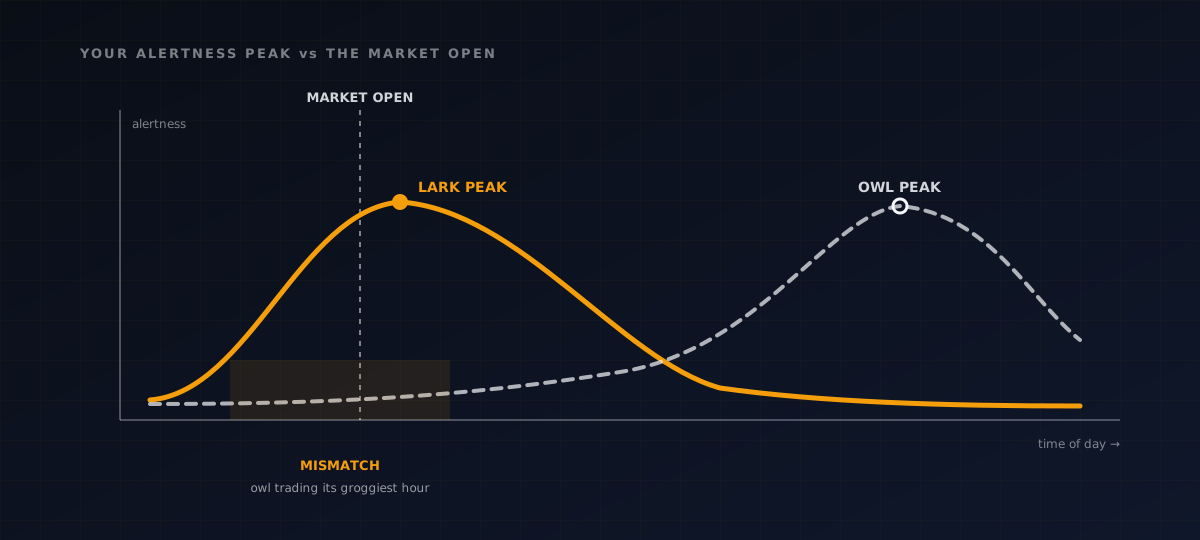
The point isn't that one chronotype is "better." It's that the mismatch between your peak and your session is a hidden, recurring tax — one you pay every day without seeing the line item. Traders blame their strategy for losses that were really just decisions made at the wrong hour.
The Post-Lunch Trough Is Where Discipline Goes to Die
Almost everyone shares one feature of the alertness curve regardless of chronotype: the early-afternoon dip. It's the same slump that makes meetings unbearable at 2 PM — and for a trader, it lands right in the middle of the session.
Here's what the trough does to your trading, in order:
- Focus narrows. You stop reading context and start reacting to the last tick.
- Impulse control drops. The "no trade" you'd take easily at 10 AM feels unbearable now.
- Fatigue reads as boredom. You reach for a trade to feel something, which is exactly how boredom trading and decision fatigue compound into a bad afternoon.
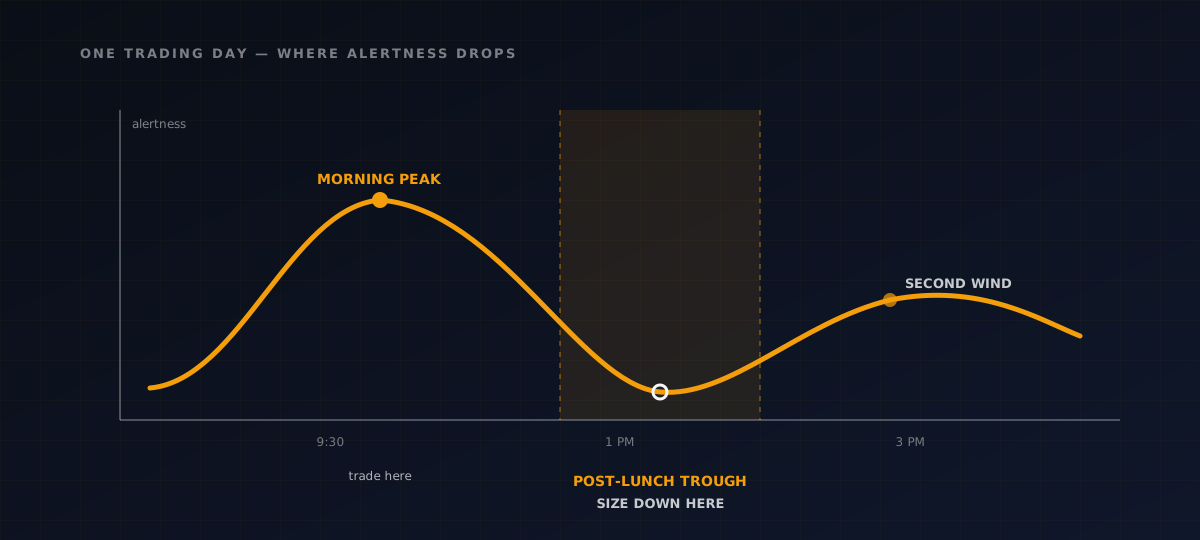
The fix isn't heroics. It's not trading your trough at full size — or not trading it at all. Recognizing that the 2:30 version of you is a different, worse trader than the 10 AM version is the whole insight. Dr. Brett Steenbarger writes often that trading is a performance discipline, and every performance discipline has peak and off-peak windows. Elite performers protect their peak and manage around the dip. They don't pretend they're the same all day.
How to Match Your Trading Hours to Your Brain
You don't need a sleep lab. You need to find your own peak window and then bend your session toward it. The order matters:
- Map your alertness for two weeks. Rate your focus 1–5 at a few fixed times each day — mid-morning, early afternoon, evening. A pattern shows up fast, and it's usually not the one you assumed.
- Find the overlap with a tradable session. If your peak is 8–11 AM, the US open is gold. If it's late evening, the London or Asia sessions may fit your brain better than forcing New York.
- Front-load the hard decisions. Put your discretionary, judgment-heavy trades in your peak window. Save the trough for management, review, or the screen-off "no trade" default.
- Size to the hour, not just the setup. A B-grade setup in your peak may beat an A-grade setup in your trough. When you're off-peak, size down or step away — the same medicine that works after a big win when your judgment is compromised.
- Protect the window like a rule. Your peak hours are your most valuable inventory. Don't spend them on admin, doomscrolling, or a slow chop you'd normally skip.
None of this requires changing your strategy. It changes when you deploy it — which, for most traders, moves the needle more than another indicator ever will.
Make Your Peak Window Visible
The reason session selection stays invisible is the same reason most self-sabotage does: it hides in the timestamps. If your journal only records what you traded, you'll never notice that four of your last five ugly exits happened after 2 PM. The hour is right there in the data, and nobody looks at it.
That's why state and timing belong in the log next to the trade. MindTradr is a trading psychology journal that logs your mood, sleep, and stress alongside your P&L — so a pattern like "my afternoon trades cost me on the days I'm running on short sleep" stops being a hunch and becomes something you can see in your own history. Composure isn't only how you handle a losing trade; it's whether you were ever awake enough to trade well in the first place.
You can't change your chronotype, and you can't move the market's hours. But you can stop scheduling your most expensive decisions into your dullest window. MindTradr is free to start, and one of the first patterns it tends to surface is the one hiding in your clock — the gap between when you trade and when your brain is actually there for it.