
Lucky Hoodies and Cursed Tickers: Trading Superstitions vs Real Rituals
You don't trade well without the hoodie. You know how that sounds. You also haven't washed it in three weeks, because the last two green days happened while you were wearing it, and you're not about to test the theory with live size on the line.
Meanwhile there's a ticker you refuse to touch — it stopped you out twice in one ugly week last spring, and now it's cursed, permanently off the watchlist, no matter how clean the setup prints. Neither of these has anything to do with price. Both of them are quietly making decisions for you. That's the difference between a trading superstition and a real ritual — and it's worth learning to tell them apart before the harmless-looking ones start costing you setups.
Where Trading Superstitions Come From
In 1948, B.F. Skinner put hungry pigeons in a box that dropped food at random intervals — no matter what the bird did. Within days, the pigeons were turning counter-clockwise, bobbing their heads, swinging in the corner. Each one had happened to be doing something when the food arrived, and repeated it, as if the move caused the reward. Skinner called the paper "Superstition" in the Pigeon, and the mechanism is exactly ours: when reward is random, the brain over-fits to whatever it was doing when the good thing happened.
Trading is the most efficient superstition machine ever built. Rewards arrive intermittently and unpredictably, the outcome of any single trade is mostly noise, and you are doing things the whole time — wearing something, sitting somewhere, entering after a coffee. The pattern-matcher in your head grabs the nearest coincidence and files it as cause.
This is a cousin of the illusion of control, but not the same bug. The illusion of control is believing your actions inside a live trade move the price — watching, nudging the stop, refreshing the chart. Superstition is one step more magical: believing something with no plausible link at all — a garment, a lucky number, a cursed symbol — bends the outcome. Same random reinforcement, louder conclusion.
What's the Difference Between a Superstition and a Ritual?
Here's the clean line. A superstition is a belief that an action with no causal path to the result still influences it. A ritual is a repeatable process that changes you — your state, your attention, your decision — which then affects results through an entirely legitimate channel.
The hoodie doesn't touch the market. But writing your intention for the session, or sizing down when you slept four hours, does change what you do next — and what you do next is the only thing you actually control. One is magic. The other is a lever.
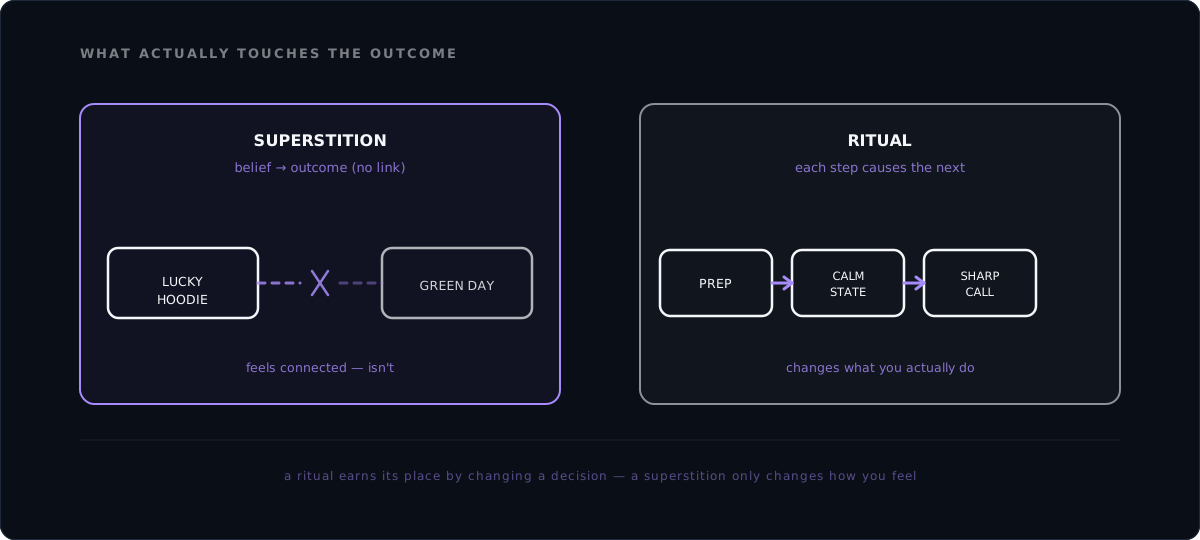
The picture is the whole argument. On the left, the belief and the outcome never actually connect — the line is broken by design. On the right, each step causes the next through a real mechanism. A ritual earns its place by changing a decision. A superstition just changes how you feel while variance does whatever it was going to do anyway.
The One Test That Separates Them
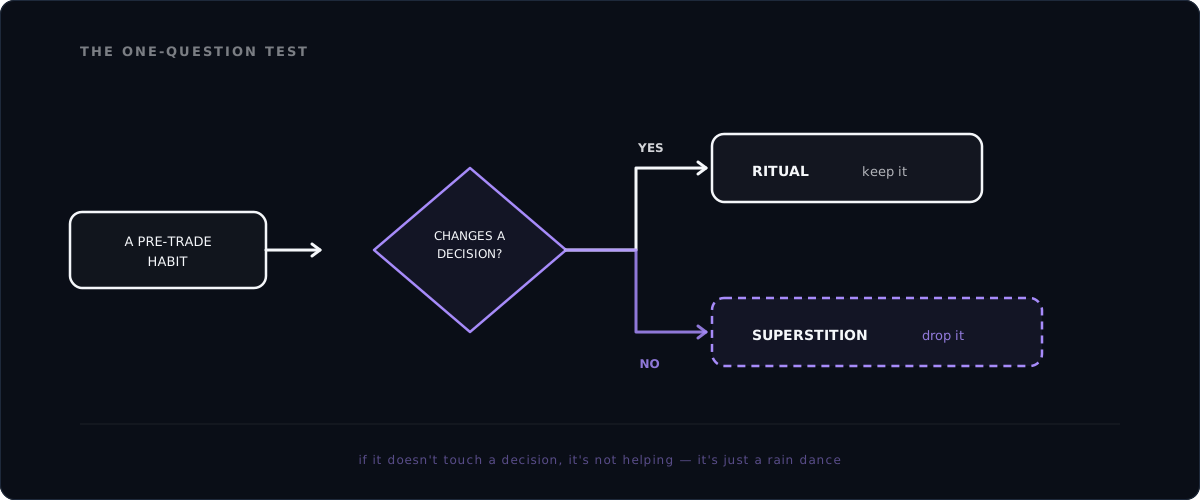
You don't need to psychoanalyze every habit. Ask one question about it: does this change a decision I actually make?
Run your habits through it and they sort themselves fast:
- Real rituals (keep, and make them deliberate): your pre-market checklist, writing one behavioral intention before the open, a fixed daily routine that gets you into "trading mode," stepping away after two losers. Each one alters what you do next.
- Harmless superstitions (strip the magic, keep the comfort if it calms you): the hoodie, the specific chair, the playlist. They don't touch a decision, so they can't hurt you — as long as you don't start believing them.
- Expensive superstitions (drop these on sight): the cursed ticker you won't trade, the "lucky" size-up after a winning ritual, refusing to enter on a Friday. These do change decisions — they just change them for a reason with no edge behind it, and they quietly delete real setups from your book.
That last group is why "it's just a superstition, it's harmless" is a trap. A belief becomes expensive the moment it starts vetoing valid trades or inflating your risk. The cursed ticker isn't neutral — it's a filter you didn't choose, running on a two-trade sample from a bad week.
How to Turn a Superstition Into a Real Ritual
Most superstitions aren't stupid — they're a real need wearing a magic costume. The hoodie is often "I trade better when I feel settled," which is true and usable. The job is to keep the signal and drop the spell.
- Say the belief out loud. "I can't trade without the hoodie." Spoken plainly, most of them stop sounding like strategy and start sounding like what they are.
- Run the test. Does it change a decision? If no, it's décor — enjoy it, don't trust it. If yes, keep going.
- Find the real mechanism underneath. "The hoodie" is usually "I need to feel calm and ready." That's a state input, and state inputs are legitimate — they belong in a routine, not a hunch.
- Rebuild it as process. Replace "wear the lucky thing" with "run a two-minute settle before the open." Now it works whether or not the laundry got done, and it survives the day the hoodie's in the wash.
- Audit the expensive ones. For every ticker you've cursed and every size you've "earned," ask what actual data it's built on. Two trades from a rough week is a superstition. Thirty logged sessions is a rule.
This is the same muscle as trading composure: reacting to what's real about your process instead of the story your pattern-matcher invented from noise.
Log the Ritual, Drop the Rain Dance
The reason superstitions survive is that nobody checks them. You feel like the hoodie works, and feeling is the entire evidence base. Trading coach Brett Steenbarger has argued for years on his TraderFeed blog that your emotional reactions are data about your process — worth studying, not worth obeying. The way you study them is by writing them down and looking later.
That's the check a journal gives you. MindTradr is a trading psychology journal that logs your mood, sleep, and stress alongside your P&L — so a ritual you think is helping shows its work in the data, and a superstition you think is harmless shows its cost. Over enough sessions, "I trade better in the hoodie" either holds up or quietly falls apart, and either answer is more useful than the belief.
Keep the rituals that move a decision. Drop the rain dances that only move your mood. MindTradr is free to start, and one of the first things it tends to surface is how few of your "lucky" habits were ever doing anything but keeping you company.