
Voice Journaling for Traders: Log It While It's Fresh
You close the trade. Your heart rate is still up, and you tell yourself you'll write it up later — the real reason you entered, the moment you almost bailed, the way your chest tightened when it ticked against you. Then the session ends, you open the journal at nine that night, and what comes out is a tidy little lie: "Good setup, took profit early." The truth evaporated somewhere around lunch.
That gap — between what actually happened and what you remember hours later — is where most journaling quietly fails. Voice journaling for traders closes it. You speak the trade the second it's done, while the emotion is still in your body, instead of reconstructing a polished version at night.
Why Voice Journaling Beats Typing
If you already know what to write in a journal and have the prompts to answer, voice isn't a replacement for either — it's the capture method that feeds them. The question here isn't what to log or how to review it. It's how to get the raw material out of your head before it degrades.
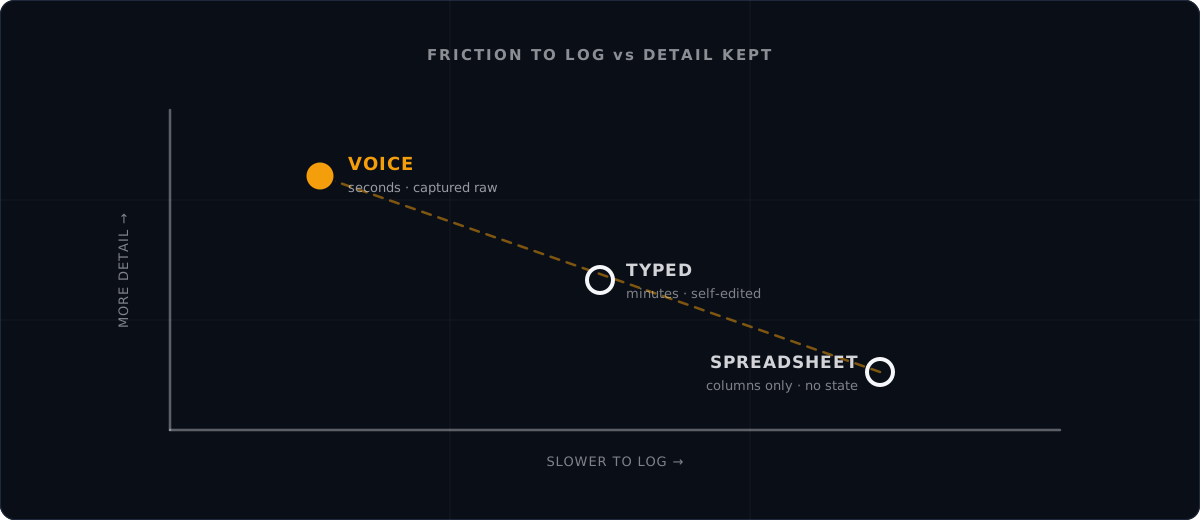
Speaking wins on the dimensions that actually decide whether you journal at all:
- Speed — you can talk far faster than you can type, and lower friction is the difference between a habit and a good intention.
- Fidelity — your tone of voice carries the tilt, the relief, the frustration that a typed sentence flattens into nothing.
- Immediacy — you can log the instant you flatten the position, hands still near the keys, without opening a doc.
- Honesty — it's harder to quietly edit yourself when you're talking in real time than when you're staring at a text box choosing safe words.
The Memory Problem Nobody Warns You About
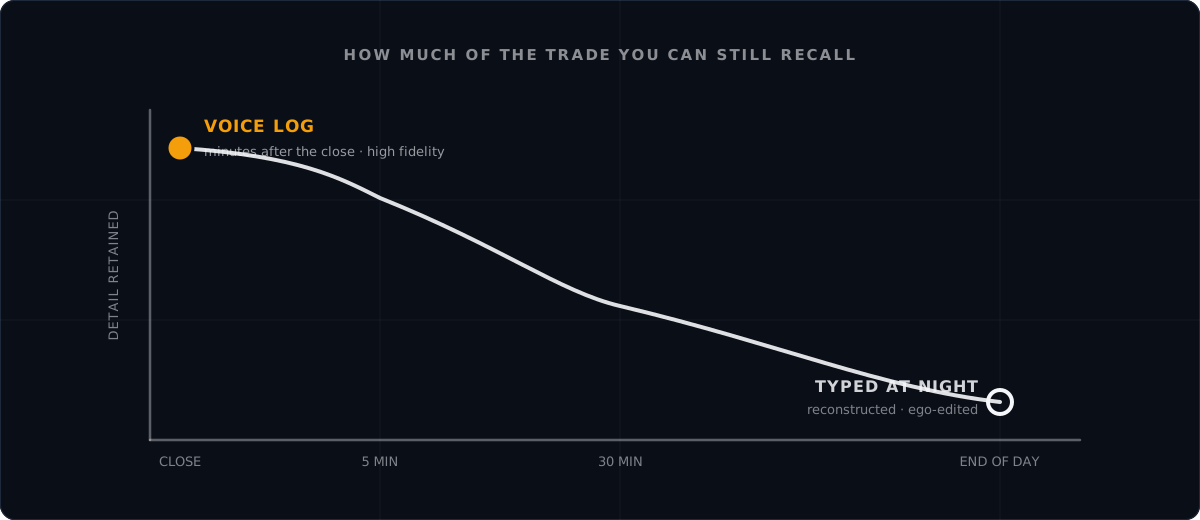
Here's the uncomfortable part: memory isn't a recording, it's a reconstruction. Every time you recall a trade you rebuild it — and your brain rebuilds it to protect your ego. Memory scientist Elizabeth Loftus spent a career demonstrating how easily and how confidently human recall drifts from what happened.
Apply that to trading and it's brutal. By the time you type your journal at night, you're not documenting the trade. You're documenting the story your brain wrote to feel okay about the outcome. The winner becomes "planned," the loser becomes "unlucky," and the impulsive entry you took out of boredom becomes "a read."
The window where your entry is still true is only a few minutes wide. Voice journaling lives inside that window.
What Do You Actually Say Out Loud?
The blank-cursor problem exists for voice too — you hit record and your mind goes empty. So don't freestyle. Talk through a tiny fixed script, the same five lines every time, until it's automatic:
- Why I actually entered — the real reason, said out loud, not the one I'd write down.
- What I felt at entry and at exit.
- Where I deviated from the plan, if I did, and what I was thinking when I did.
- My mood, sleep, and stress right now, one to five.
- The one thing I'd change if I re-took this trade.
Thirty seconds. Five sentences. No typing, no formatting, no cursor. Line 4 is the one traders skip and shouldn't — your worst sessions usually correlate with your state, not your setup, and you can only see it later if you captured it in the moment.
How to Build the Voice Habit Without Cringing
Everyone hates the sound of their own recorded voice. Nobody is listening but you, and future-you will be grateful, so get over it fast. The mechanics are simple:
- Use whatever voice-memo app is already on your phone — no new tool required.
- One recording per trade, and log it before you go hunting the next setup. If you're still watching the last trade's P&L, you're not ready to read the next chart anyway.
- Keep the recordings; the point isn't the audio, it's what you do with it later.
This is deliberate practice, the way Brett Steenbarger frames improvement on his TraderFeed blog — structured repetition with real feedback, not just more screen time. And per Jared Tendler's The Mental Game of Trading, you improve fastest by targeting one pattern at a time, so don't try to narrate a dissertation. Five lines, every trade.
Turning Voice Notes Into Reviewable Data
A pile of audio clips isn't a journal — it's a shoebox of receipts. The value shows up when you convert those spoken notes into something you can pattern-match across dozens of sessions. Once a week, listen back and pull the signal into structured fields: the real entry reason, the yes/no rule check, and especially the numbers from line 4.
That last step is where the note becomes useful. In MindTradr, your mood, sleep, and stress are 1–5 fields you tap right next to the P&L, so the state you spoke into your phone at the close lands as data you can actually chart — and the pattern behind your bad sessions stops being a vibe and becomes a line you can see. Do that consistently and you build composure: the habit of meeting your own trading with a clear head instead of a rewritten memory.
MindTradr is a trading psychology journal that logs your mood, sleep, and stress next to your trades, so the state you capture in the moment becomes a pattern you can review later.
If you want your journal to hold what actually happened instead of the story you tell yourself afterward, MindTradr is free to start.