
The Walk-Away Rule: When Stopping Is the Most Profitable Trade
Two trades down, both clean setups, both stopped out. You're not angry yet — you're calculating. There's an hour left in the session, the number in the corner is red, and some quiet part of you has already decided you're not closing the laptop until it's green again. That decision, the one you made without noticing, is the one that turns a normal down day into the kind you remember for a month.
The walk-away rule is the thing that would have stopped you right there. Not willpower in the moment — a pre-set line you drew when the market was closed, that ends your session the instant you cross it. It's the most profitable trade most traders never take, because it doesn't look like a trade at all. It looks like quitting.
What the Walk-Away Rule Actually Is
A walk-away rule — sometimes called a circuit breaker or a daily stop — is a fixed condition that ends your trading day automatically. Hit it, and you're done: platform closed, no negotiation, regardless of how good the next setup looks.
This is not the same problem as overtrading, which is about taking too many trades across a normal session, or trading tilt, which is the nervous-system state that makes you reckless. The walk-away rule is narrower and more surgical: it's the single line that says this session is over now, before either of those has a chance to empty your account. Overtrading is death by a thousand cuts. The walk-away rule is for the one afternoon that can undo a good month.
The trigger is usually one of three things:
- A daily loss limit — down a set amount (say two of your normal risk units) and you stop, full stop.
- A losing-streak cap — three losers in a row and you're out, even if you're still net green.
- A behavioral trip-wire — you took a trade that wasn't in your plan, so the plan clearly isn't running the show anymore.
Why Stopping Feels Like Losing
Here's why almost nobody follows their own daily stop: closing a red session feels like accepting the loss, and the brain treats accepting a loss as a fresh injury. So it offers you a deal — one more trade to make it right — and the deal sounds reasonable because it's framed as recovery, not risk.
Behavioral finance has shown for decades that losses register roughly twice as strongly as equivalent gains — the loss aversion that Kahneman and Tversky built prospect theory around. That asymmetry is exactly what a walk-away rule is designed to override. Left alone, your brain will always rate "guaranteed small loss now" as worse than "possible big loss later," because the small loss is certain and the disaster is only a maybe. The rule exists precisely because your in-the-moment math is broken.
The reframe that fixes it: stopping is a position, not the absence of one. When you walk away flat, you're choosing to hold cash and preserve tomorrow's capital and clarity. That's a decision with an expected value, and on a bad day the expected value of "one more trade" is deeply negative. You're not quitting — you're taking the highest-EV trade available, which happens to be no trade.
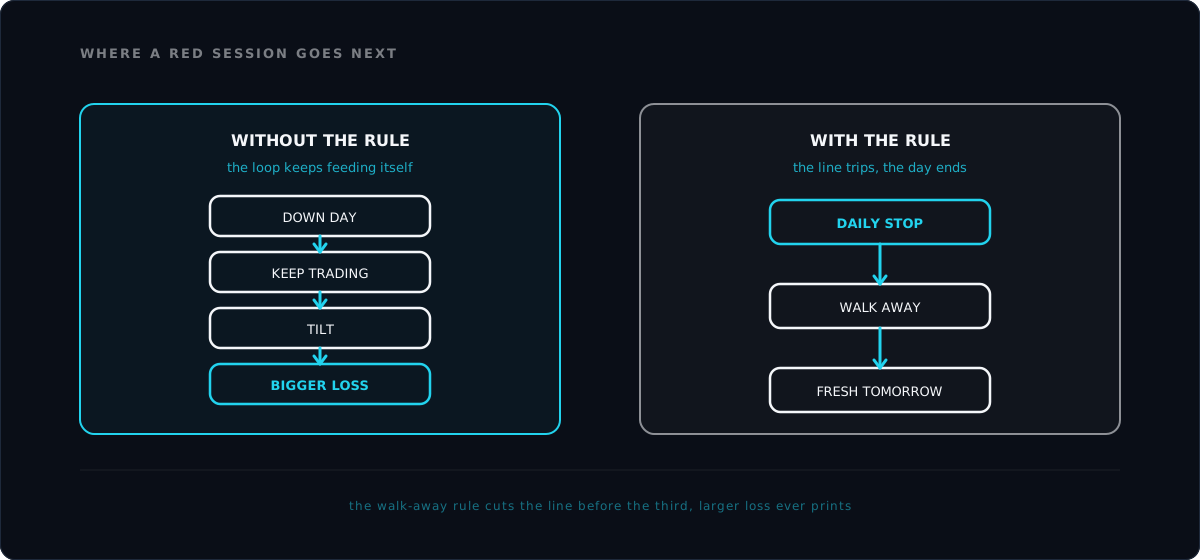
The picture is the whole case. The path without a circuit breaker doesn't end at the second loss — it feeds forward into the exact state that produces the third, larger one. The walk-away rule cuts the line before the feedback loop closes.
What Should Trigger Your Walk-Away?
The rule only works if the trigger is objective — a number or a condition you can check without interpreting your own mood. "I'll stop when I feel off" is not a rule, because the tilted version of you doesn't feel off, it feels right.
Pick triggers you can read off the screen:
- A hard daily loss number. Define it as a multiple of your standard risk, not a dollar figure that drifts with account size. Down 2R for the day and the session ends.
- Consecutive losers, not net P&L. Three stop-outs back to back is a signal about your read of the market today — the conditions aren't matching your edge, and pushing harder rarely fixes that.
- One off-plan trade. The moment you take a trade you can't point to in your written plan, the plan has already lost control. That's your cue to leave, even if that trade won.
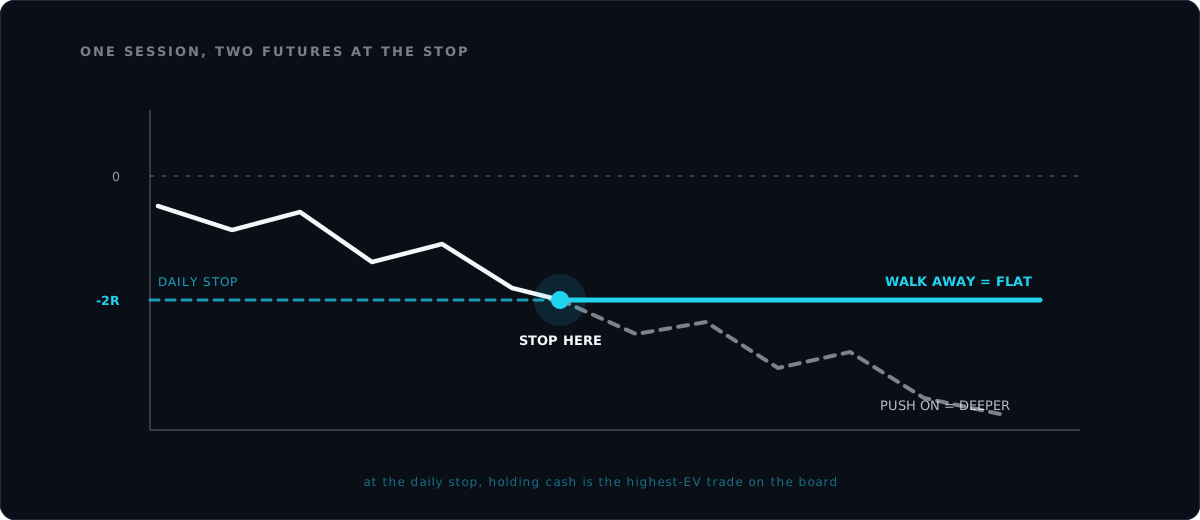
Notice what the second and third triggers protect against: they fire before your P&L hits the floor. A losing streak and an off-plan entry are early symptoms — the daily loss number is the last line of defense. Good circuit breakers catch you at the symptom, not at the wreckage.
How to Make the Rule Stick
A rule you can override at will isn't a circuit breaker — it's a suggestion. The whole point is to move the decision out of the moment where you're least able to make it:
- Write it down before the session, in the same place every day. A pre-market checklist with your daily stop at the top turns overriding it into a visible act of ignoring your own rule — small friction, but real.
- Automate the exit if you can. Set a max daily loss in your platform, or physically close the terminal at the trigger. Friction beats willpower every time.
- Log the stop as a win. This is the part traders skip. When you honor a walk-away, journal it as a disciplined session — because it was — regardless of the P&L. If stopping only ever registers as "the day I lost," your brain keeps voting to trade through it.
That last point is where the habit is actually built. The skill underneath all of this is trading composure — keeping your decisions attached to your process while the pressure is on — and the walk-away rule is composure's bluntest, most reliable instrument. Trading psychologist Brett Steenbarger has argued for years on his TraderFeed blog that the traders who last aren't the ones who feel less — they're the ones who've built routines that act correctly regardless of how they feel. Jared Tendler makes the same case in The Mental Game of Trading: the goal isn't to eliminate tilt, it's to have a default response that costs less than trading through it.
Log the Stop, Not Just the Trades
The reason walk-away rules erode is that nobody scores them. You honor the stop on Tuesday, feel vaguely like you missed out, and by Thursday the rule is negotiable again — because the discipline was invisible and the FOMO was loud.
That's the gap a journal closes. MindTradr is a trading psychology journal that logs your mood, sleep, and stress alongside your P&L — so the day you walked away shows up as a disciplined session in your data, and the day you traded through your stop shows exactly what it cost. Over enough sessions, the pattern gets undeniable: the accounts that survive drawdowns are the ones that stopped on time, and the drawdowns that spiraled almost always have a walk-away rule that got overridden at the top of them.
Draw the line while the market's closed and the rational version of you is in charge. Then let the rule, not the red number, decide when the day is over. MindTradr is free to start, and one of the first things it tends to surface is how many of your worst days were one honored stop away from being ordinary ones.