
The Perfect-Entry Trap: How Perfectionism Wrecks Traders
The setup was clean. Trend aligned, level held, risk defined. But the candle closed a hair below where you wanted, so you waited for the next one to "confirm." That one gapped. Now the entry's worse, so you wait again — for the perfect pullback that never comes. Twenty minutes later price is 3R into the move and you're still flat, telling yourself you were being disciplined.
You weren't. You were being a perfectionist. And in trading, those two things look identical from the outside and cost wildly different amounts.
The Perfect-Entry Trap
Let's separate this from a neighbor it gets confused with. If you freeze on a valid setup because your chest tightens and your nervous system screams danger, that's the fear of pulling the trigger — a threat response you can't logic your way out of in real time. Perfectionism is quieter and more flattering. You're not scared. You're holding out for better, adding one more condition, waiting for the textbook version of the trade to materialize.
The trap is that the market doesn't do textbook. It does good enough, right now, then gone. A perfectionist keeps pricing in a version of the trade that isn't on offer — and pays for it in missed entries, late fills, and a strategy they can never leave alone.
This isn't a character flaw you should feel bad about. In most of life, high standards pay off. In trading, where outcomes are probabilistic and the "perfect" entry is only visible in hindsight, the same instinct becomes a leak.
Why Does Perfectionism Cost Traders Money?
Because trading is a game of edges, not certainties — and perfectionism is a demand for certainty that the market structurally cannot supply.
Mark Douglas built Trading in the Zone around exactly this: any single trade has a random outcome, and your edge only shows up across a large sample. A perfectionist rejects that math emotionally. They want this trade to be the flawless one, so they:
- Wait for conditions that never fully align, and skip valid setups that were 85% of the way there — which is most of them.
- Enter late, after "confirmation," with a wider stop and a worse risk:reward on the exact same idea.
- Over-manage the exit, hunting the perfect top instead of the planned target — the other half of taking profits too early or too late.
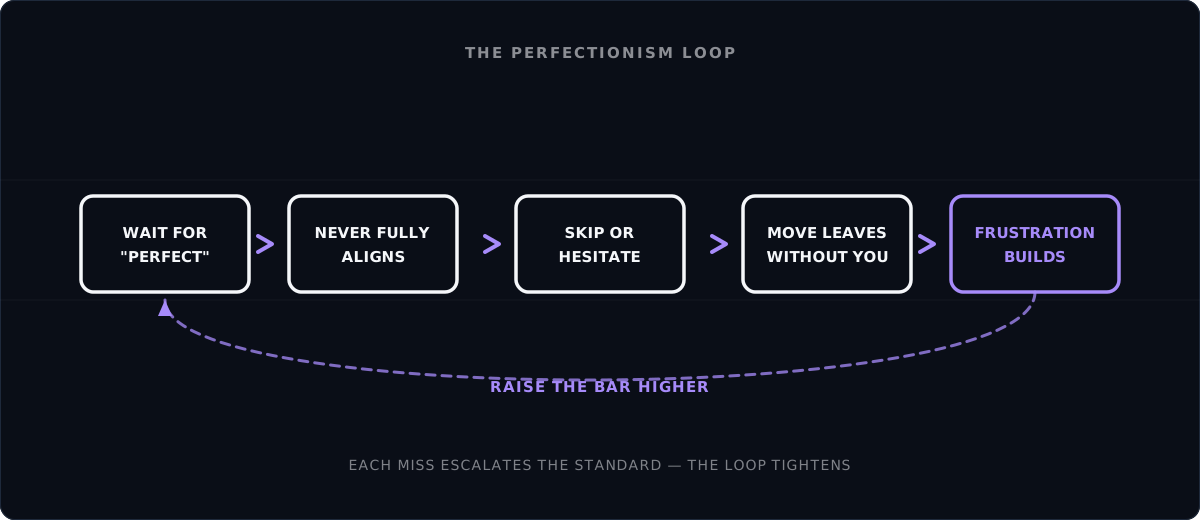
The loop is self-reinforcing. Every missed runner feels like proof you should have waited for something even better next time, so you raise the bar higher — which guarantees more misses. Perfectionism doesn't calibrate itself down after a bad result. It escalates.
Perfectionism Wears Three Disguises
The reason it's so hard to catch is that it never announces itself as perfectionism. It shows up wearing the costume of good habits:
- The endless optimizer. You tweak the strategy after every losing streak, convinced the system is one setting away from flawless. This is how strategy-hopping starts — a working edge abandoned mid-sample because it wasn't perfect. The rule of thumb: if you can't name a fixed number of trades you'll run before you're allowed to change anything, you're optimizing your anxiety, not your edge.
- The setup snob. You've added so many mental filters that almost nothing qualifies. Each new condition feels like rigor. Stacked together, they're a machine for staying flat while the tape prints A-grade setups you disqualified on a technicality.
- The self-flagellator. You take a rule-perfect trade, it loses, and you tear yourself apart anyway — grading the outcome instead of the decision. Punishing good process because of a bad result teaches your brain to fear correct trades.
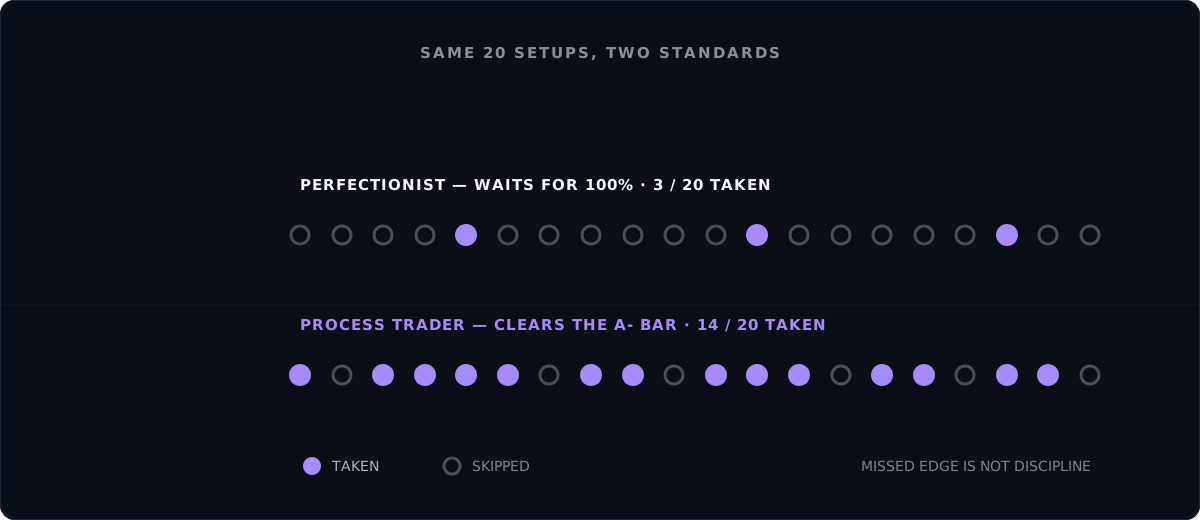
Notice the shared root: all three swap the thing you control — execution quality — for the thing you don't: the outcome. Brett Steenbarger hammers this point on TraderFeed, where he treats trading as a performance discipline judged by process adherence, not by whether any one trade won.
How to Trade Like a Craftsman, Not a Perfectionist
The fix isn't lowering your standards. It's pointing them at the right target — your process, which is trainable, instead of the outcome, which is noise.
- Define "good enough" in advance. Set a fixed checklist and a threshold — say, an A-minus setup — and pre-commit to taking every trade that clears it. The bar lives on paper, not in your mood.
- Cap your conditions. If a real rule can't be checked in a few seconds, it's a vibe, not a filter. Waiting well is patience; waiting forever is perfectionism wearing patience's clothes.
- Score the decision, not the dollars. After each trade, ask one question: did I follow my process? A losing trade with clean execution is a good trade. A winning trade you fluked into by breaking your rules is a warning.
- Run the sample before you touch the system. Commit to N trades before any optimization. Edges only reveal themselves across a sample; perfectionism wants to judge them one candle at a time.
Most traders can't even see which flavor of perfectionism is quietly costing them the most — the endless tinkering, the disqualified setups, or the post-loss self-punishment. If you want to find out which pattern is draining your account, MindTradr's quick quiz maps your behavior to the exact moment your discipline tends to slip.
Score the Process, Not the Perfection
Here's why the leak stays invisible: most journals only log the outcome — entry, exit, P&L. They never record whether you executed your plan or what state you were in when perfectionism took the wheel. So a rule-perfect losing trade and a reckless winner look the same in the numbers, and you learn the wrong lesson from both.
That's the whole point of logging the process next to the result. When your execution score and your composure — mood, sleep, stress — sit beside your P&L, "I keep missing setups" stops being a vague ache and becomes a coachable pattern: I disqualify clean A-minus trades on low-sleep mornings when I'm already frustrated. That, you can fix.
MindTradr is free to start — no credit card required. MindTradr is a psychology-first trading journal that scores your process and tracks your mood, sleep, and stress alongside your P&L, so chasing the perfect trade stops costing you the good ones.