
Living With a Daily Drawdown Limit: Prop Firm Rules and Your Brain
You're down 1.4% on the day. The limit is 2%. Somewhere in the back of your skull, a calculator you never asked for is running: 0.6% left. That's three trades. Maybe two.
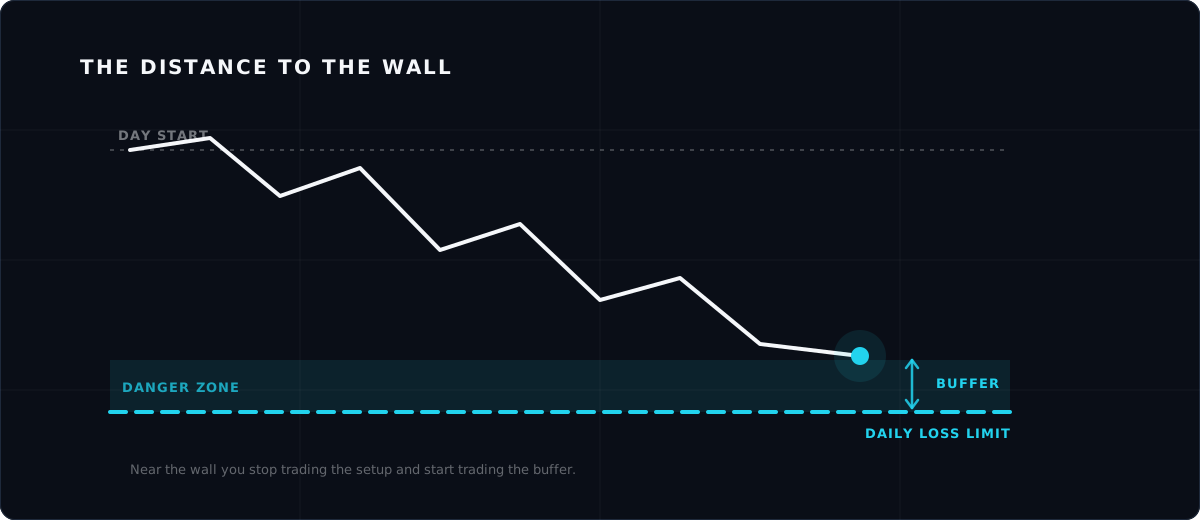
You didn't decide to think about that. It just showed up, and now it's sitting behind every chart you look at. The setup in front of you is clean, but you're not really reading the setup anymore. You're reading the distance to the wall.
That's what a daily drawdown limit does. It's not just a number in the rulebook — it's a number that installs itself in your head and starts making trades with you.
What a Daily Drawdown Limit Actually Does to Your Brain
A prop firm daily loss limit is a hard ceiling that resets every session. Hit it and the day is over — sometimes the account is over. Unlike a personal account, where a bad day just means a smaller balance, here the rule is external, non-negotiable, and it has a same-day guillotine attached.
This is a narrower problem than the two it sits next to. It isn't the broad "can I pass this?" question of a prop firm challenge, and it isn't the slow-burn erosion of a multi-day equity drawdown. It's the specific daily mechanic: a fresh ceiling every morning, and a "distance to the limit" figure your brain computes on every single trade whether you want it to or not.
The mechanism underneath is anchoring. Your attention latches onto the buffer — the gap between where you are and the limit — and that gap becomes the reference point every decision gets measured against. I've written about how this reference-point trap distorts trade reads in anchoring bias in trading; the daily limit is that same bias with a countdown timer bolted on.
The result is that you stop trading the market and start trading the buffer. Two traders can see the identical setup — one with a full daily buffer, one with 0.4% left — and make opposite decisions. Same chart. Same edge. The rule moved the decision.
The Specific Traps of a Hard Daily Ceiling
The daily limit doesn't fail you in one obvious way. It leaks into your decisions from several directions at once:
- The buffer freeze. Close to the limit, you stop taking genuine A-setups because the math feels existential. Passing on five real trades to protect a number is not discipline — it's a different way of losing, just slower and quieter.
- The morning fire sale. With a full buffer at the open, some traders feel rich — over-sizing early because "I've got room today." The buffer isn't spare cash. It's the last thing standing between you and a failed account.
- The reset-day revenge. The limit resets tomorrow, which quietly tells your brain the damage is erasable. So you push the last trade of a losing day, reasoning you get a clean slate at midnight. You don't get a clean slate on a blown account.
- Tick-level fixation. Inside the danger zone, every price tick feels amplified. Your time horizon collapses from "my edge over 50 trades" to "please don't let this next candle end my day."
None of these are strategy failures. Your entries can be perfect and the daily limit will still walk you into all four — because it's operating on your attention, not your analysis.
Should You Set Your Personal Limit Below the Firm's?
Yes — and it's the single most useful move here. The firm's limit is the disqualification line. Your job is to never make decisions near it, because that's exactly where your judgment degrades. So you build a buffer inside the buffer.
Set a personal daily stop at roughly half the firm's limit. If the rule is 2%, you're done at 1%. This isn't timidity — it's keeping every decision inside the zone where your prefrontal cortex is still in charge, well away from the tick-level fixation that starts as you approach the real wall.
Two things make this work in practice:
- Write the personal number down before the open. A limit you set mid-slide is a negotiation, and you always lose that negotiation. The number has to exist before there's any P&L to defend.
- Treat hitting your personal stop as a win, not a defeat. You protected the account and you protected tomorrow's decisions. Stopping at 1% on a bad day is a rule followed, not an opportunity missed. Dr. Brett Steenbarger writes often that the trader's real edge is consistency of process, not maximizing any single session — and a self-imposed floor is process, not surrender.
How to Trade Like the Limit Isn't There
The traders who survive under a daily cap share one habit: they make the ceiling irrelevant by never getting close to it. The limit is a fence at the edge of a cliff, and they simply don't picnic near the fence.
- Front-load your review, not your size. Do your prep before the open so your first trades come from a plan, not from a full-buffer sugar rush.
- Name the buffer thought when it shows up. The moment you catch yourself computing "trades left," that's the signal — not to trade, but to log it. Naming the pressure is what pulls it out of your blind spot.
- Log your emotional state next to the trade, not just the P&L. Was that entry a real setup, or a buffer-anxious flinch? You can't answer that from the price alone.
That last point is the whole reason MindTradr exists. Jared Tendler, in The Mental Game of Trading, calls this "pressure-induced regression" — under stress you drop to less-developed behavior, and you rarely notice it happening. The only way to catch it is to have logged what you were feeling when you pulled the trigger, so you can see the pattern across sessions instead of re-litigating a single bad day.
MindTradr is a trading psychology journal that logs your mood, stress, and sleep alongside every trade — so a funded trader can see when the daily drawdown limit, not the setup, is driving the decision. In a prop firm account, that link between emotional state and trade quality is the early-warning signal that shows up days before it hits the balance.
The daily limit isn't the enemy. It's a mirror. It shows you, every single session, exactly how you behave when a hard number is watching — and that's information worth having whether you're funded or not. If you want to catch buffer-anxiety before it costs you the account, MindTradr is free to start.
Already through the challenge and eyeing the payout? The funded trader's first payout picks up where the daily grind leaves off.