
Recency Bias: Why Your Last 5 Trades Control Your Next One
Five red trades in a row. Same setup you've traded for months, same rules — it just isn't landing today. Then a clean signal prints, textbook, exactly the thing you're supposed to take. And you don't. Your hand hovers, and a quiet voice says not today, it's not working.
Nothing about that sixth setup changed. What changed is that your brain is now running the whole market off a sample size of five. That's recency bias — and it's steering your next trade before you've even looked at the chart properly.
What Is Recency Bias in Trading?
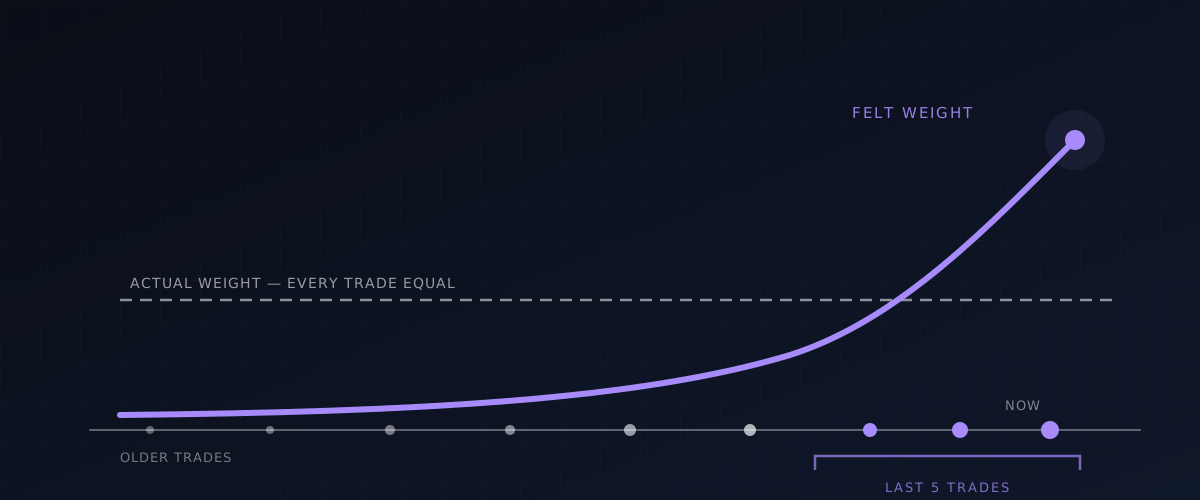
Recency bias is the tendency to weight your most recent experiences far more heavily than older ones when you judge what's likely to happen next. A handful of fresh outcomes feel like the truth about the market right now, while everything before them fades into background noise.
In trading, that means your last five trades quietly overwrite the last five hundred. A short losing run convinces you the setup is broken. A short winning run convinces you you've finally "figured it out." Neither streak is a big enough sample to conclude anything — but recency doesn't care about sample size. It cares about what happened last.
This is worth separating from a close cousin. The gambler's fallacy says a streak is due to reverse — "I've lost four, the fifth has to win." Recency bias usually points the other way: it makes you extrapolate the streak forward — "I've lost four, so trades aren't working." Same recent data, opposite conclusion, both wrong for the same reason: five trades can't tell you what the next one will do.
Why Do Your Last Five Trades Feel Like the Whole Market?
Because your brain retrieves what's easy to recall and treats ease of recall as evidence. This is the availability heuristic, which Daniel Kahneman lays out in Thinking, Fast and Slow (2011): we estimate how likely something is by how easily examples come to mind. Your last five trades are vivid, recent, and emotionally loud. The forty trades before them are a blur.
So when you sit down to size the next position, the "data" your gut serves up isn't your real distribution of outcomes. It's the handful of trades still ringing in your ears. Recent, emotional, and small — the worst possible sample to reason from — is exactly the sample your brain reaches for first.
The market, of course, has no idea what your last five trades were. Your edge is defined over hundreds of occurrences, not the last afternoon. But the last afternoon is what you feel, and feeling beats statistics when you're tired or rattled.
The Two Faces of Recency Bias
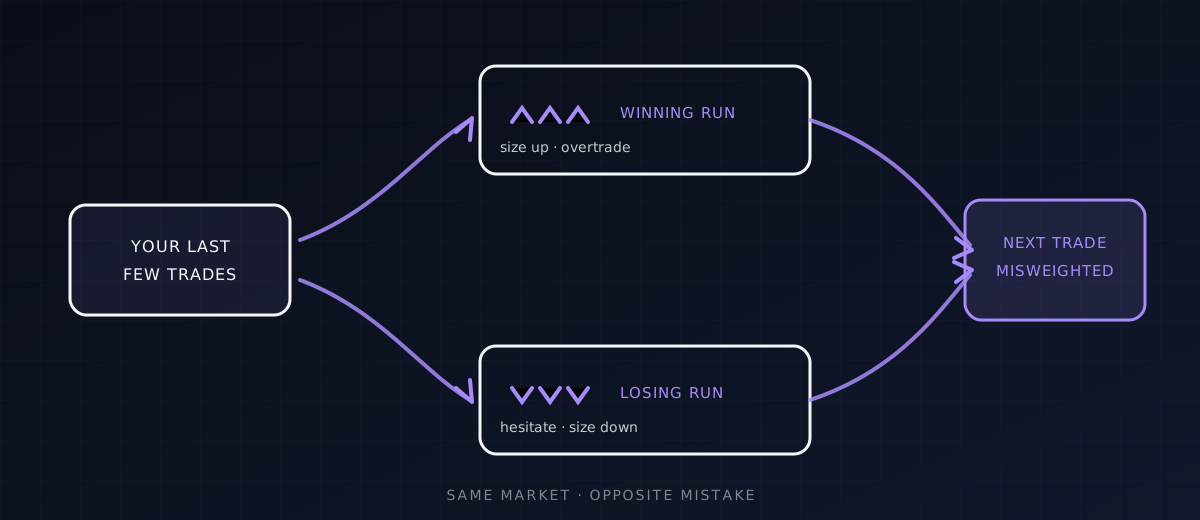
Recency bias isn't only a losing-streak problem. It flips your behavior in both directions, and the winning-side version is sneakier because it feels earned.
- After a losing run: you shrink. You cut size, hesitate on valid setups, tighten stops into the noise, or sit out the exact conditions your edge is built for. The market didn't change — your read of it did. This is the same fear-of-the-trigger spiral that follows any rough patch of streaks.
- After a winning run: you swell. You size up beyond your plan, take marginal setups because "everything's working," skip the checklist, and hold too long because you feel unstoppable. This is the recency version of overconfidence — and it usually front-runs the giveback.
The tell is the same in both cases: your position size and your setup filter are moving with your recent results instead of with your rules. When the last few trades set today's risk, recency is driving.
Recency Bias vs the Gambler's Fallacy
It's worth nailing the difference, because the fixes overlap but the misreads don't. The gambler's fallacy is a bet against recent history ("I'm due"). Recency bias is a bet with it ("this is how the market is now"). One expects the pattern to snap; the other expects it to hold. Both mistake a small, recent sample for a signal about the very next trade — which is why traders who fall for one usually fall for the other, just on different days.
The antidote to both is the same: judge the trade in front of you on its own merits, not on the ones behind it.
How to Beat Recency Bias
You don't fix this with willpower, because willpower is exactly what a five-loss streak burns through. You fix it by making the recent sample smaller in your decision and the full sample larger.
- Zoom out your own stats. Before the session, look at your edge over the last 100+ trades, not the last five. Anchoring on the real distribution shrinks the last afternoon back to its actual size.
- Fix size before the open, not during it. Decide position size from your written rules ahead of time, so a hot or cold streak can't renegotiate it mid-session.
- Score the setup, not the streak. Ask the fresh-eyes question: would I take this trade, at this size, on a clean account with no recent history? If yes, take it. If your only hesitation is "the last few didn't work," that's recency talking.
- Log the state, not just the result. Note what your recent run was and how you felt going into each entry — mood, sleep, stress — next to the trade itself.
That last one is where the pattern stops being invisible. In MindTradr, you log your emotional state, sleep, and stress alongside each trade, so you can look back and see which entries were driven by a clean read and which were driven by whatever your last five trades did to your head. It's the same composure muscle behind staying level when a position moves against you (more on that in trading composure) — and Mark Douglas built the whole argument of Trading in the Zone (2000) on it: the traders who last are the ones who treat every setup as one sample in a long series, not as a referendum on the last one.
Your last five trades are the loudest voice in the room. They're almost never the most useful one.
MindTradr is a trading psychology journal that logs your mood, sleep, and stress next to your trades, so you can see when recent wins and losses — not your actual edge — are steering your decisions.
If you want to catch recency bias before it sizes your next trade for you, MindTradr is free to start.