
Why You Quit Journaling After Two Weeks (And How to Restart)
It's day fifteen. Your journal has four solid entries, then a couple of rushed ones, then a single line that just says "rough day." You know you should open it. You don't. By Friday the tab is closed, and the habit is quietly dead — again.
You've done this before. Maybe more than once. Every time you're convinced this is the round where journaling finally sticks, and every time it drops off somewhere around the two-week mark.
Here's the thing worth saying up front: you didn't fail because you lack discipline. You quit journaling because the version you built was designed to be abandoned. This post isn't about how to set up a journal you'll actually fill out — it's about why the one you already have keeps dying, and how to restart it so it survives past week two.
Why You Quit Journaling After Two Weeks
The two-week cliff is almost universal, and it has a predictable shape.
You start a journal on motivation. You've just had a painful loss, or read something that lit a fire, and for a week or so the energy carries you. Motivation is a great starter and a terrible engine — it burns hot, then it's gone, usually right around the time the novelty wears off.
By week two, three things line up against you at once:
- The entries are too big. You built a template with twelve fields. On a good day that's fine. On a losing day, a twelve-field post-mortem feels like punishment, so you skip it — and one skipped day breaks the chain.
- There's no feedback yet. Two weeks isn't enough data to see a pattern, so the journal feels like effort with no payoff. Your brain is very good at quietly dropping things that cost effort and return nothing.
- You only logged the interesting trades. The big wins and ugly losses got entries. The flat, boring, "did my job" trades didn't — which means the record is already incomplete, and an incomplete record feels not worth maintaining.
None of that is a character flaw. It's the natural decay curve of any habit that runs on motivation instead of design.
Is the Problem Discipline, or Design?
It's design — almost every time.
The behavior scientist BJ Fogg, who runs the Behavior Design Lab at Stanford and wrote Tiny Habits, has a simple model for why habits stick or die: behavior happens when motivation, ability, and a prompt arrive together. When motivation dips — and it always does — the only way the behavior survives is if the ability cost is low enough to clear the bar anyway.
Your twelve-field journal has a high ability cost. So the moment your motivation drops below "enthusiastic," the whole thing collapses. You didn't need more willpower. You needed a smaller journal.
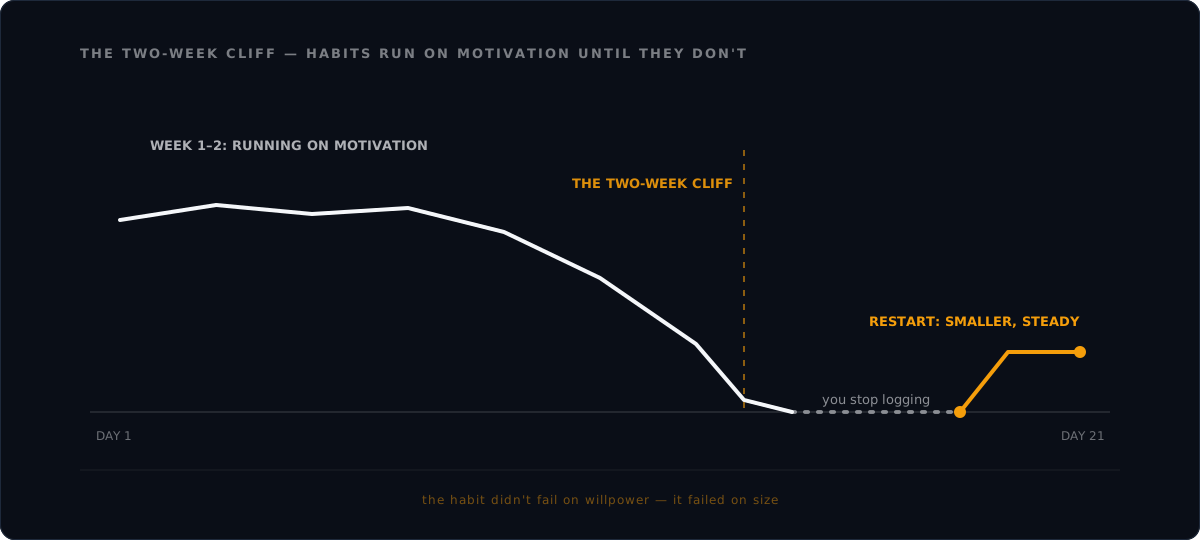
That's why the restart matters more than the fresh start. A fresh start rebuilds the same oversized habit that failed last time. A real restart rebuilds it smaller.
The Real Reasons the Habit Dies
Before you restart, it helps to name exactly what killed the last attempt. In practice it's almost always one of these:
- The entry was too long. If logging a trade takes longer than the trade took to plan, you'll stop.
- There was no trigger. "I'll journal at the end of the day" is not a trigger — it's a hope. A habit needs to be pinned to something that already reliably happens.
- You only wrote on emotional days. Journals kept only when you feel like it become journals about your feelings, not your process — and they read like a diary of regret.
- Perfectionism. One missed day felt like failure, so you gave up the whole thing rather than log a messy, partial entry.
Notice what's not on that list: laziness. The people who quit journaling are usually the most diligent — they built something so thorough it couldn't survive contact with a bad week.
How to Restart (Smaller Than You Think)
Restarting is not "try harder this time." It's rebuilding the habit at a size that a losing day can't kill.
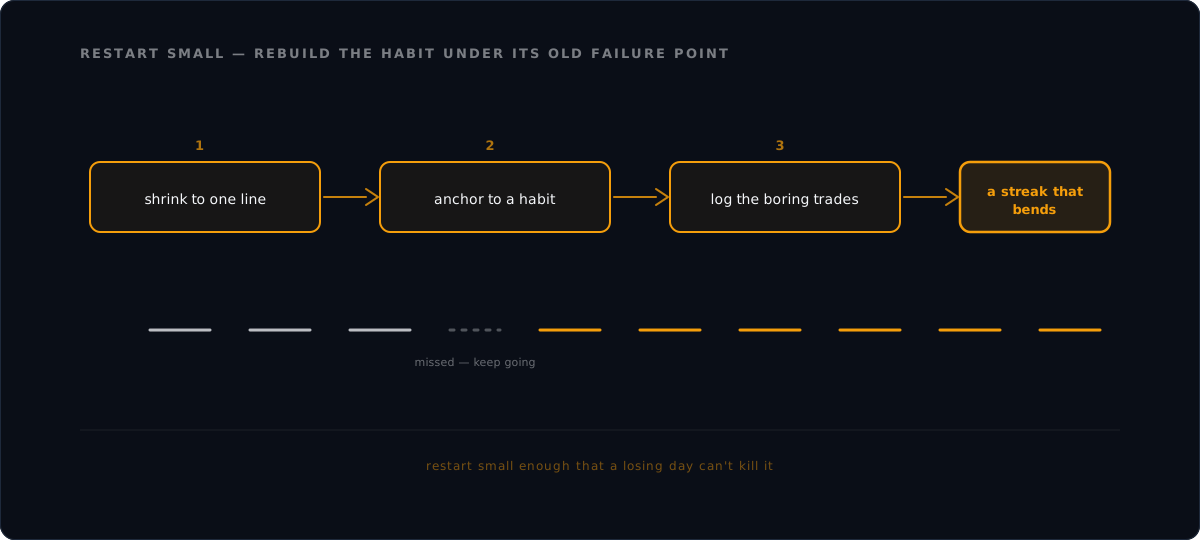
Shrink the entry to one line. Not twelve fields — one sentence. "Took the breakout, chased it late, felt rushed." That's a complete, useful entry. This is the whole idea behind micro-journaling — the 20-second trade log: build the habit at a size a bad day can't kill, then add depth later once it's load-bearing.
Anchor it to something that already happens. Don't journal "at the end of the day." Journal right after you close a position, or the moment you shut the platform. Attach the new habit to an existing, reliable one — Fogg calls this the anchor, and it's the difference between a habit and a good intention.
Log the boring trades too. The flat, rule-following trades are the ones that build your baseline. When you only log drama, you never learn what "normal" looks like — and normal is what you're trying to protect.
Let missed days stay missed. A broken streak is not a failed habit. Log today, ignore the gap, keep going. The goal is a streak that bends, not one that shatters the first time you skip. Once one-line entries are automatic, you can layer back in the prompts that turn a log into real self-review.
A Journal That Survives a Losing Day
The reason a one-line entry works isn't just speed — it's that it lowers the emotional cost of showing up on the days that matter most. The days you least want to journal are the days the entry is most valuable, so the entry has to be trivially cheap to make.
That's the whole design philosophy behind MindTradr: capture your state in seconds, not minutes. You log the trade with one tap and a quick read on your mood, sleep, and stress alongside the P&L — the inputs that quietly shape your composure — so the record builds itself even on the days you'd normally walk away. Consistency, not depth, is what makes a journal pay off, and consistency comes from lowering friction, not raising willpower.
If your last three journals died at the two-week mark, don't start a fourth big one. Start a tiny one. MindTradr is free to start — and it's built on a simple bet: a trading journal you actually keep, even a one-line one, beats a perfect one you abandon by Friday.