
Micro-Journaling: The 20-Second Trade Log That Sticks
You just closed the trade. You mean to write it up — you really do — but another setup is already forming, your hands are still a little shaky, and opening the twelve-field template feels like homework. So you tell yourself you'll do it tonight. You won't. The entry that never gets written is the most common trade in every journal.
That's the exact failure mode micro-journaling is built to beat. A micro-log is a deliberately tiny trade record — one you can finish in about twenty seconds, standing up, before the next candle prints — made so small that a losing day can't talk you out of it.
Micro-Journaling: The 20-Second Trade Log That Sticks
Before we go further, let's separate this from three ideas it gets confused with, because they solve different problems:
- If your journals keep dying at the two-week mark, that's a restart problem — read why you quit journaling instead.
- If the issue is capturing emotion before it fades, the fix is a medium, not a format: voice journaling lets you speak the trade while it's still raw.
- If you want the deep questions that turn a log into real self-review, that's what trading journal prompts are for.
Micro-journaling is none of those. It's the steady-state format — the smallest complete log that still produces reviewable data, meant to run for years without ever becoming a chore. It isn't an emergency shrink you do after quitting; it's the size you build at from day one so you never quit in the first place.
The bet underneath it is simple: the best journal is the one you actually keep. A flawless post-mortem you write once a week loses badly to a scruffy four-line log you write on every single trade, because patterns live in the boring trades you'd otherwise skip.
What Goes in a 20-Second Trade Log?
Four things. Nothing more, or it stops being twenty seconds.
- Real reason I entered — the honest one, three words. Not "good setup." Try "bored, forced it" or "clean retest."
- Rule check — did I follow my plan? Yes or no. No partial credit, no essay.
- State — mood, sleep, stress, on a 1–5 scale each. Numbers, not sentences.
- One fix — the single thing I'd change if I re-took it.
That's the whole log. No screenshots, no paragraphs, no grading the P&L. The P&L is already recorded by your broker; what your broker can't see is why you clicked and what state you were in — which is the only part worth your twenty seconds.
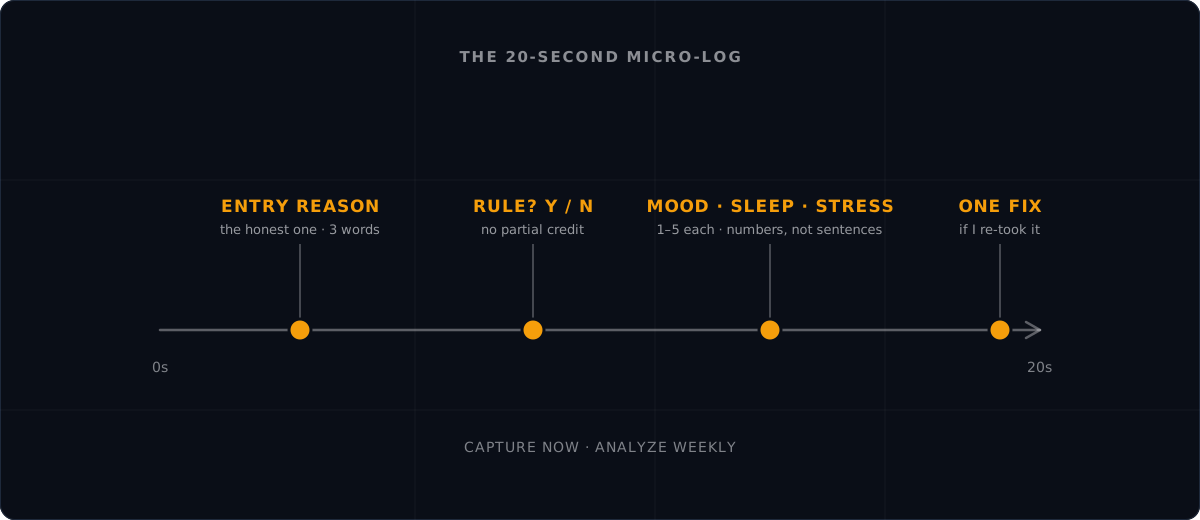
Notice what's missing: the analysis. Analysis is a weekly job you do once, across thirty logs, when you're calm. The micro-log's only job is capture — get the raw truth down before your brain rewrites it into a flattering story.
Why Smaller Beats Thorough
This feels backwards. Surely a richer entry is a better entry? Not if you don't write it.
Behavior scientist BJ Fogg, who runs the Behavior Design Lab at Stanford, frames it cleanly: a behavior happens only when motivation, ability, and a prompt line up. Motivation is unreliable — it spikes after a painful loss and evaporates by Friday. The only lever you actually control is ability: make the action so cheap it clears the bar even on the days you feel like doing nothing. A twelve-field template has a high ability cost, so it collapses the moment your motivation dips. A twenty-second log doesn't.
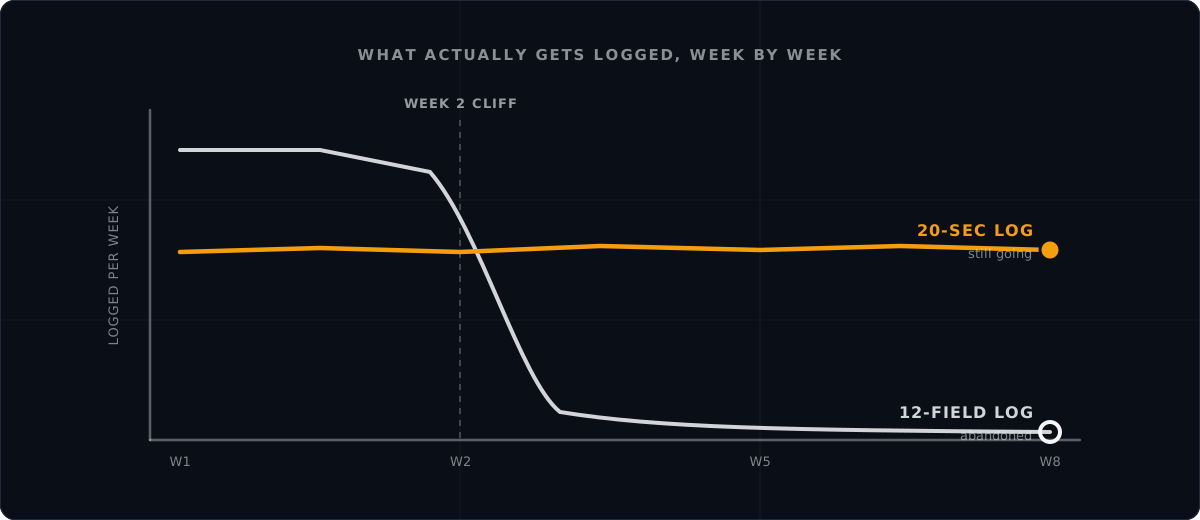
The compounding is the whole point. Brett Steenbarger describes improvement as deliberate practice on his TraderFeed blog — structured repetition with feedback, not just more screen time. Deliberate practice needs reps. Forty scruffy micro-logs beat four polished essays and a three-week gap, every time, because you can't pattern-match on data you never collected.
And consistency matters more than depth for a reason people underrate: it protects the record on the days that count most. Your worst sessions are exactly the ones you least want to write up — which is why the entry has to be trivially cheap to make.
How to Make It a Reflex
A tiny log still dies if you leave when to write it up to chance. Pin it to something that already happens:
- Anchor it to the close. Log the instant you flatten the position, hands still near the keys — not "at the end of the day," which is a hope, not a trigger.
- Log before the next chart. If you're still watching the last trade's P&L, you're not ready to read the next setup anyway. The micro-log is the clean break between them.
- Log the boring ones too. The flat, rule-following trades are your baseline. Skip them and you only ever journal drama.
- Let missed logs stay missed. One gap is not a failed habit. Log the next one and keep the streak bending instead of shattering.
The state field is the one traders drop first and shouldn't. Most people can't even name which state quietly pulls them off-script — revenge after a red trade, the itch to size up on a green one, boredom in a dead tape. If you'd like to find out which pattern is costing you the most, the MindTradr quiz maps your behavior to the exact moment your discipline tends to slip.
From Micro-Log to Real Data
A pile of twenty-second logs isn't the finish line — it's the raw material. The payoff comes once a week, when you read thirty of them together and a pattern you'd never have felt in the moment jumps off the screen: I break my rule on 2-out-of-5 sleep days when I'm already down. One noisy trade hides that. Thirty logged trades reveal it.
That's the entire design behind MindTradr: your entry reason, a one-tap rule check, and your mood, sleep, and stress ratings are fields you tap, not sentences you write — so a full log really does take seconds, and the state you capture becomes a line you can chart. Do it enough and you build composure: the habit of meeting your own trading with a clear head instead of a rewritten memory.
MindTradr is free to start — no credit card required. MindTradr is a psychology-first trading journal that logs your mood, sleep, and stress next to your P&L in seconds, so the tiny log you keep today becomes the pattern you can see tomorrow.