
Sizing Up: The Psychology of Trading a Bigger Account
You doubled your account, so today you're trading double the size — and the position that used to be a shrug is now sitting on your chest. The chart looks identical to a hundred trades you've taken before. Your rules haven't changed. But your finger is hovering over the exit at the first tick against you, and you can't figure out why the same setup suddenly feels dangerous.
Nothing about the market changed. The number in your risk field did. Trading a bigger account is a psychological event before it's a financial one, and most traders walk into it assuming the skills that got them here will carry over automatically. They don't — not without work.
Why Trading a Bigger Account Feels Different at the Same Risk
Here's the trap. You tell yourself size doesn't matter because you're still risking the same percentage — 1% is 1% whether the account is $5,000 or $50,000. Mathematically, true. Emotionally, worthless.
Your nervous system doesn't process percentages. It processes the dollar figure it sees flashing red. A 1% loss on a small account is lunch money; the identical 1% on a bigger account is a week's pay evaporating in real time. Same risk model, completely different threat signal to your brain.
This is a different problem from the one where you impulsively balloon your size after a hot streak — that's a leak, and it has its own fix in position sizing and psychology. Scaling up is the opposite: a deliberate, planned step to a bigger account where the challenge isn't restraint, it's staying composed while every trade now carries more felt weight. And it's the mirror image of the small-account problem, where the numbers are tiny but the emotions are somehow enormous. The constant across all three: your emotional response tracks the stakes you perceive, not the risk you actually took.
What Actually Breaks When You Size Up
The damage from sizing up too fast rarely shows up as one dramatic blowup. It shows up as your normal edge quietly degrading, trade by trade, because a bigger number is hijacking your execution. Watch for these:
- You cut winners early. A $500 open profit screams "lock it in" louder than a $50 one ever did, so you take partials or bail before your target — quietly taking profits too early and shrinking your average win.
- You freeze on entries. The setup is clean, but the size makes you hesitate, and you miss it — then chase it late at a worse price.
- You widen stops to "give it room." Really you're just trying to avoid feeling the bigger loss, converting a planned small loss into an unbounded one.
- You over-monitor. You babysit the position tick by tick instead of trusting the plan, which only amplifies every micro-move into a decision.
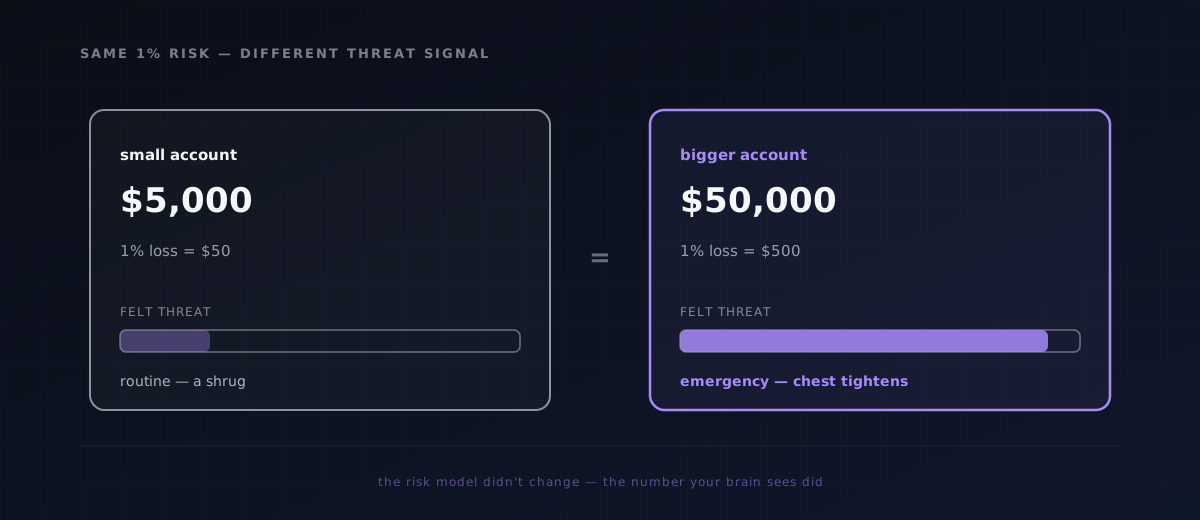
None of these are strategy failures. They're composure failures, triggered by a number your brain hasn't been trained to see as normal yet. The account grew in a day; your tolerance for the new dollar swings didn't.
How Do You Trade a Bigger Account Without Choking?
You acclimatize the way you'd acclimatize to altitude — in steps, not in one jump. The goal is to let the new dollar amounts become boring before you add more.
- Scale in increments, not leaps. Bump size by 20–30%, not 200%. Trade the new level until a normal loss stops producing a spike — then step up again. Example: if a full-size loss at the new tier still makes your pulse jump after a dozen trades, you moved too fast; hold there longer.
- Anchor to R, not dollars. Define every trade in units of risk (1R, 2R) and review your journal in R. It keeps the shape of your performance visible while your brain slowly renormalizes the cash.
- Pre-commit before the session. Decide your size and your stop before the open, when you're calm. A number chosen cold holds far better than one you're negotiating with mid-trade — the essence of trading composure.
- Track the state, not just the score. Log how the bigger size felt alongside the result. If sizing up correlates with worse decisions, you'll see it in weeks instead of learning it the expensive way.
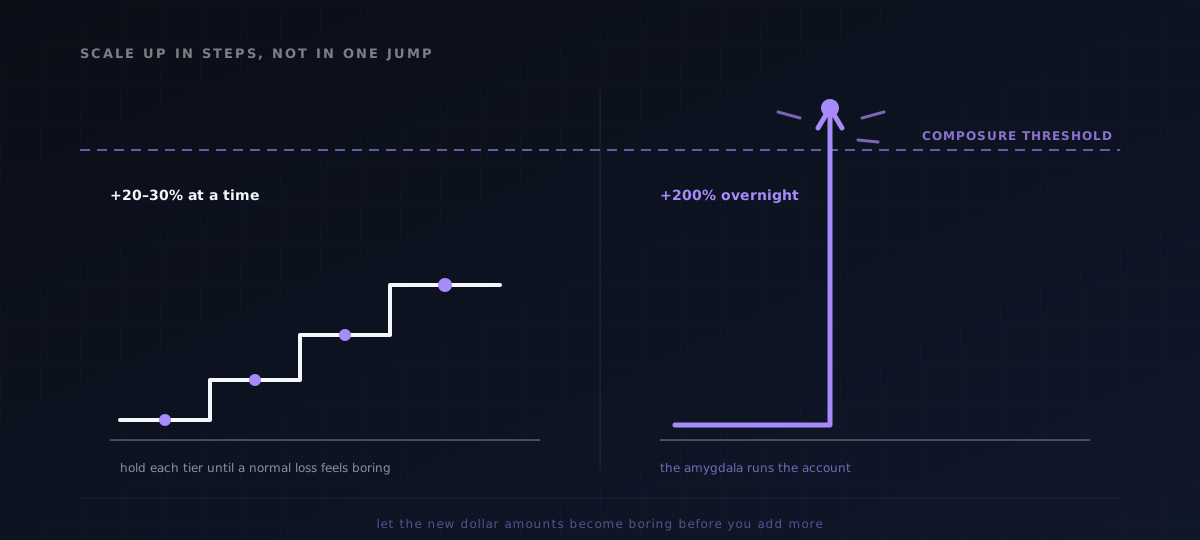
Trading coach Brett Steenbarger has written for years on his blog that performance under pressure comes from rehearsal and self-awareness, not willpower — you build tolerance for a new level by exposing yourself to it in controlled, repeated doses. Sizing up is exactly that kind of exposure. Rush it and your amygdala runs the account; pace it and your process stays in charge. This is the same "trading without fear" state Mark Douglas describes in Trading in the Zone — one you reach by making the stakes familiar, not by white-knuckling through them.
Scale the Account and Your Nervous System Together
The mistake isn't sizing up. It's sizing up your capital without sizing up your composure to match — leaving a gap where a routine drawdown feels like a crisis. If you've been through a rough stretch at the new level, the drawdown psychology that applies to any losing streak hits twice as hard when every dollar figure is bigger.
The fix is to treat your emotional tolerance as something you train on purpose, at the same pace as the account. That starts with making the invisible part visible: logging how a bigger position actually felt — your stress, your sleep, your impulse to override — right next to what you did with it. This is exactly what MindTradr is built for: you record your state alongside every trade, so the correlation between "I sized up this week" and "my execution got twitchy" stops being a vague feeling and becomes a pattern you can see and manage.
Scale slowly, keep your rules fixed, and let the new normal become genuinely normal before you push again.
MindTradr is a trading psychology journal that logs your emotional state, sleep, and stress alongside your P&L, so you can see which conditions — including a freshly scaled-up account — break your composure and quietly cost you money.
If you want to size up without your nerves running the trade, MindTradr is free to start.