
When Losses Come Home: Trading and Your Relationships
You closed the laptop twenty minutes ago, down for the day, and now you're at the dinner table trying to look normal. Your partner asks how it went. You say "fine." Then they mention the thing about the weekend, or the dishwasher, or nothing at all — and you snap at them over it, harder than the moment deserved. The trade is gone. The tone in the room isn't.
That's the part of trading and relationships nobody puts in the strategy course. The P&L doesn't stay on the screen. It walks into the kitchen with you, sits down at dinner, and rides shotgun into the bedroom — and the people who live with you end up paying interest on a loss they never took.
How a Red Day Follows You to the Dinner Table
A losing session doesn't end when you close the platform. It leaves you in a physiological state — elevated stress, a short fuse, attention still half-locked on the chart — and that state is what actually crosses the threshold into your home. Your partner doesn't experience your drawdown. They experience the version of you that a drawdown produces.
This is a different problem from trading loneliness, where the danger is that no one is checking your decisions and your judgment quietly drifts. Here the danger runs the other way: there is someone in the room, and your unmanaged state is landing on them. One is about isolation degrading your trading; this is about your trading degrading the relationship that's supposed to be your ground.
The spillover shows up in small, deniable ways:
- Presence goes first. You're at dinner but you're re-running the trade, so the people in front of you get a body with nobody home.
- The fuse shortens. Stress narrows your bandwidth, and a normal household ask lands like an attack.
- Money talk gets radioactive. A red week makes every ordinary spending conversation feel like a referendum on whether this whole thing was a mistake.
None of these are about the money itself. They're about the state the money put you in — which is exactly why "I'll just make it back tomorrow" doesn't fix any of them.
Is It the Money, or the State You Bring Home?
Here's the distinction that changes what you actually do about it. When a red day sours the evening, it's tempting to think the problem is the loss — that if you'd just been green, the night would've been fine. Usually that's backwards.
The research on money and relationships is blunt about this. In a widely cited 2012 study in Family Relations, Jeffrey Dew, Sonya Britt, and Sandra Huston found that arguments about finances were among the strongest predictors of divorce — a stronger signal than most other common conflict topics. What predicts trouble isn't the size of the account. It's the conflict pattern the money sets off.
So the real question isn't "was I profitable?" It's "what state did I carry through the door, and did I make it my partner's problem?" You can have a losing month and a solid home life. You can also have a green month and torch the evening because you were still buzzing, distracted, and impossible to reach. The account and the relationship are two different ledgers, and confusing them is how good traders end up lonely.
The Feedback Loop Between Desk and Home
The reason this gets dangerous is that it doesn't stay one-directional. Trading strains the relationship, and then the strained relationship comes back and strains your trading. Tension at home means worse sleep, a distracted open, and a nervous system already halfway to tilt before the bell — which produces exactly the kind of session that sours the next evening.
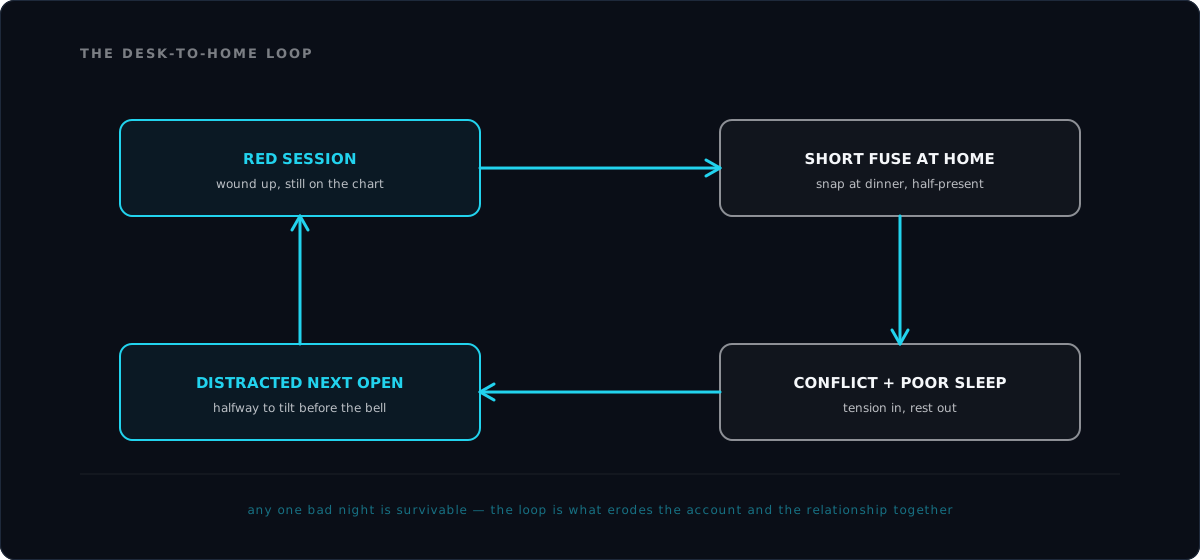
The loop is the whole problem. Any single bad evening is survivable; it's the cycle — desk to home to desk — that quietly erodes both the account and the relationship at the same time, each one feeding the other. Trading psychologist Brett Steenbarger has argued for years on his TraderFeed blog that a trader's life outside the screen isn't separate from performance — it's the base that performance stands on. Wreck the base and the trading goes with it.
Protecting the Relationship (and the Account)
You don't fix this by trading better. You fix it by building a hard seam between the session and the rest of your life — a decompression buffer that stops the state from crossing the threshold raw.
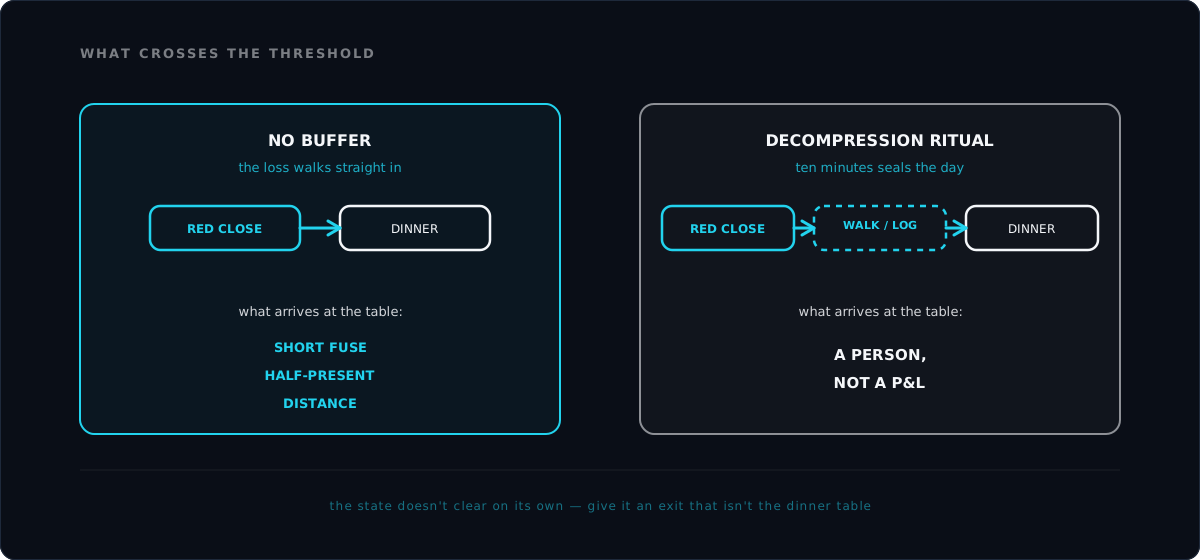
A few things that actually hold the line:
- Build a shutdown ritual. Ten minutes between the close and the rest of your night — a walk, a shower, logging the session — that physically marks the trading day is over. The state doesn't clear on its own; you have to give it an exit that isn't the dinner table.
- Name the state instead of leaking it. "I had a rough session and I'm still wound up — give me twenty minutes" is a complete sentence. It's the difference between owning your state and making your partner decode it.
- Keep a hard walk-away rule. The single biggest source of home spillover is the drawdown that spirals because you traded past your stop. Ending the session on time protects the evening as much as the account.
- Let them in on the plan, not the ticks. Partners handle a process far better than a running score. "I risk a fixed amount and some weeks are red" is reassuring. A live P&L readout at breakfast is not.
The skill underneath all four is the same one that keeps your trading intact: composure — keeping your response attached to your process instead of your state. It's just that at home, the process is the relationship.
Log the State, Not Just the Trade
The reason this pattern survives for years is that it's invisible in the P&L. Your account shows the red day; it doesn't show that the red day cost you a fight, a cold evening, and a distracted open the next morning. Without a record, the spillover looks like a run of unrelated bad moods instead of the single mechanical loop it usually is.
That's why state belongs in the log next to the trade. MindTradr is a trading psychology journal that tracks your mood, sleep, and stress alongside your P&L — so the nights a red session followed you home stop looking like random friction and start looking like the pattern they are: the days you brought the desk to the dinner table. Once you can see the loop, you can put the buffer exactly where it breaks.
Trading is hard enough without letting it quietly bill the people you're doing it for. Draw the seam between the session and the rest of your life, and a losing day stays a losing day instead of a losing evening. MindTradr is free to start, and one of the first things it tends to surface is how many of your worst nights were one decompression ritual away from being ordinary ones.