
Trading Is Lonely: Why Isolation Degrades Your Decisions
It's 2 p.m. You've been at the screen since the open and you haven't said a word out loud all day. You just took a trade that broke your own rule — and there was no one in the room to raise an eyebrow, no one to say "that's not your setup." The only voice in the room was the one that talked you into it.
That's the part of trading nobody warns you about. Not the losses, not the volatility — the silence. Most high-stakes performance jobs come with a team, a coach, or at least a colleague who notices when you're off. Trading strips all of that away and hands you a live account, a mute button, and your own unchecked judgment.
This isn't burnout, where the tank is empty. And it isn't comparison, where you're drowning in other people. It's the opposite: nobody is checking your work, so your worst ideas get a clear runway.
Why Trading Loneliness Degrades Your Decisions
Good decisions aren't made in a vacuum — they're corrected in one. In almost every field, error correction is a social process: someone reviews the code, second-reads the scan, questions the plan before it ships. That outside glance is a safety rail, and it works precisely because it comes from someone who isn't already invested in your story.
Trading removes the rail entirely. You are the analyst, the risk manager, and the executor — and all three of you agree with each other, because you're the same person under the same pressure. When you're already leaning toward a trade, the "review" happening in your head isn't a review. It's a lawyer building your case.
The result is a slow drift you can't feel from the inside:
- Rule-breaking stops feeling like rule-breaking. With no one to flag it, the exception quietly becomes the norm.
- Bad narratives go unchallenged. "This one's different" sounds reasonable when it's the only voice in the room.
- Emotional state runs the desk unsupervised. Fear, boredom, and revenge don't announce themselves — a colleague would spot them before you do.
The Feedback Loop You Lost
Picture how a healthy decision loop is supposed to work: you act, reality answers, an outside perspective helps you read that answer honestly, and you adjust. The correction comes from outside the loop — that's what makes it correction and not just repetition.
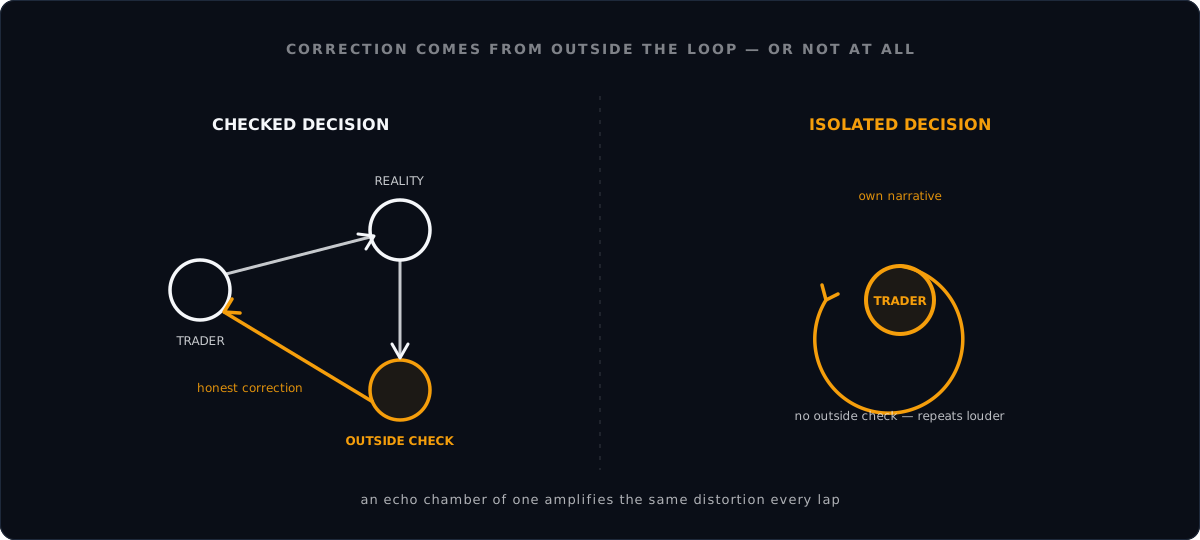
Isolate the trader and the loop snaps shut. Your action feeds back to your own narration, which feeds the next action — an echo chamber of one, where the same distortion gets louder every lap. Dr. Brett Steenbarger, who has spent a career coaching professional traders, writes often that trading communities and mentorship aren't a soft nicety but a performance tool: other people are how you see the blind spots your own eyes can't reach.
The cost compounds physically, too. Chronic isolation keeps you in a low-grade stress state, and — as covered in stress and trading performance — elevated cortisol narrows attention and nudges you toward impulsive, short-horizon choices. Alone and stressed is a worse decision-maker than either one alone.
Is Solitude the Problem, or Just Working Alone?
Here's the distinction that matters, because "trade less alone" is easy to hear as "trade in a crowd," and that's the wrong fix.
Solitude is fine — often necessary. You need quiet, uninterrupted focus to read a chart and execute cleanly. A busy room full of opinions would wreck that. Plenty of great traders work entirely by themselves and are perfectly healthy doing it.
Isolation is different. Isolation isn't "I work alone." It's "I have zero external checkpoint — no one and nothing that reflects my decisions back to me honestly." You can be surrounded by a noisy chatroom all day and still be isolated in that sense, because a hype feed doesn't correct you; it just agrees louder. That's the trap FinTwit sets — the feeling of company without any of the honest feedback that actually helps.
The goal isn't more people. It's one reliable channel of truth that sits outside your own head. That can be a person, a community with real standards, or a written record — but it has to be able to disagree with you.
Building a Reality Check Into a Solo Desk
You don't need to move onto a trading floor. You need to manufacture, on purpose, the outside perspective the job took away. A few things that actually build one:
- Find one honest peer, not an audience. A single trader you trust enough to send "here's the dumb thing I just did" beats a thousand followers. Accountability needs a witness, and one is enough.
- Verbalize the trade out loud. Saying your thesis and risk before you click — even to an empty room — forces the internal lawyer to argue in the open, where weak logic sounds weak. This is why voice journaling catches what silent trading hides.
- Let your journal be the outside voice. A record you review honestly is a version of you that isn't currently under pressure. Yesterday-you is a colleague — one who remembers the last three times "this one's different" cost money.
- Schedule human contact around the day. Especially if you trade around a full-time job or from home, put real, non-trading connection on the calendar. Isolation compounds fastest when the desk is the only place you go — and when it isn't, be careful the trading doesn't follow you home and strain the people who are there.
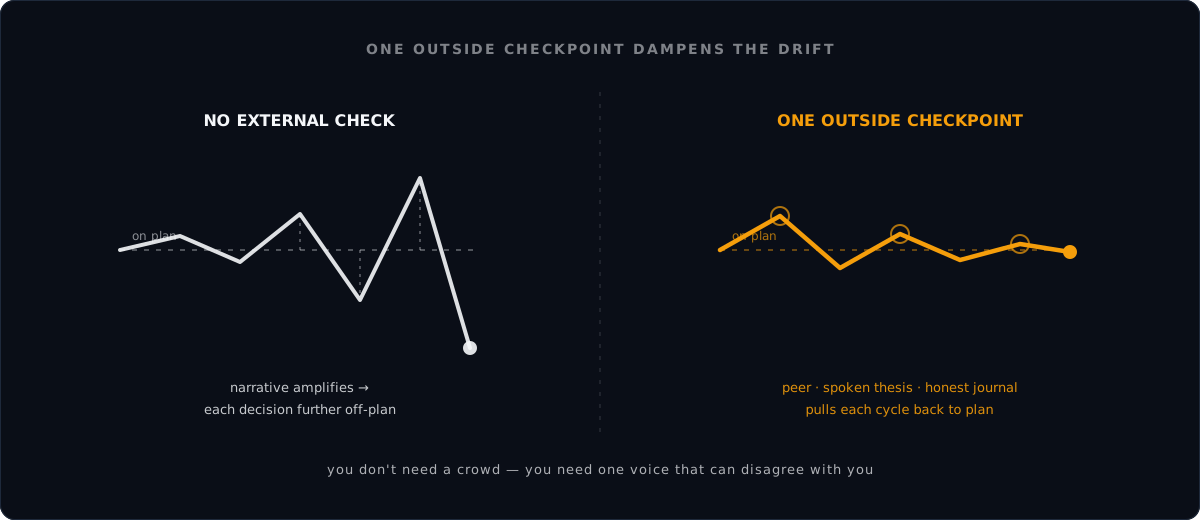
Notice what every one of these has in common: it inserts a perspective that isn't the you who wants to take the trade. That's the whole mechanism. You're not trying to feel less lonely for its own sake — you're rebuilding the error-correction the job deleted.
Make the Isolation Visible
The reason trading loneliness stays dangerous is that it's invisible. A rule you broke in silence leaves no fingerprints; a narrative no one challenged just looks, in hindsight, like a decision you made. Without a record, isolation's damage reads as a string of unrelated bad calls instead of the single pattern it usually is.
That's exactly why state belongs in the log next to the trade. MindTradr is a trading psychology journal that tracks your mood, stress, and sleep alongside every trade — so a run of impulsive, unchecked decisions stops looking random and starts looking like what it is: the days you traded with no one, and nothing, checking your work. Composure isn't something you summon alone in a quiet room; it's the reality check you build so you never have to.
None of this means trading has to be a solitary grind that slowly warps your judgment. Build one honest channel outside your own head, and the loneliest job in finance gets a witness. MindTradr is free to start, and the pattern it tends to surface first is the one hiding in the days you spent entirely alone with the trade.